
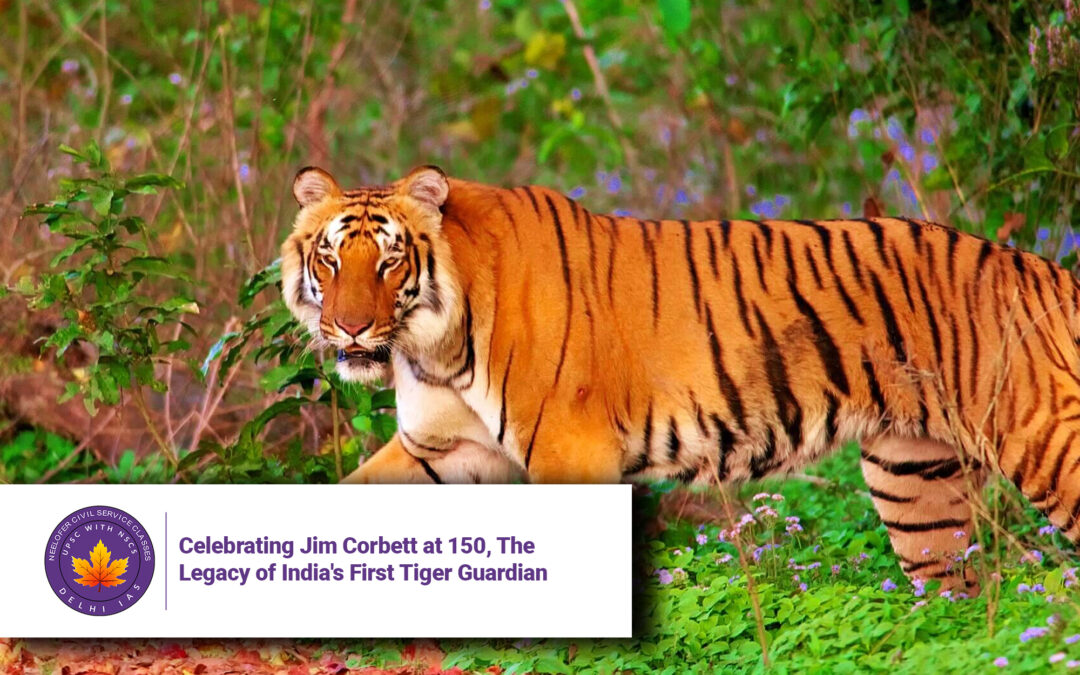
Celebrating Jim Corbett at 150, The Legacy of India’s First Tiger Guardian
Why in News?
2025 marks the 150th birth anniversary of Edward James Corbett, widely known as Jim Corbett — the legendary hunter-turned-conservationist. Revered for saving lives by hunting man-eating tigers and leopards, Corbett’s legacy today is celebrated for his pioneering role in India’s conservation movement, especially tiger preservation. His name lives on through the Jim Corbett National Park and numerous wildlife protection efforts inspired by his work. 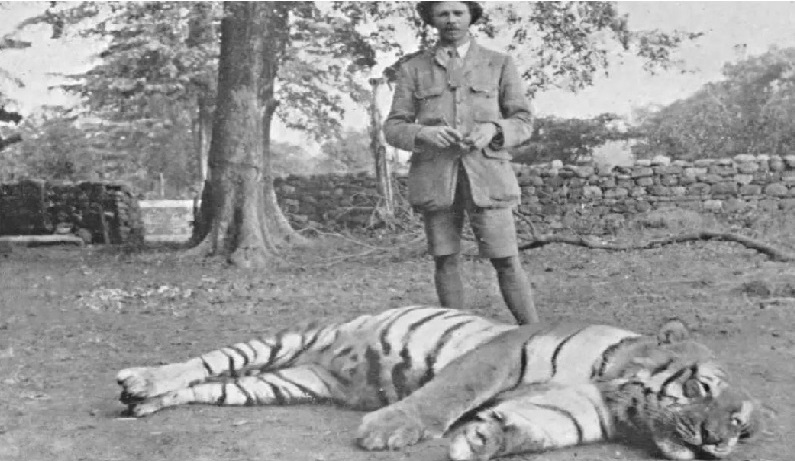
Introduction
Jim Corbett was more than just a skilled hunter; he was a naturalist, author, and early voice for wildlife conservation. Born in 1875 in Nainital, Corbett belonged to a British colonial family and grew up amidst the forests of Kumaon, which shaped his deep connection with nature. His transformation from hunter to conservationist and storyteller left an enduring impact on both the Indian wilderness and the global perspective on environmental stewardship.
Key Issues and Background
1. Life and Career of Jim Corbett
-
Born in the colonial town of Nainital, Corbett was the eighth child of the local postmaster, Christopher Corbett.
-
He served as a British Army officer, which took him to military camps in difficult forested terrains — shaping his survival instincts.
-
His early exposure to Indian forests and people gave him a profound understanding of local ecology and communities.
2. Man-Eater Hunts and Heroic Feats
-
In the early 20th century, Corbett hunted man-eaters responsible for hundreds of deaths in villages.
-
Major cases include:
-
Champawat Tiger – killed over 436 people
-
Panar Leopard – over 400 deaths
-
Leopards of Rudraprayag – terrorized rural communities
-
-
Unlike other hunters, Corbett hunted alone, using field knowledge and empathy rather than brute force.
3. Shift from Hunter to Conservationist
-
After witnessing the ecological crisis caused by indiscriminate hunting and habitat loss, Corbett used his voice to champion the protection of tigers and ecosystems.
-
He wrote books like Man-Eaters of Kumaon, The Temple Tiger, and My India, blending adventure with appeals for conservation.
-
He emphasized: “The book of nature has no beginning as it has no end… I who cannot read, have read and understood it better than many who can read.”
Specific Impacts or Effects
-
Founding Legacy of Corbett National Park: Established in 1957 (originally named Hailey National Park in 1936), it was renamed after Corbett and remains India’s first and most iconic national park.
-
Inspiration for Project Tiger: His work influenced India’s Project Tiger (1973), which not only protected tigers but also benefited other species like elephants, crocodiles, and birds.
-
Influence on Conservation Thinking: Corbett’s writings reshaped how both policymakers and citizens viewed wildlife — not as threats, but as fellow residents of the forest.
-
Global Appeal: His books are still widely read by wildlife enthusiasts, researchers, and conservationists around the world.
Challenges and the Way Forward
Challenges
-
Human-wildlife conflict continues, especially in buffer zones near reserves.
-
Urbanization and habitat fragmentation threaten tiger corridors.
-
Lack of local community participation in modern conservation efforts.
Steps Forward
-
Promote community-led conservation inspired by Corbett’s model in Kumaon and Garhwal.
-
Educate future generations using Corbett’s life and literature as tools.
-
Strengthen wildlife protection laws and improve patrolling.
-
Enhance coexistence models, especially in tiger reserves and surrounding villages.
Conclusion
Jim Corbett’s legacy is not only embedded in the forests of Uttarakhand but also in the very spirit of India’s conservation journey. From slaying man-eaters to protecting their species, Corbett exemplified how love for nature evolves into duty. As we celebrate his 150th birth anniversary, we are reminded that conservation is not just the responsibility of forest departments but of every citizen. In the era of climate change and biodiversity loss, remembering Corbett is more relevant than ever. Let us echo his voice — not just to save the tiger, but to save the soul of the jungle.
5 Questions and Answers
Q1: Why is Jim Corbett in the news in 2025?
A: It marks his 150th birth anniversary, celebrating his role as a hunter-turned-conservationist and the impact of his work on Indian wildlife protection.
Q2: What made Jim Corbett’s hunting different from others?
A: He hunted alone, only targeted man-eaters, and used deep knowledge of animal behavior and empathy toward local communities.
Q3: What is Corbett’s conservation legacy?
A: He advocated for tiger protection, helped establish India’s first national park, and inspired Project Tiger and over 50 other reserves.
Q4: How did Corbett influence public perception of wildlife?
A: Through his books and speeches, he humanized wild animals and stressed mutual respect between humans and nature.
Q5: What should be done to carry forward Corbett’s vision?
A: Promote local participation in conservation, educate youth through his writings, and strengthen legal and community protection for wildlife.

