
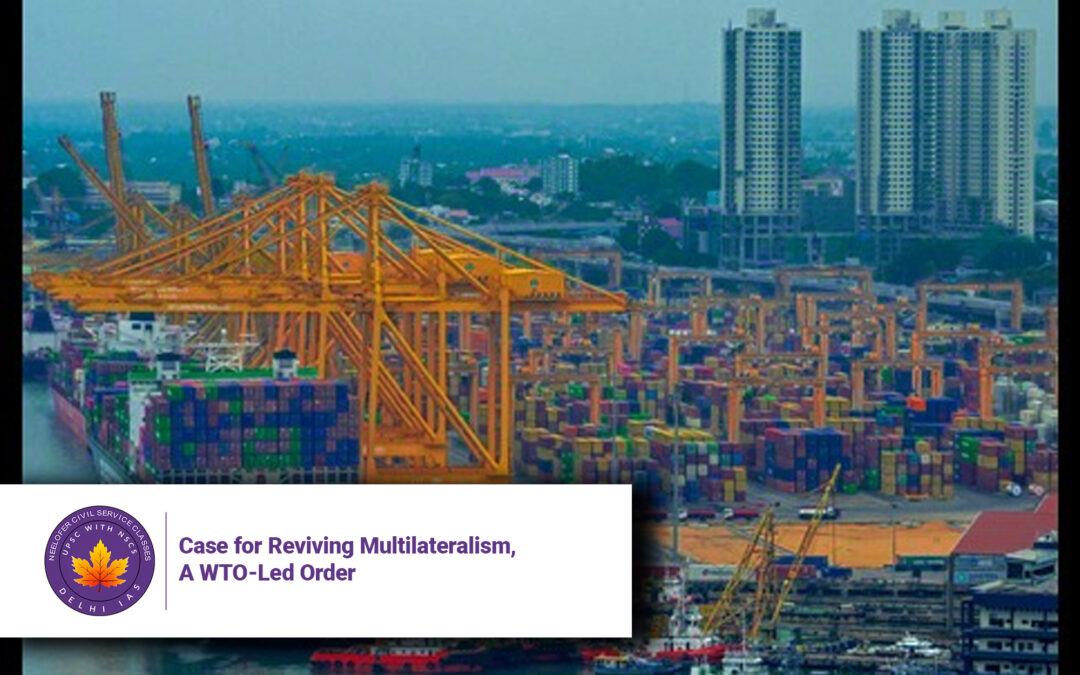
Case for Reviving Multilateralism, A WTO-Led Order
Why in News?
The G20 New Delhi Leaders’ Declaration, adopted on 9 September 2023, reaffirmed the commitment to a rules-based, non-discriminatory, fair, open, inclusive, and equitable multilateral trading system. In this context, the World Trade Organization (WTO) and its relevance have re-entered the global conversation. 
Introduction
The emergence of the WTO in 1995 marked a milestone in global trade governance. It provided stability and a rules-based framework that helped many economies—including India—grow. However, in recent years, the WTO has lost influence due to unilateralism, geopolitical fragmentation, and the U.S. blocking of the dispute settlement system. India, as a key voice in the Global South, must reinvigorate the WTO’s relevance by pushing for reform and inclusive multilateralism.
Key Issues and Institutional Concerns
1. Erosion of WTO’s Central Role
While bilateral and regional trade agreements have risen, the WTO’s significance has declined. The U.S. blocking appointments to the WTO Appellate Body since 2019 has created a dysfunctional dispute settlement system. The paralysis has reduced trust in WTO mechanisms.
2. Rise of Bilateralism and Plurilateralism
India’s negotiating focus has tilted toward bilateral FTAs (Free Trade Agreements), such as with the UAE, Australia, and the UK. However, these are no substitute for robust multilateral trade norms. This shift may weaken the global rule-based order in the long term.
3. India’s Opportunity as Global South Leader
India has historically benefitted from WTO provisions, including special and differential treatment. As the world’s most populous country and a G20 leader, India must lead the effort to restore trust in WTO’s core mechanisms and ensure that the interests of developing countries are protected.
4. Fragmented Trade Landscape
Trade liberalisation efforts are now increasingly governed by regional and digital trade pacts, causing fragmentation and diluting the WTO’s centrality. The proliferation of fragmented trade regimes adds complexity, especially for developing nations.
5. Need for Forward-looking WTO Reform
Reform is needed in the dispute settlement system, global agricultural trade rules, and digital trade governance. A reformed WTO can also become a platform to address emerging challenges, such as climate-related trade policies, AI, and sustainability-linked trade standards.
Challenges and the Way Forward
-
Reviving trust in WTO systems by resolving the impasse in the dispute resolution body and reinforcing the rules-based trade framework.
-
Balancing development needs with liberalisation, ensuring Special and Differential Treatment (SDT) is preserved for low- and middle-income countries.
-
Championing inclusivity, especially for the Global South, by pushing an agenda that is both development-centric and climate-resilient.
-
Bridging the North-South divide through active negotiations that factor in the needs of emerging economies.
Conclusion
India must take a leadership role in reinvigorating the WTO and championing a rules-based multilateral trading order. While bilateral FTAs offer short-term gains, only a revived and reformed WTO can ensure equitable long-term economic stability for all. As the global economy becomes more fragmented and digital, restoring the relevance of the WTO is not just beneficial—but essential.
Q&A Section
1. Why is the WTO’s dispute settlement system dysfunctional?
Since 2019, the U.S. has blocked new appointments to the WTO Appellate Body, paralysing its judicial function and undermining member confidence in dispute resolution.
2. How has India’s trade strategy shifted recently?
India has focused more on bilateral trade agreements with countries like Australia, UAE, and the UK, instead of multilateral platforms like the WTO.
3. Why is multilateralism still important for India?
India benefitted from WTO’s rules during its liberalisation phase. A fair global trading system protects the interests of developing economies and offers a stable platform for resolving disputes.
4. What role can India play in WTO reform?
As a G20 leader and Global South representative, India can push for an inclusive reform agenda, especially in agriculture, digital trade, and equitable dispute resolution.
5. What are the main reforms needed at the WTO?
Key reforms include restoring the dispute settlement mechanism, preserving special treatment for developing countries, and updating trade rules to include climate, technology, and sustainability dimensions.

