
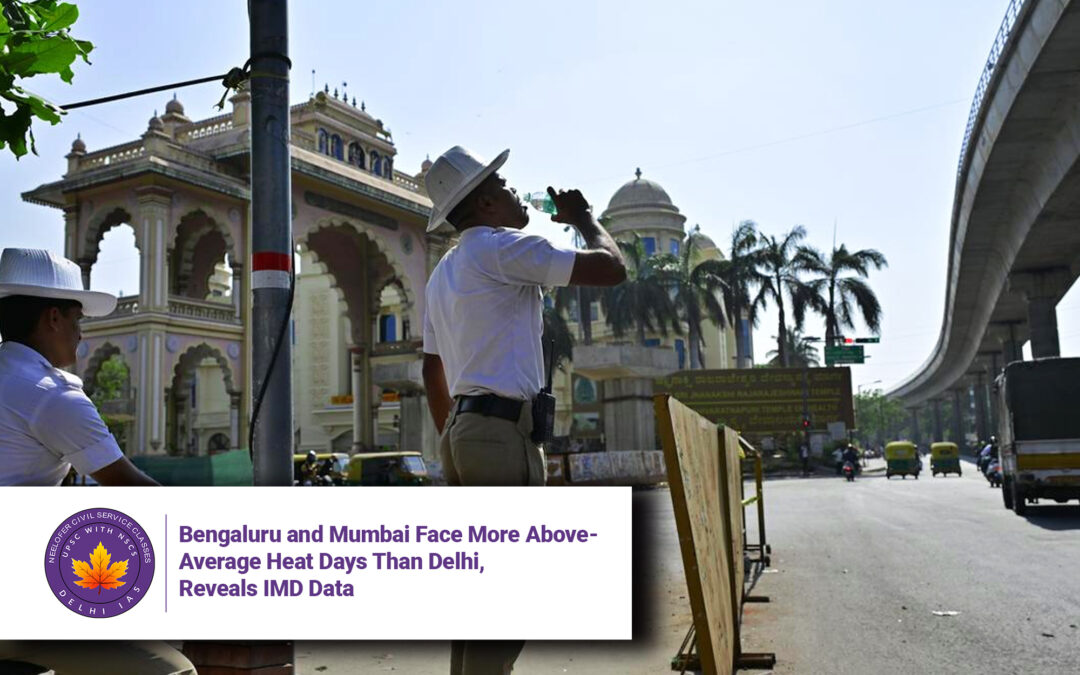
Bengaluru and Mumbai Face More Above-Average Heat Days Than Delhi, Reveals IMD Data
Why in News
Recent data from the India Meteorological Department (IMD), accessed by The Hindu, shows that traditionally cooler cities like Bengaluru and Mumbai have been experiencing more days of above-average heat than Delhi — a city typically associated with extreme summer temperatures. This trend has intensified post-2015 and signals a disturbing shift in India’s urban climate patterns.
Introduction
India’s climate is undergoing a marked transformation. While Delhi remains known for its scorching summers, cities once considered ‘moderate’ — such as Bengaluru and Mumbai — are witnessing a surge in the number of days with above-average temperatures. This phenomenon, driven by urban heat islands and changing climate patterns, shows how heat anomalies are no longer limited to the north.
Key Issues and Background
-
Data Period Studied: 2015–2024
-
Baseline: 30-year climatological average (1991–2020) from the World Meteorological Organization
-
Metric: Daily maximum temperatures exceeding the long-term monthly average
Bengaluru’s Heat Rise:
-
Bengaluru, once known for its mild climate, recorded 86 days of above-average heat in summer 2019 alone — highest among all metros.
-
The monthly 30-year average maximum temperatures for Bengaluru are:
-
April: 35.34°C
-
May: 31.76°C
-
June: 31.70°C
-
-
Cumulative excess heat days in 2019 = 86/91 days
-
Bengaluru also saw:
-
67 such days in summer 2017
-
66 days in 2023
-
81 above-average summer days in 2015
-
72 in 2020 (Chart 1)
-
Mumbai’s Warming Trend:
-
Mumbai had intense summer periods in 2016 and 2019, with 90 above-average days each year (Chart 2).
-
Even during monsoons, Mumbai experiences high above-average temperatures.
Delhi’s Heat Consistency:
-
Despite Delhi’s reputation for extreme heat, it didn’t lead the chart. Instead, its most intense summer was in 2022, not in terms of average temperature, but in the number of days exceeding norms (Chart 3).
Chennai’s Climate Volatility:
-
Chennai saw a high of 74 above-average monsoon days in 2020 (Chart 5B).
-
While not consistent, spikes in extreme heat are observed.
Kolkata’s Steady Highs:
-
Kolkata consistently shows frequent above-average temperature days in both summer and monsoon months (Chart 4).
Specific Impacts or Effects
-
Urban Heat Island Effect: The increasing urbanization and concretization in cities like Bengaluru and Mumbai likely amplify local heat levels.
-
Shift in Risk Zones: Cities previously not prioritized for heat-wave preparedness now require urgent attention.
-
Increased Health Risks: Long exposure to higher-than-normal temperatures may lead to heat stress, exhaustion, and dehydration, especially among outdoor workers and vulnerable populations.
Challenges and the Way Forward
-
Public Awareness:
Heat preparedness campaigns are still Delhi-centric. Other metros need localized public advisories. -
Urban Greening:
Cities like Bengaluru and Mumbai need to reclaim green spaces and reduce concrete density to minimize heat retention. -
Climate-Responsive Infrastructure:
Building codes must adapt to heat-resilient designs, promoting natural ventilation and reflective surfaces. -
Accurate, Real-Time Monitoring:
Daily temperature tracking should be integrated into city disaster management dashboards, not just during heatwaves.
Conclusion
The data tells a clear story: India’s heat map is shifting. Delhi may still grab headlines for record-breaking highs, but the silent surge in above-average temperature days in Mumbai, Bengaluru, and Kolkata points to a larger climate crisis. Cities once considered cool are heating up — and they are less prepared.
Urban climate adaptation must no longer be reactive. With more than 90 days of summer heat anomalies, even our most comfortable cities are becoming climate hotspots. It’s time to redraw India’s heat vulnerability map — before the next summer makes it impossible to ignore.
5 Questions and Answers
1. Which city recorded the highest number of above-average heat days in summer 2019?
Bengaluru, with 86 days exceeding the long-term average.
2. How is an “above-average heat day” defined in the study?
A day when the maximum temperature exceeds the 30-year climatological average (1991–2020) for that month.
3. Did Delhi have the most number of above-average days?
No. Delhi had fewer above-average days than Bengaluru and Mumbai, though its 2022 summer was the most intense in recent years.
4. Why are Mumbai and Bengaluru seeing more heat anomalies?
Due to factors like urbanization, loss of green cover, and climate change, which intensify the urban heat island effect.
5. What steps can cities take to combat this heat trend?
Cities must invest in urban greening, climate-smart architecture, heat action plans, and public awareness campaigns.

