
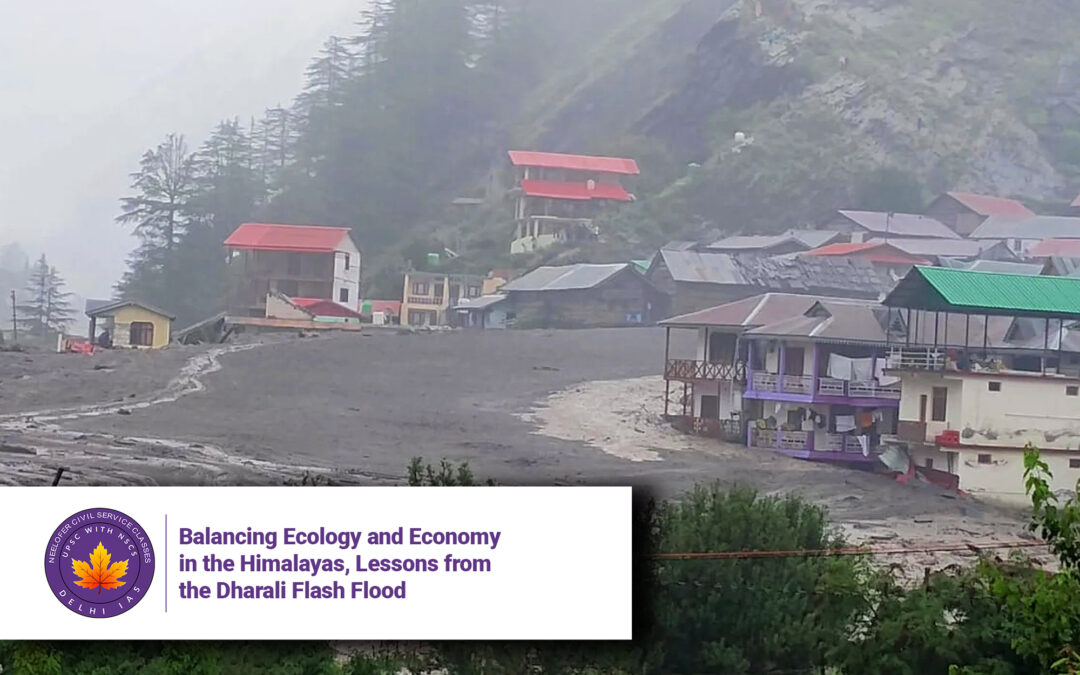
Balancing Ecology and Economy in the Himalayas, Lessons from the Dharali Flash Flood
Why in News?
A devastating flash flood recently struck Dharali village in Uttarakhand, raising critical concerns about unchecked infrastructure development in fragile Himalayan ecosystems. While such events might be linked to climate change and natural variability, the deeper and more disturbing truth lies in poor planning, disregard for ecological balance, and economic greed outweighing environmental responsibility. This tragedy underlines a pressing need to prioritize ecology over economy in mountain infrastructure development.
Introduction
The Himalayan region, a vital part of India’s ecological and cultural heritage, is increasingly facing the brunt of reckless development and climate change. In the latest incident, Dharali village in Uttarakhand suffered from a catastrophic flash flood, which washed away buildings and infrastructure constructed on floodplains. This was not just a natural calamity — it was a disaster magnified by human choices.
The Dharali flash flood exemplifies what happens when economic development is pursued at the cost of environmental sustainability. It provides a stark warning: if India continues to ignore ecological logic in the development of mountain infrastructure, more such tragedies are imminent.
Key Issues and Institutional Concerns
1. Encroachment on Natural Floodplains
Traditional hill architecture is designed to harmonize with the terrain, with homes built on slopes and terraces, safely away from rivers and flood-prone zones. However, the structures destroyed in Dharali were built directly on the floodplain — a violation of common-sense and ecological guidelines. Over three dozen hotels, homestays, and shops were constructed right in the path of potential torrents, motivated by tourist traffic and commercial benefits.
2. Char Dham Project and Infrastructure Push
Dharali is a beneficiary of the government’s ambitious Char Dham highway project, which aims to improve connectivity to pilgrimage destinations like Badrinath and Kedarnath. While improved roads have undoubtedly boosted tourist numbers — with 14 lakh visitors to Badrinath and 16 lakh to Kedarnath last year — the infrastructure is rapidly outpacing the region’s environmental carrying capacity.
In 1956, a journey to Badrinath took four days on foot, as per Lok Sabha records. After the 1962 war, road building and public transport facilitated easier travel, increasing tourism. However, the current scale of road widening and building construction is unprecedented and unregulated in many cases. These changes have led to serious ecological damage, including deforestation, increased landslides, and loss of natural water regulation.
3. Mass Tourism and Vehicular Burden
The influx of millions of tourists and vehicles into geologically fragile zones like Garhwal, Shimla, and Mandi, while economically profitable, is causing severe environmental stress. Roads are being indiscriminately widened at the cost of forests, and concrete structures are choking hillsides and riversides. What was once a serene and delicate ecosystem is now a chaotic hub of construction and traffic.
4. Rising Landslides and Natural Hazards
Landslides have become a daily phenomenon in mountain regions where new highways are being constructed. Every monsoon season now brings with it the risk of landslides, floods, and soil erosion, further exacerbated by climate change and unscientific urbanization. These hazards are not just environmental — they are also economic and human tragedies waiting to happen.
5. Legal and Judicial Perspective
The Supreme Court recently commented in a Himachal Pradesh case that “Earning revenue is not everything. Revenue cannot be earned at the cost of environment and ecology.” This powerful remark captures the essence of India’s current developmental dilemma. If commercial ventures continue unchecked in ecologically fragile zones, they will destroy the very resources they depend on.
Challenges and the Way Forward
1. Balancing Development with Ecology
India faces a serious dilemma: how to balance the need for infrastructure and economic growth with the imperative of environmental preservation. The Char Dham project and similar developments aim to facilitate pilgrimage tourism and local employment, but they must not sacrifice ecological stability in the process.
2. Enforcing Zoning and Environmental Laws
There needs to be stricter enforcement of zoning regulations, especially in floodplains, riverbanks, and landslide-prone areas. Construction should only be allowed based on thorough Environmental Impact Assessments (EIA), and authorities must ensure that building norms are followed.
3. Rehabilitating Natural Buffers
Natural buffers such as forests, riverbanks, and wetlands must be restored to their original state. These ecosystems act as protective barriers during extreme weather events. Dharali’s flood would likely have been less severe if the natural floodplain hadn’t been encroached upon.
4. Sustainable Tourism Policies
While tourism is an important source of revenue, especially in Himalayan states, it must be regulated and decentralized. Instead of concentrating infrastructure and visitors in a few overcrowded spots, policies should promote spread-out tourism, including lesser-known sites, eco-tourism, and seasonal quotas.
5. Learning from Global Experiences
The editorial rightly references the Aral Sea disaster in the Soviet Union — where rivers were diverted to grow cotton, causing the sea to shrink drastically. This illustrates how poorly planned development can lead to irreversible damage. India must heed such warnings and adopt a precautionary approach to its own fragile landscapes.
Conclusion
The tragedy in Dharali is not an isolated incident. It is part of a larger pattern of environmental neglect in the face of economic ambition. While development is essential, it cannot and must not override ecological logic. If we continue to bulldoze our way through the Himalayas in the name of progress, we are only preparing for more disasters like Dharali.
India stands at a crossroads. It must choose between short-term economic gain and long-term environmental stability. The decision made today will shape the destiny of its hills, rivers, and communities for generations to come. Put ecology before economy — or prepare for more Dharalis.
Q&A Section
1. What caused the flash flood in Uttarakhand’s Dharali village?
The flash flood in Dharali was triggered by natural causes, but its impact was worsened due to human activities such as encroachment on the floodplain, unregulated construction, and poor infrastructure planning.
2. How does the Char Dham project relate to this disaster?
The Char Dham project, while improving connectivity to pilgrimage sites, has led to excessive and often unregulated construction, road widening, and deforestation, which has made the region more vulnerable to disasters like floods and landslides.
3. What warning did the Supreme Court give regarding mountain development?
The Supreme Court stated that “Earning revenue is not everything. Revenue cannot be earned at the cost of environment and ecology,” highlighting the need to prioritize ecological considerations in infrastructure projects.
4. What lessons can India learn from international examples?
India can learn from the Soviet Union’s ecological failure in the Aral Sea, where river diversion for economic gain led to the collapse of an entire ecosystem. It shows the dangers of prioritizing short-term revenue over long-term sustainability.
5. What steps can be taken to prevent future tragedies like Dharali?
Key steps include enforcing environmental regulations, conducting proper environmental impact assessments, restoring natural buffers, promoting sustainable tourism, and balancing infrastructure growth with ecological preservation.

