
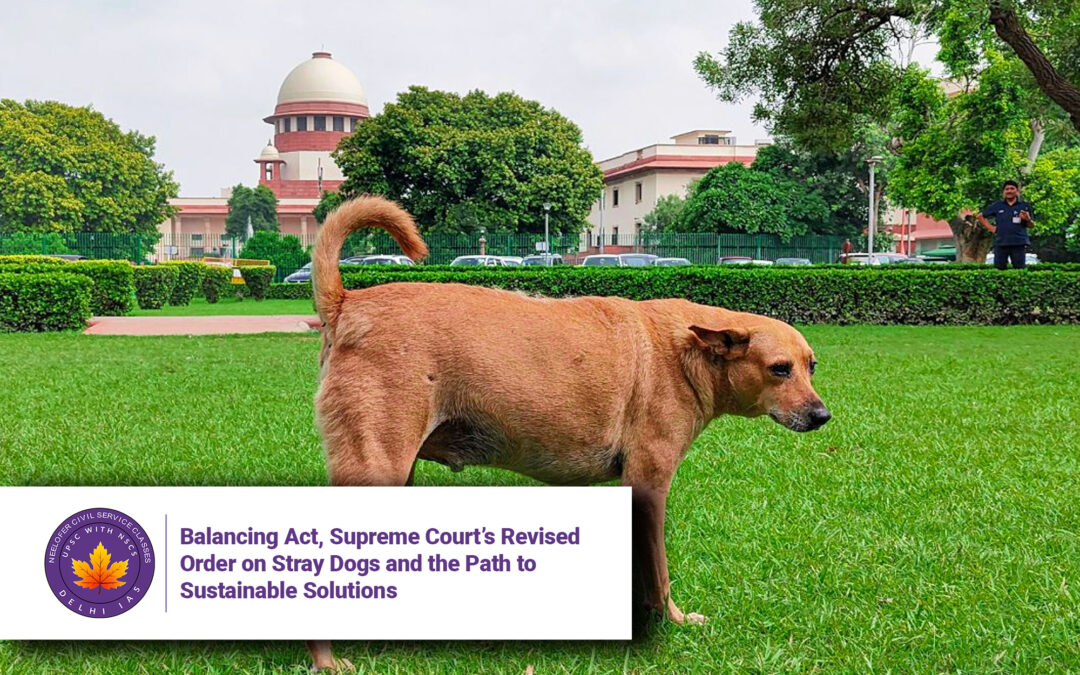
Balancing Act, Supreme Court’s Revised Order on Stray Dogs and the Path to Sustainable Solutions
Why in News?
The Supreme Court of India’s recent intervention in the management of stray dogs in Delhi-NCR has sparked a nationwide debate, highlighting the deep polarization between animal welfare advocates and public safety concerns. On August 11, the Court initially ordered the removal of all stray dogs to shelters, a directive that faced immediate backlash for its potential to exacerbate the very issues it sought to address. Recognizing the complexities involved, the Court revised its order on August 18, adopting a more nuanced approach that balances the provisions of the Animal Birth Control (Dog) Rules, 2001, with the imperative of public safety. This revised directive mandates that sterilized and vaccinated dogs be returned to their original locations, while those exhibiting aggression or suspected of rabies remain in shelters. This decision opens a critical window for stakeholders to collaborate on long-term, humane, and effective solutions to India’s stray dog crisis.
Introduction
Stray dogs are an integral yet contentious part of India’s urban and rural landscapes. With an estimated population of 35 million strays nationwide, their presence evokes strong emotions—from compassion and care to fear and hostility. The challenges they pose are multifaceted, encompassing public health risks, animal welfare concerns, and municipal management failures. The Supreme Court’s revised order represents a pivotal moment to move beyond adversarial standoffs and toward evidence-based, collaborative strategies. This article examines the legal, social, and ecological dimensions of the stray dog issue, the implications of the Court’s directives, and the comprehensive measures needed to achieve sustainable coexistence.
Key Issues and Background
1. The Legal and Regulatory Framework
India’s approach to stray dog management is governed by the Animal Birth Control (Dog) Rules, 2001, which emphasize sterilization and vaccination as the primary methods for population control and rabies prevention. These rules, framed under the Prevention of Cruelty to Animals Act, 1960, prohibit the killing of stray dogs and instead advocate for their rehabilitation and release. However, implementation has been plagued by:
-
Insufficient Resources: Municipalities lack the infrastructure, veterinary services, and personnel needed to carry out effective ABC programs.
-
Bureaucratic Inertia: Poor coordination between animal welfare boards, local bodies, and health departments has hindered progress.
-
Legal Ambiguities: Conflicting interpretations of laws and court orders often lead to confusion and inaction.
2. Public Health and Safety Concerns
Stray dogs are associated with several public health issues:
-
Rabies Risk: India accounts for 36% of global rabies deaths, with dogs being the primary transmitters.
-
Dog Bites: Annual reports indicate over 10 million dog bite cases, causing physical and psychological trauma.
-
Sanitation Problems: Strays often scavenge from garbage dumps, contributing to the spread of diseases.
3. Animal Welfare and Ethical Considerations
Animal rights organizations argue that dogs are victims of human negligence and deserve humane treatment. They emphasize:
-
Compassionate Management: Sterilization and vaccination are more ethical and effective than culling.
-
Community Involvement: Caretakers and feeders play a crucial role in monitoring and managing dog populations.
4. Ecological and Urban Planning Factors
The proliferation of stray dogs is closely linked to urban mismanagement:
-
Waste Management: Overflowing garbage bins and open landfills provide abundant food sources, sustaining stray populations.
-
Habitat Encroachment: Rapid urbanization reduces natural habitats, forcing wildlife and strays into closer contact with humans.
5. Sociocultural Dynamics
Attitudes toward dogs vary widely across India:
-
Cultural Reverence: In many communities, dogs are considered protectors or even sacred.
-
Fear and Hostility: Incidents of attacks, especially on children, have fueled calls for drastic measures like mass removal or culling.
Specific Impacts or Effects
1. On Public Health
The revised order could reduce rabies transmission and dog bite incidents by ensuring that aggressive or rabid dogs are isolated. However, returning vaccinated dogs to their territories may alleviate concerns about overburdened shelters and ensure ecological balance.
2. On Animal Welfare
The directive reaffirms the importance of sterilization and vaccination, aligning with ethical treatment principles. It also prevents the unnecessary euthanasia of healthy dogs.
3. On Municipal Resources
Local bodies must now inventory their resources—shelters, veterinarians, and equipment—to comply with ABC Rules. This could lead to better funding and infrastructure for animal management.
4. On Community Relations
The order acknowledges the role of caregivers and feeders, potentially reducing conflicts between residents and animal lovers.
Challenges and the Way Forward
Challenges
-
Resource Constraints: Many municipalities lack the funds and expertise to implement ABC programs effectively.
-
Public Resistance: Deep-seated fears and prejudices against strays may hinder community participation.
-
Administrative Coordination: Multiple agencies must collaborate, which is often hampered by bureaucratic red tape.
-
Waste Management: Without addressing the root cause of food availability, stray populations will continue to thrive.
Steps Forward
-
Strengthen Infrastructure: Municipalities should establish more sterilization centers, hire trained veterinarians, and deploy modern equipment for humane catching and handling.
-
Community Engagement: Involve local residents, feeders, and NGOs in monitoring and managing dog populations. Create awareness about rabies prevention and responsible feeding.
-
Integrated Waste Management: Improve garbage collection and processing to eliminate food sources for strays. This will naturally reduce their numbers over time.
-
Research and Data Collection: Use technology like GPS tracking and population surveys to devise targeted interventions.
-
Legal Clarity: Ensure consistent implementation of laws across states to avoid confusion and litigation.
-
Public Health Campaigns: Educate citizens on first aid for dog bites, vaccination schedules, and reporting mechanisms for aggressive animals.
Conclusion
The Supreme Court’s revised order on stray dogs is a testament to the judiciary’s ability to adapt and seek equilibrium in complex issues. It underscores the need for a multifaceted approach that combines legal mandate, scientific management, and community participation. The stray dog dilemma is not merely an animal welfare issue but a reflection of broader societal challenges—urban planning, public health, and ethical coexistence. By addressing the root causes and fostering collaboration, India can transform this crisis into an opportunity to build more compassionate and sustainable communities. The path forward requires patience, empathy, and a unwavering commitment to the well-being of both humans and animals.
5 Questions and Answers
Q1: What was the Supreme Court’s initial order on stray dogs, and why was it revised?
A: The initial order mandated the removal of all stray dogs in Delhi-NCR to shelters. It was revised to allow sterilized and vaccinated dogs to be returned to their locations, while aggressive or rabid dogs remain in shelters, ensuring a balance between animal welfare and public safety.
Q2: What are the Animal Birth Control (Dog) Rules, 2001?
A: These rules, framed under the Prevention of Cruelty to Animals Act, advocate sterilization and vaccination as the primary methods for managing stray dog populations, prohibiting killing and emphasizing rehabilitation.
Q3: How does waste management relate to the stray dog issue?
A: Overflowing garbage provides a steady food source for strays, sustaining and increasing their populations. Effective waste management is crucial to reducing their numbers humanely.
Q4: What role do community caregivers play?
A: Caregivers and feeders help monitor dog populations, ensure vaccinations, and provide care. Their involvement is vital for the success of sterilization and rabies control programs.
Q5: What are the key challenges in implementing stray dog management programs?
A: Challenges include insufficient municipal resources, public fear and hostility, administrative coordination issues, and poor waste management practices.

