
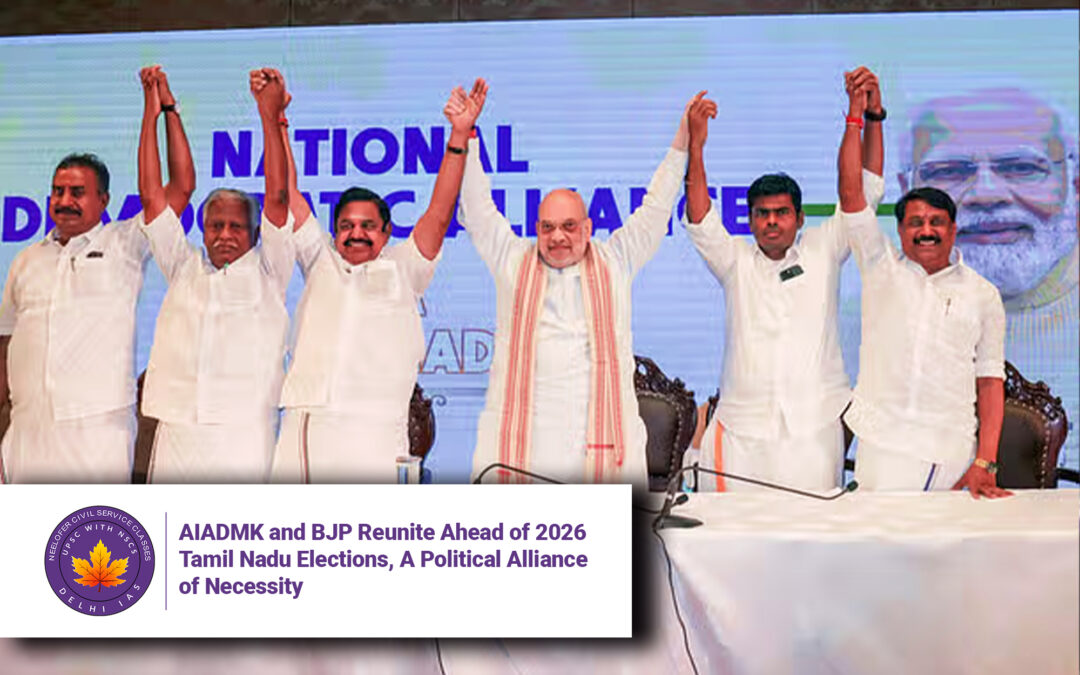
AIADMK and BJP Reunite Ahead of 2026 Tamil Nadu Elections, A Political Alliance of Necessity
Why in News?
In a significant political development, Union Home Minister Amit Shah announced the formal reunion of the Bharatiya Janata Party (BJP) with the All India Anna Dravida Munnetra Kazhagam (AIADMK), a year ahead of the 2026 Tamil Nadu Assembly elections. The move is being seen as an urgent strategy by the BJP to regroup and counter the growing influence of the DMK-led alliance in the state.
Introduction 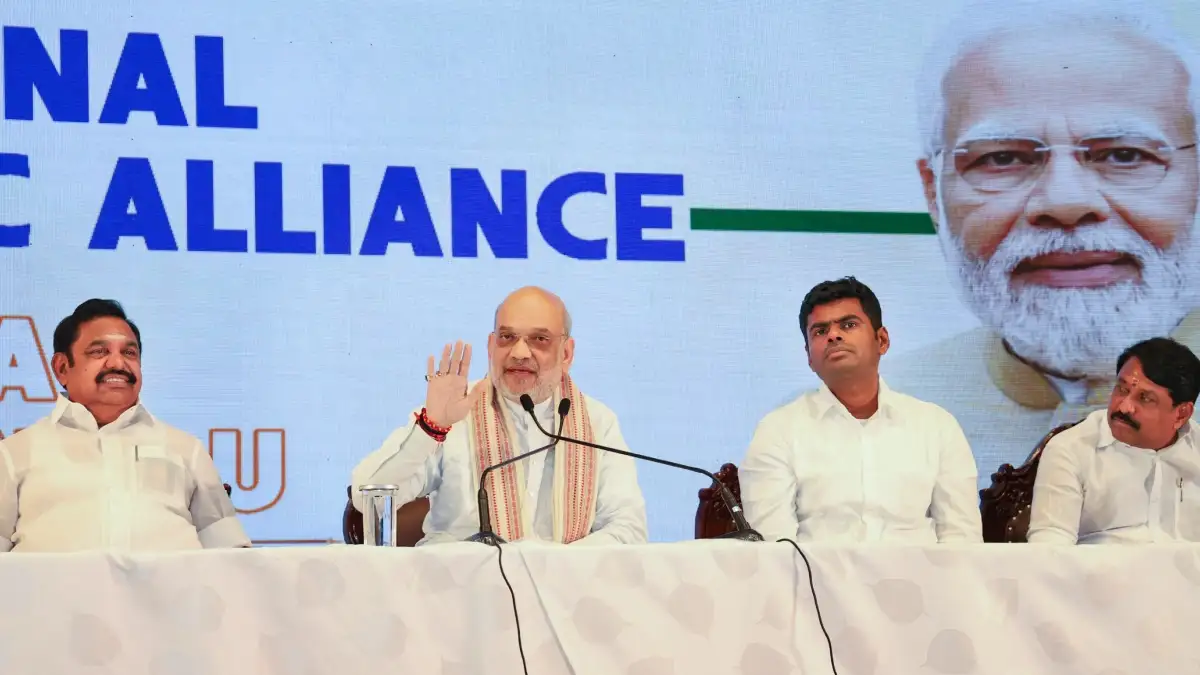
Tamil Nadu’s political landscape is undergoing a strategic reshaping as BJP and AIADMK come together once again. Their pre-poll alliance, confirmed shortly after the AIADMK voted against the Waqf (Amendment) Bill, signals not just electoral planning but also ideological adjustments and strategic compromise to corner the ruling DMK.
Key Political Developments
1. BJP-AIADMK Coalition Revived
Amit Shah successfully convinced AIADMK leader Edappadi K. Palaniswami to join hands with the BJP under a pre-poll pact. This alliance now limits the AIADMK’s political independence on critical policy issues, aligning it more closely with BJP’s national agenda.
2. Rising Political Polarisation
The alliance will likely polarise the Tamil Nadu electorate further, reducing room for fence-sitters and marginal players. Voters may now be forced to choose primarily between the DMK-led and AIADMK-led fronts.
3. Reaction to DMK’s Growing National Role
BJP appears unsettled by DMK’s increasing national prominence, especially after CM M.K. Stalin’s role in forming the Joint Action Committee for Fair Delimitation. BJP accused DMK of using linguistic and educational issues to mask governance failures.
4. BJP’s Leadership Shift in Tamil Nadu
The alliance announcement coincided with BJP’s leadership transition in Tamil Nadu from K. Annamalai to Nainar Nagenthran, a former AIADMK member. This is being viewed as a step to smoothen ties with AIADMK.
5. Coalition Dynamics and Challenges
The NDA might include other parties like PMK and TMC (Moopanar), but it is unclear whether AIADMK rebels from the 2024 elections will be accommodated. Additionally, a fair seat-sharing arrangement could be difficult to finalise due to competing interests within the alliance.
Challenges and the Way Forward
-
Ideological Clarity: Despite the alliance, the AIADMK’s stance on several issues remains similar to DMK’s. Harmonising views within a common minimum programme will be crucial.
-
Internal Unity: BJP avoided siding with splinter AIADMK factions to preserve unity under Palaniswami’s leadership.
-
Seat-Sharing Tensions: Managing seat allocation among NDA partners ahead of the 2026 elections will be a significant hurdle.
-
Electoral Chemistry: Reviving grassroots-level coordination between AIADMK and BJP workers will be key to mounting an effective campaign.
-
DMK’s Dominance: With DMK still strong, and Naam Tamilar Katchi and Vijay’s party likely contesting, the NDA faces a multi-cornered contest.
Conclusion
The BJP-AIADMK reunion marks a strategic realignment driven more by necessity than ideology. While it offers both parties a stronger position to challenge the DMK, success will depend on their ability to navigate internal tensions, maintain unity, and offer a coherent alternative to Tamil Nadu voters. The road to the 2026 Assembly election is now set for a high-stakes two-front battle.
Q&A Section
Q1. What prompted the BJP-AIADMK reunion?
The reunion was driven by electoral urgency, growing DMK dominance, and the need for a strong coalition to counter it in the 2026 Tamil Nadu Assembly elections.
Q2. What was the AIADMK’s recent stand on the Waqf (Amendment) Bill?
The AIADMK voted against the bill in the Rajya Sabha, aligning with BJP’s stance and paving the way for the coalition’s formalisation.
Q3. Who is leading the alliance on the AIADMK side?
Edappadi K. Palaniswami continues to lead the AIADMK and will head the party’s campaign in alliance with BJP.
Q4. How has the BJP leadership in Tamil Nadu changed?
K. Annamalai was replaced by Nainar Nagenthran as the BJP’s state leader. The latter’s appointment, being a former AIADMK member, is expected to ease alliance tensions.
Q5. What are the major challenges facing the NDA alliance in Tamil Nadu?
Key challenges include internal factional disputes, seat-sharing negotiations, reconciling ideological differences, and reviving voter trust to mount a credible campaign against the DMK.

