
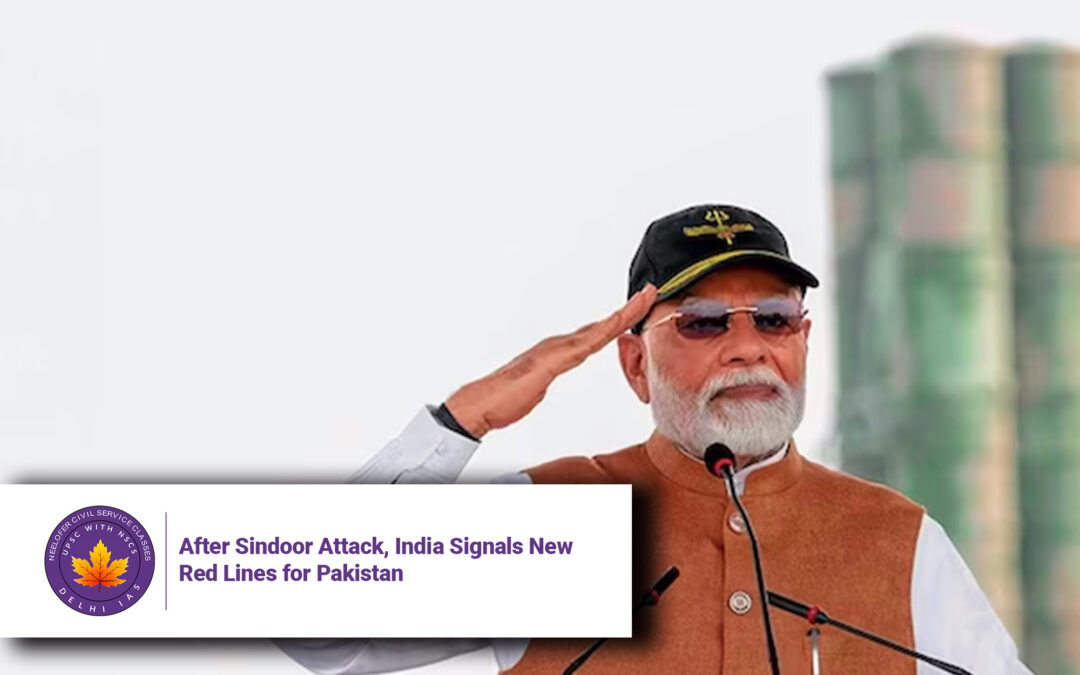
After Sindoor Attack, India Signals New Red Lines for Pakistan
Why in News?
The Pulwama-style terrorist attack in Jammu and Kashmir’s Reasi district on April 21, 2024, where innocent Hindu pilgrims were massacred, has reignited tensions between India and Pakistan. The Indian government has clearly signaled a policy shift by calling out Pakistan in a joint Indo-U.S. statement and through tough diplomatic and military posturing. 
Introduction
The recent terrorist attack at Reasi, attributed to Pakistan-backed terrorists, has once again exposed Islamabad’s unwillingness or inability to crack down on terror groups operating from its soil. India’s decisive diplomatic and military responses indicate that patience is wearing thin and the global perception of Pakistan’s support for terrorism is rapidly declining.
Key Issues
1. Reasi Attack Echoes Past Tragedies
The Sindoor massacre bears chilling similarities to past incidents such as:
-
The 2008 Mumbai attacks, where multiple coordinated terror strikes killed over 160 people.
-
The Pulwama attack in 2019, which led to Operation Balakot, India’s cross-border air strike on terrorist camps in Pakistan.
2. Shift in India’s Foreign Policy Stance
-
PM Narendra Modi’s administration, known for its zero-tolerance policy toward terrorism, has showcased a tougher stand against Pakistan’s role in fomenting cross-border terrorism.
-
In a rare move, Pakistan was publicly named in a joint statement with the U.S. condemning the attack.
-
This marks a shift from previous ambiguity in naming Pakistan in diplomatic forums.
3. Operation Sindoor – The Turning Point
-
The Reasi killings are being viewed as a watershed moment akin to earlier triggers like Pulwama and Uri.
-
There are growing expectations of a stronger military and diplomatic retaliation.
4. Diplomatic Fallout for Pakistan
-
Pakistan continues to face global scrutiny, including from FATF (Financial Action Task Force), for its terror funding networks.
-
International confidence in Pakistan’s ability or willingness to curb terrorism is eroding.
-
Countries like the U.S. have expressed alignment with India’s views on the issue.
5. The China Factor
-
India’s relationship with China, another regional rival, is stable but complex.
-
India is increasingly leveraging diplomatic engagement with Western nations to isolate Pakistan while keeping China in check.
Challenges and the Way Forward
Challenges
-
Balancing strategic restraint with public and political demands for retaliation.
-
Preventing further escalations in Kashmir and on the international diplomatic front.
-
Managing the narrative globally to keep international pressure on Pakistan intact.
Way Forward
-
Continue with calibrated diplomatic pressure by exposing Pakistan’s duplicity on global platforms.
-
Engage more with allies like the U.S., EU, and ASEAN to isolate Pakistan diplomatically.
-
Upgrade intelligence and border security mechanisms.
-
Maintain military readiness while exploring cyber and covert capabilities to counter asymmetric threats.
Conclusion
The Reasi terror attack marks a crucial point in India-Pakistan relations. It signals a new threshold for India’s tolerance toward terrorism emanating from Pakistani soil. With a tougher diplomatic posture and increased international support, India is poised to reshape its counterterrorism doctrine while sending a clear message to its adversaries.
5 Questions and Answers
Q1: What triggered India’s tough stance on Pakistan recently?
A: The massacre of Hindu pilgrims in Jammu and Kashmir’s Reasi district, attributed to Pakistan-backed terrorists, triggered India’s strong reaction.
Q2: What is Operation Sindoor?
A: Operation Sindoor refers to India’s internal codename for its policy shift after the Reasi killings, seen as a potential turning point in counterterrorism strategy.
Q3: How has India responded diplomatically to the Reasi attack?
A: India called out Pakistan directly in a joint statement with the U.S., breaking with previous patterns of cautious diplomacy.
Q4: What precedent does this attack follow?
A: It follows previous attacks like the 2008 Mumbai attacks and the 2019 Pulwama bombing, both of which led to significant shifts in India’s security policy.
Q5: What challenges does India face in its approach?
A: India must balance retaliatory actions with diplomatic restraint to avoid escalation, while keeping global attention focused on Pakistan’s role in supporting terrorism.

