
A Disaster Waiting to Happen, Lessons from the Uttarkashi Cloudburst Tragedy
Why in News?
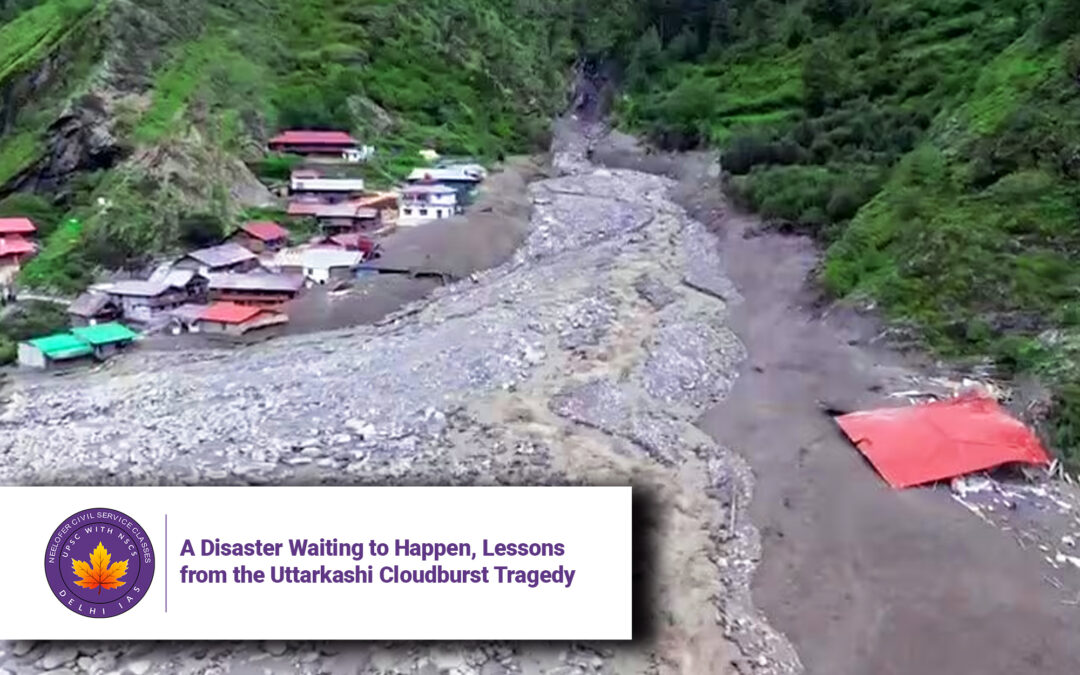
The recent catastrophic cloudburst in Uttarkashi, Uttarakhand, has brought the Himalayan region’s extreme vulnerability to natural disasters back into the spotlight. The incident devastated the Dharali village, located at an elevation of about 2,550 meters, sweeping away houses within minutes and leaving behind an uncertain death toll, with reports of dozens dead and over a hundred missing. This tragedy once again underlines the urgent need to address the systemic governance, planning, and environmental lapses that continue to put lives in peril across the fragile Himalayan belt.
Introduction
For decades, experts, environmentalists, and governments have acknowledged that the Himalayan mountains are geologically fragile and naturally prone to hazards. Their limited carrying capacity makes them highly susceptible to landslides, flash floods, and cloudbursts. However, despite repeated warnings and disasters, development practices in the region have often ignored ecological limits. This disregard has transformed many vulnerable locations into high-risk zones.
The Uttarkashi disaster, particularly in Dharali village, has emerged as a grim reminder of the consequences of ignoring environmental realities. This is not an isolated event but part of a recurring pattern — one that has been seen in previous tragedies like the 2013 Kedarnath floods and the 2014 floods in the Bhagirathi basin. The combination of unplanned construction, unchecked tourism-related exploitation, and poor governance has amplified the destructive potential of natural hazards.
The Dharali Tragedy: What Happened
Dharali village, known for its picturesque landscape, is located in the middle of a river channel and its natural flood zone. Over the years, its settlement size has swelled significantly, with buildings creeping dangerously closer to the riverbanks. Satellite imagery comparisons from the early 2000s to the present clearly show the rapid, unregulated expansion.
During the recent cloudburst, the Himalayan torrents exhibited their characteristic high-speed, high-volume discharge. While extreme precipitation is part of the natural climatic pattern in the Himalayas, the devastation in Dharali was not purely natural. The disaster’s scale was exacerbated by human-made factors — namely, reckless encroachment into riverbanks, lack of proper zoning regulations, and absence of disaster preparedness measures.
Recurring Pattern of Disasters in the Himalayas
Events like this are becoming almost annual occurrences due to the ongoing climate crisis. Extreme rainfall, cloudbursts, and flash floods regularly follow one another in rapid succession. In every instance, the National Disaster Response Force (NDRF) is deployed, loss of life is mourned, promises of inquiry are made — and yet, the cycle repeats.
Historical examples reinforce this pattern:
-
June 2013 Kedarnath Floods: Triggered by a massive cloudburst, flash floods and landslides killed thousands. The root causes included deforestation, unregulated construction, and blocked drainage paths.
-
2014 Bhagirathi Basin Floods: Another severe flood incident, again worsened by haphazard building practices along riverbanks.
Each event underscores the combination of climatic extremes and human negligence, leading to escalating damage.
Key Issues and Institutional Concerns
1. Ignoring the Golden Rule of River Safety
In flood-prone regions, one fundamental rule is to keep human settlements as far as possible from the natural river channel. This principle was ignored in Dharali, where constructions steadily moved closer to the watercourse. The result was inevitable: the river reclaimed its floodplain during the extreme event.
2. Geological Vulnerabilities of the Region
Dharali and its surroundings are geologically fragile. The nearby Kheer Ganga, a lesser-known tributary of the Bhagirathi, brings down vast amounts of unconsolidated rock debris from upstream. These materials, combined with steep gradients, make the area prone to sudden and deadly landslides.
3. Lack of Penalties for Violations
The unchecked construction boom in high-altitude Himalayan settlements has thrived due to weak enforcement. There are no significant penalties for individuals, groups, or even state bodies that allow violations. Without accountability, the cycle of destruction continues.
4. Absence of Carrying Capacity-Based Planning
There is little to no integration of carrying capacity studies into local governance. High-elevation villages often lack a register of geological, climatic, and seismic data — essential for safe development planning.
5. Inadequate Enforcement of Building Codes
Even basic building regulations are rarely enforced. The construction of shanties, cheap hotels, and large tourist accommodations has continued unchecked, often directly within hazardous zones.
Lessons from the Disaster
Lesson 1: Respect Natural River Channels
Keeping human activity away from active river channels is the first and most important precaution. Any construction in flood-prone zones should be prohibited, especially at elevations above 2,500 meters where the terrain is most unstable.
Lesson 2: Mandatory Vulnerability Mapping
Village councils in high-risk Himalayan areas must maintain a carrying capacity register that documents geological, climatic, and seismic risk factors. This data should guide all development decisions.
Lesson 3: Strict Penalties for Unsafe Construction
Rapid construction of unsafe structures must be treated as a punishable offense. Officials — including Sub-Divisional Magistrates (SDMs) and District Magistrates (DMs) — should be held personally accountable for failing to enforce zoning and safety laws.
Lesson 4: Restricting Construction Above 2,500 Meters
A strict zoning code should be implemented to prevent new constructions above a certain altitude unless proven to be safe through rigorous environmental assessments.
Lesson 5: Sustainable Development Model
Future development must adhere to the “Himalayan Triumvirate” of:
-
Geological Vulnerability – Recognizing and respecting the inherent risks.
-
Ecological Fragility – Avoiding environmental degradation.
-
Cultural Sensitivity – Preserving local traditions and knowledge systems that have historically enabled safer habitation.
The Role of Government and Local Communities
While local communities often make decisions for short-term economic gain, the government bears the primary responsibility for preventing high-risk areas from turning into unsafe, unsustainable townships. Cheap tourism exploitation may boost revenue temporarily, but it leads to higher disaster management costs in the long run.
Moreover, easements for construction in fragile areas should be avoided. Where tourism is a major economic activity, it should be carefully regulated to ensure ecological balance and protect human lives.
Challenges and the Way Forward
1. Bureaucratic Inertia
Even when new regulations are proposed, they often get bogged down in administrative delays. Streamlining the process without compromising safety is critical.
2. Balancing Local Livelihoods with Safety
Over-regulation without providing alternative livelihoods can cause resentment among local populations. Any enforcement plan must be paired with sustainable economic alternatives.
3. Climate Change Intensifying Disasters
The Himalayas are experiencing more intense and frequent extreme weather events due to global climate change. This increases the urgency for proactive measures.
4. Infrastructure vs. Ecology Conflict
There is an ongoing tension between building roads, hydropower projects, and tourist facilities versus protecting ecological integrity. A middle path is necessary.
Conclusion
The Uttarkashi cloudburst disaster is not an isolated tragedy but part of an escalating cycle of destruction in the Himalayan region. While nature plays its role through extreme weather, the magnitude of devastation is largely man-made. Ignoring geological and ecological limits, promoting unregulated construction, and failing to enforce existing laws have transformed many villages into high-risk death traps.
A sustainable future for the Himalayas lies in strict adherence to carrying capacity guidelines, enforcing construction bans in hazardous zones, and adopting community-led conservation practices. Without these changes, the mountains will continue to witness disasters “waiting to happen.”
Q&A Section
1. What caused the recent disaster in Uttarkashi’s Dharali village?
The disaster was triggered by a cloudburst that led to massive flooding in the river channel. However, the severity of destruction was amplified by unregulated construction within the natural flood zone and absence of proper safety measures.
2. Why is the Himalayan region considered so vulnerable to such disasters?
The Himalayas have a fragile geological structure, steep gradients, and limited carrying capacity. Combined with heavy rainfall and rapid snowmelt, these factors make the region prone to landslides, floods, and cloudbursts.
3. What measures can be taken to reduce the risk of such disasters in the future?
Key measures include enforcing strict zoning laws, banning construction in floodplains, creating carrying capacity registers, holding officials accountable for violations, and promoting sustainable development practices.
4. How does climate change influence disasters in the Himalayas?
Climate change has increased the frequency and intensity of extreme weather events such as heavy rainfall and cloudbursts, which in turn heighten the risk of floods and landslides in the already fragile region.
5. What is meant by the “Himalayan Triumvirate” in sustainable development?
It refers to an approach that balances development with (a) geological vulnerability, (b) ecological fragility, and (c) cultural sensitivity. This ensures that growth in the region does not compromise safety or environmental integrity.

