
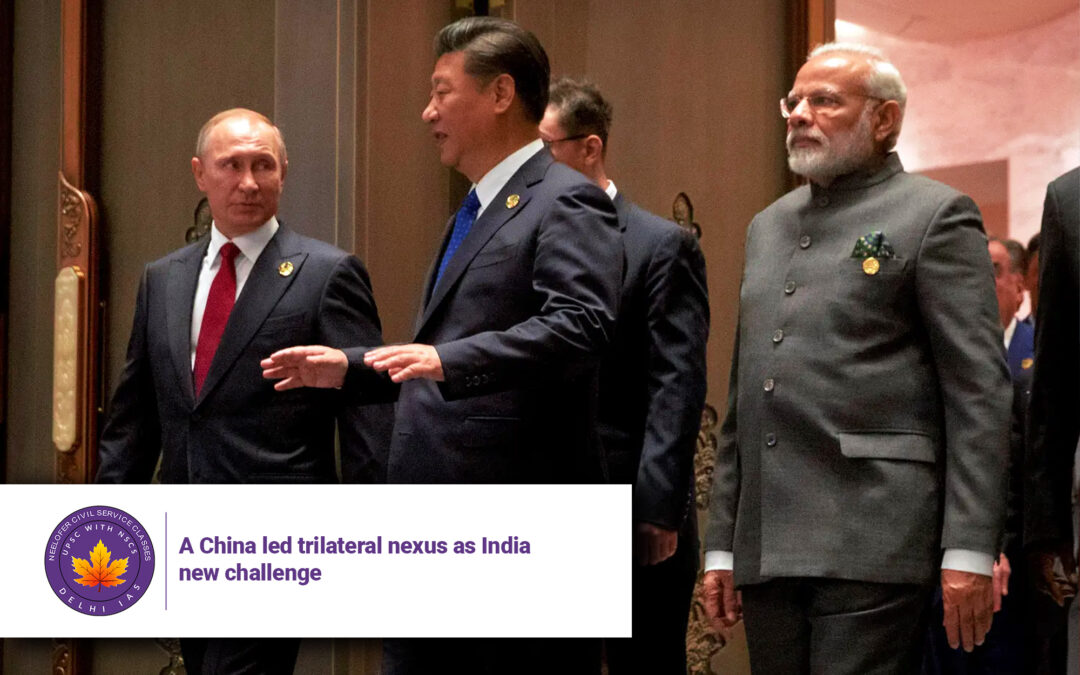
A China led trilateral nexus as India new challenge
Why in News?
A strategic trilateral meeting was recently held in Kunming, China, involving China, Pakistan, and Bangladesh. It is being seen as a new diplomatic challenge for India, especially in light of the increasing regional convergence between China’s interests and its partners in South Asia. India now faces a complex trilateral front that may reshape power dynamics in the region. 
Introduction
While trilateral meetings are not new, this China-Pakistan-Bangladesh format signals a subtle but significant shift in South Asian geopolitics. The meeting occurred just weeks after the China-hosted China-Pakistan-Afghanistan dialogue, indicating an expanding Chinese effort to encircle India, both geographically and diplomatically. This development comes amid India’s strained ties with China, tense relations with Pakistan, and diplomatic drift with Bangladesh.
Key Issues and Strategic Concerns
1. Shift from Bipolar to Trilateral Alignments
The 1947 regional power alignment, which once saw Pakistan and China forming counterweights against India, is now evolving into a broader trilateral configuration. With Bangladesh drawn into this orbit, India is increasingly surrounded by states with converging positions that challenge its leadership in the region.
2. China’s Broader Strategy
China is using these trilateral arrangements to push forward its “strategic encirclement” of India, often referred to as a “String of Pearls.” Recent moves include military aid to Pakistan, deepened ties with Taliban-led Afghanistan, and infrastructure expansion in Bangladesh.
3. India’s Receding Influence in the Region
India’s influence in South Asia has weakened due to multiple setbacks, including tensions with Bangladesh over the Citizenship Amendment Act, border killings, and water-sharing disputes. Bangladesh’s growing ties with China, including energy cooperation and infrastructure funding, highlight this drift.
4. Military and Diplomatic Synchrony
China and Pakistan are increasing military cooperation with joint air defence systems, drone programs, and fighter jet deals. Pakistan’s response to Operation Sindoor by invoking China’s diplomatic support further reflects a unified front. Meanwhile, Afghanistan under the Taliban remains receptive to Beijing and Islamabad, having previously resisted Indian overtures.
5. Challenges for Indian Diplomacy
India now has to counter not just one, but a combined diplomatic pressure front. With Pakistan exploiting China’s clout and Bangladesh growing distant, India faces regional isolation, requiring renewed diplomacy, especially with smaller neighbours.
Challenges and the Way Forward
-
India must reinvigorate ties with Bangladesh through people-centric engagement, water-sharing pacts, and resolution of CAA-related concerns.
-
India needs to adopt a multi-pronged strategy combining military deterrence, regional trade leadership, and diplomatic agility.
-
Re-engagement with Afghanistan may also be critical. Even under the Taliban regime, developmental aid and humanitarian diplomacy can create influence.
-
India should step up QUAD and IPEF engagements, using them as leverage against growing China-centric blocs.
-
Initiatives like Neighbourhood First and Act East Policy must be revitalized with real deliverables and bilateral trust-building.
Conclusion
The China-led trilateral model represents an ideological and strategic challenge to Indian hegemony in South Asia. While the formations may seem diplomatic, their implications are deeply military, economic, and geopolitical. India must evolve from reactive posturing to proactive regional stewardship if it wishes to retain influence and stability in its backyard.
Q&A Section
1. What was the purpose of the recent trilateral meeting in Kunming?
The meeting aimed to strengthen cooperation between China, Pakistan, and Bangladesh on regional and economic matters, with implications for defence and diplomacy.
2. Why is this trilateral arrangement a concern for India?
It reflects an attempt to strategically encircle India, reducing its influence in South Asia and undermining its bilateral relationships.
3. How has India’s relationship with Bangladesh changed?
Tensions have grown due to disputes over citizenship laws, border killings, and water-sharing. Bangladesh has moved closer to China for infrastructure and energy ties.
4. What role does Afghanistan play in this triangle?
Afghanistan, now under Taliban rule, has increased its diplomatic engagement with China and Pakistan, further complicating India’s strategic calculus.
5. What should India do in response?
India must rebuild trust with neighbours, engage diplomatically with all three countries, and counterbalance China’s influence via strategic partnerships and multilateral groupings.

