
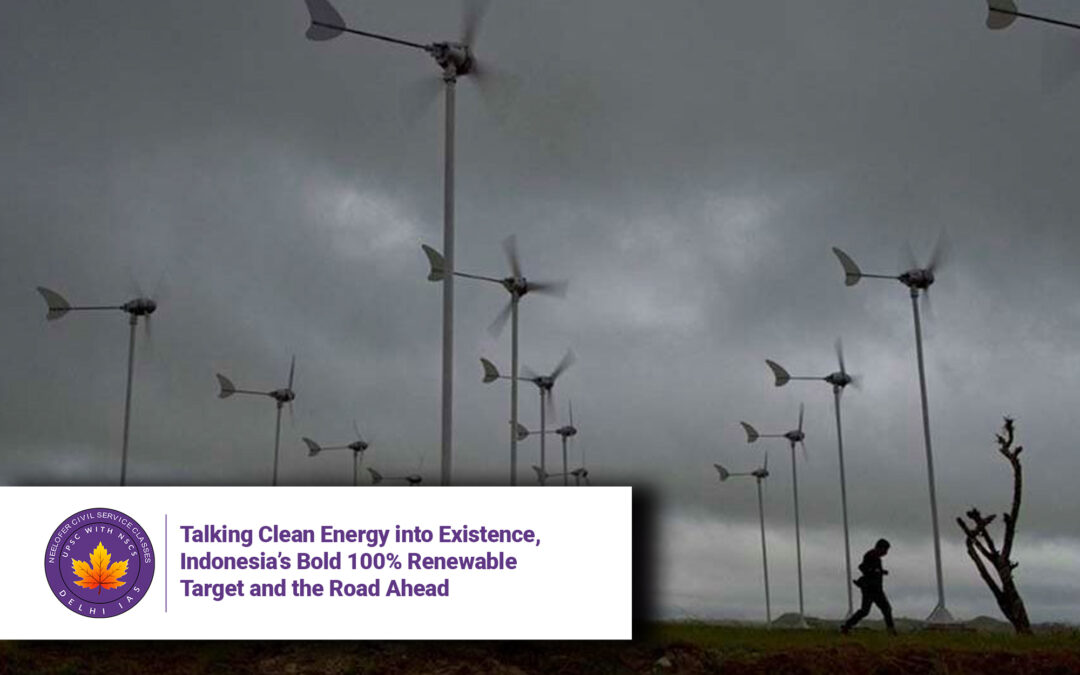
Talking Clean Energy into Existence, Indonesia’s Bold 100% Renewable Target and the Road Ahead
Introduction
On August 15, 2024, President Prabowo Subianto surprised the nation and the international community in his state budget address by declaring that Indonesia must achieve 100 percent power generation from new and renewable energy within 10 years or sooner. This bold statement, delivered ahead of Independence Day, caught many observers off guard. Even environmental advocates and energy experts, known for ambitious visions, have hesitated to make such a demand, given the immense scale of the challenge.
At present, renewable sources contribute just about 15 percent of Indonesia’s nationwide electricity supply. State-owned power distributor PLN’s electricity procurement business plan (RUPTL) envisions 34.3 percent renewable energy share only by 2034—still a decade later than the timeline Prabowo set. The gap between aspiration and technical feasibility is stark, and yet, the President’s declaration offers a rallying cry for accelerating Indonesia’s energy transition.
This essay examines the implications of the President’s clean energy vision, the structural and policy barriers to achieving it, the economics of coal versus renewables, and the broader socio-political challenges of Indonesia’s green transformation.
The Bold Clean Energy Promise
The President’s statement was simple yet revolutionary:
“We must achieve 100 percent power generation from new and renewable energy within 10 years or sooner. I believe this is achievable.”
While Indonesia has long discussed renewable energy expansion, official policy documents have never mentioned 100 percent clean power within such a short timeline. Most government strategies, including RUPTL, remain anchored in gradual energy diversification, with coal still dominating until well into the 2030s.
This raises important questions:
-
Was this an off-script statement, a moment of political aspiration rather than technical planning?
-
Or was it a deliberate national rallying call intended to accelerate reforms and investments in clean energy?
Either way, the declaration places energy transition squarely at the center of Indonesia’s national development agenda.
Current State of Indonesia’s Energy Mix
Today, Indonesia’s electricity supply is heavily dominated by coal, which accounts for around 60 percent of generation. Gas, diesel, and hydropower contribute additional shares, while solar, wind, and geothermal remain relatively small players despite Indonesia’s vast potential.
-
Coal Dependency: Indonesia is the world’s third-largest coal producer and exporter, supplying both domestic and international markets. Coal has long been considered cheap and reliable, thanks to Domestic Market Obligation (DMO) policies that require coal producers to sell a portion of their output domestically at capped prices.
-
Renewable Potential: Indonesia is blessed with abundant renewable resources:
-
Solar energy potential: Over 200 GW, but utilization is minimal.
-
Geothermal reserves: Among the largest in the world, but underdeveloped.
-
Wind and hydro: Considerable, but underinvested.
-
Despite this potential, investment barriers, regulatory hurdles, and market distortions have slowed renewable energy adoption.
Barriers to Achieving 100 Percent Renewable Power
1. Regulatory Bottlenecks
-
A long-delayed Renewable Energy Bill remains stuck in legislative processes.
-
Sector-specific reforms, such as making rooftop solar more appealing and less bureaucratic, have seen little progress.
-
Private power producers face difficulties transmitting electricity through PLN’s grid, which limits market competition.
2. Market Distortions
-
The coal price cap keeps coal artificially cheap, discouraging renewable investments.
-
Oversupply of power from coal plants in the Java-Bali grid crowds out opportunities for renewables.
3. Investment Challenges
-
General business regulations, such as local content requirements, hamper investment. For example, solar panel projects must meet domestic manufacturing rules, even though most components still rely on imports.
-
Lack of clear incentives for storage technologies and grid upgrades discourages private participation.
4. Financial Constraints
-
Renewable projects often require high upfront costs, which private investors are hesitant to bear without long-term certainty.
-
The energy transition involves short-term financial sacrifices that need burden-sharing between the government, private sector, and international partners.
5. Institutional Inertia
-
PLN, as the dominant utility, has historically favored large-scale coal projects, which are easier to finance and integrate into existing infrastructure.
-
The transition to a decentralized renewable system challenges long-standing institutional norms.
The Coal Question
Coal is both an economic lifeline and a stumbling block in Indonesia’s energy transition.
-
Artificial Affordability: Domestic Market Obligation requires coal miners to sell 25 percent of output at capped prices, making coal artificially cheaper than renewables.
-
Oversupply: Indonesia currently faces an excess supply of power, particularly in Java-Bali, meaning new renewable projects often struggle to find buyers.
-
Global Shift: With the EU’s Carbon Border Adjustment Mechanism (CBAM) and declining global demand, Indonesia’s reliance on coal exports faces long-term risks.
Transitioning away from coal requires phasing out subsidies, redesigning the electricity market, and retraining workers dependent on coal industries—a politically sensitive process.
Opportunities in Renewable Energy
Despite the hurdles, Indonesia stands to gain significantly from embracing clean energy.
1. Economic Diversification
-
Investing in renewables could generate millions of jobs in construction, manufacturing, and maintenance.
-
Developing domestic solar and wind industries could reduce reliance on imported fossil fuels.
2. Global Leadership
-
By setting bold targets, Indonesia can establish itself as a climate leader in Southeast Asia, boosting its credibility in global negotiations.
3. Attracting Investment
-
International green finance flows are growing, with mechanisms like the Just Energy Transition Partnership (JETP) offering billions in concessional funding.
-
Private investors increasingly seek markets with strong renewable commitments.
4. Technological Leapfrogging
-
Indonesia can leapfrog directly into next-generation technologies such as green hydrogen, battery storage, and smart grids.
From Vision to Mission: What Needs to Be Done
A bold vision is a starting point, but successful energy transition requires technical precision and policy consistency.
Short-Term Steps (2025–2027)
-
Pass the Renewable Energy Bill to provide legal certainty.
-
Reform PLN’s monopoly to allow greater private participation.
-
Introduce tariff incentives for rooftop solar and energy storage.
-
Begin phasing out the coal price cap gradually.
Medium-Term Steps (2028–2032)
-
Scale up investments in solar, wind, and geothermal projects.
-
Modernize the electricity grid for intermittent renewable integration.
-
Support domestic manufacturing of solar panels, batteries, and wind turbines.
-
Train workers for clean energy jobs.
Long-Term Steps (2032–2035)
-
Achieve majority renewable penetration (50–70%).
-
Begin decommissioning older coal plants.
-
Invest in regional interconnection across ASEAN for energy trade.
-
Move towards a carbon pricing system aligned with international standards.
The Politics of Energy Transition
Indonesia’s energy transformation cannot be achieved by political speeches alone. True success requires:
-
Cross-party consensus to ensure continuity beyond election cycles.
-
Stakeholder collaboration among government, industry, civil society, and local communities.
-
Regional equity, ensuring that resource-rich but underdeveloped provinces like Kalimantan and Papua also benefit from renewable projects.
Ultimately, political will must translate into policy execution, something that has historically been Indonesia’s weakest link.
Conclusion
President Prabowo’s declaration of achieving 100 percent renewable power within 10 years may not be technically realistic, but it carries symbolic and strategic importance. It forces the nation to confront the urgency of energy transition, spotlighting the need for structural reforms, investment-friendly policies, and an end to coal dependency.
The road ahead is challenging, requiring both domestic commitment and international support. Indonesia must balance short-term costs with long-term gains, ensuring a just and inclusive transition that protects workers, secures affordable electricity, and reduces carbon emissions.
In the end, what matters is not whether Indonesia reaches 100 percent clean power by 2035, but whether it manages to double or triple its renewable share, set the right foundations, and move decisively away from fossil fuel dependence.
Five Exam-Oriented Q&A
Q1. What was the clean energy commitment announced by Indonesia’s President Prabowo Subianto in his state budget address?
A: He announced that Indonesia must achieve 100 percent power generation from new and renewable energy within 10 years or sooner.
Q2. Why is the target considered highly ambitious and unrealistic by experts?
A: Because renewables currently account for only 15 percent of electricity supply, PLN’s roadmap targets just 34.3 percent by 2034, and existing market distortions (coal subsidies, oversupply) make rapid scaling technically and financially difficult.
Q3. What are the main barriers to renewable energy growth in Indonesia?
A: Regulatory bottlenecks, coal price caps, oversupply of coal power, lack of grid modernization, investment uncertainty due to local content requirements, and high upfront costs of renewable projects.
Q4. How does coal distort Indonesia’s electricity market?
A: Domestic Market Obligation requires coal miners to sell 25% of output domestically at capped prices, making coal artificially cheap, leading to oversupply and leaving little market space for renewables.
Q5. What steps should Indonesia take to move from vision to mission in achieving clean energy goals?
A: Passing the Renewable Energy Bill, reforming PLN’s monopoly, phasing out coal subsidies, incentivizing rooftop solar, investing in storage and grids, supporting domestic manufacturing, and fostering international green finance partnerships.

