
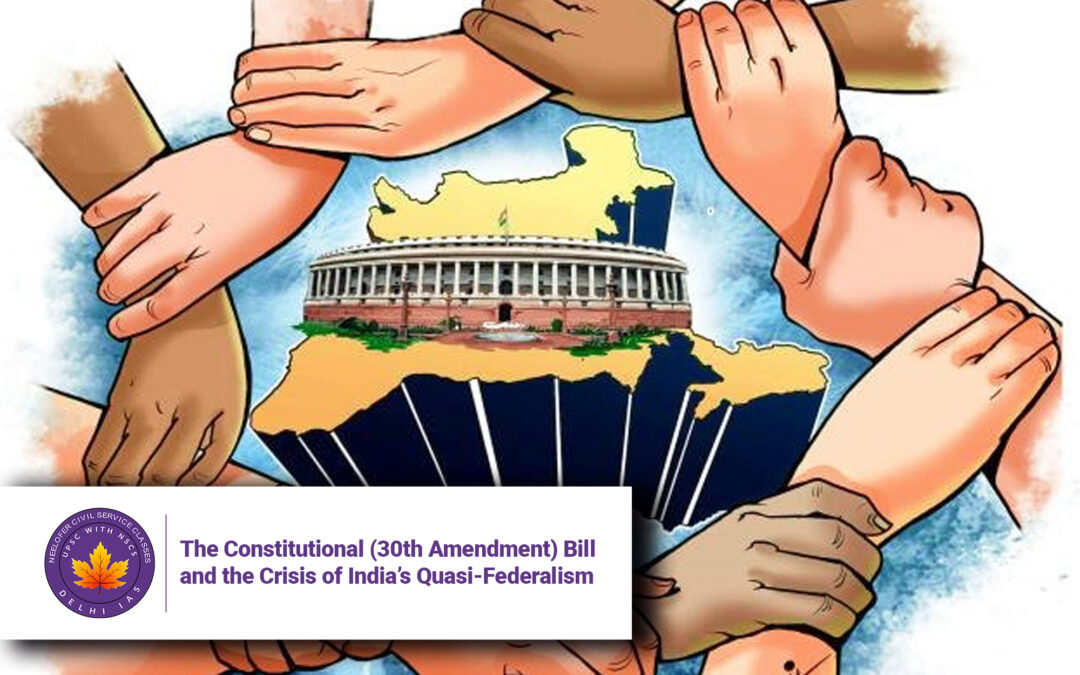
The Constitutional (30th Amendment) Bill and the Crisis of India’s Quasi-Federalism
Why in News?
The proposed Constitution (30th Amendment) Bill, which seeks to automatically remove ministers, chief ministers, and even the prime minister from office if jailed for 30 consecutive days for offenses punishable by five or more years, has ignited a critical debate on India’s federal structure. While the intent to decriminalize politics is laudable, the procedural approach—using Parliament’s unilateral amending power without state ratification—exposes deep imbalances in India’s constitutional framework. This analysis delves into the bill’s implications for federalism, the historical context of India’s quasi-federal design, and the urgent need for a more balanced distribution of power between the Centre and states.
Introduction
India’s Constitution is often described as “quasi-federal,” blending unitary and federal features to accommodate the nation’s diversity while ensuring central authority. However, the proposed 30th Amendment Bill highlights a persistent tension: the Centre’s ability to enact changes that directly impact state autonomy without their consent. By targeting Article 164, which governs the appointment and tenure of state ministers, the bill raises fundamental questions about the integrity of India’s federal compact. This examination explores the constitutional nuances, historical origins, and democratic imperatives of federalism, arguing that the bill’s passage without state ratification could undermine the very foundations of India’s democratic structure.
Key Issues
1. The Constitutional Amendment Process: Article 368 and Its Loopholes
-
Special Majority and Entrenched Provisions: Article 368 requires a special majority for most amendments but mandates state ratification only for specific “entrenched” provisions, such as the election of the President and the distribution of legislative powers.
-
Exclusion of Article 164: Since Article 164 (state ministers’ tenure) is not listed among entrenched provisions, the Centre can amend it unilaterally, despite its direct impact on state autonomy.
-
Historical Context: The Constituent Assembly, responding to Partition and the need for national unity, prioritized a strong Centre, resulting in a constitutional design that often subordinates federal principles to unitary control.
2. Federalism as a Basic Structure
-
Judicial Precedents: In landmark cases like Kesavananda Bharati (1973) and S.R. Bommai (1994), the Supreme Court declared federalism part of the Constitution’s “basic structure,” immune to amendment.
-
Potential Challenges: The 30th Amendment will likely face judicial scrutiny, with petitioners arguing that it violates federalism by enabling the Centre to destabilize state governments without their consent.
3. Implications for State Autonomy
-
Destabilization of Elected Governments: The bill could allow central agencies to target state ministers and chief ministers, potentially toppling elected governments through prolonged custody.
-
Erosion of Democratic Mandate: State executives, chosen by the people, could be removed via a process where state legislatures have no say, undermining electoral democracy.
-
Central Overreach: The bill exemplifies the Centre’s expanding role in state affairs, from law enforcement to political governance.
4. Comparative Federal Perspectives
-
Global Models: Federations like the U.S. and Germany require broad consensus for constitutional changes affecting states. India’s procedure is unusually centralized.
-
Asymmetric Federalism: Countries like Canada and Australia provide greater autonomy to provinces, whereas India’s states remain heavily dependent on the Centre.
5. Political and Ethical Dimensions
-
Decriminalization vs. Federalism: While removing criminal elements from office is ethically sound, the method must respect federal principles.
-
Partisan Misuse: The bill could be weaponized by ruling parties at the Centre to target opposition-led states, exacerbating political vendettas.
6. Historical Roots of India’s Unitary Tendencies
-
Partition Legacy: The withdrawal of the Muslim League and the trauma of Partition led the framers to abandon looser federal models in favor of a strong Centre.
-
Centralizing Provisions: Articles 356 (President’s Rule), 352 (Emergency), and the Seventh Schedule (Union List) grant the Centre overriding powers.
Alternative Approaches
-
Including Article 164 in Entrenched Provisions:
-
Amend Article 368 to require state ratification for changes to Article 164, protecting state autonomy.
-
-
State-Led Amendment Initiation:
-
Allow states to propose constitutional amendments on matters affecting their powers, fostering cooperative federalism.
-
-
Judicial Safeguards:
-
Strengthen judicial review to strike down amendments that violate federalism’s basic structure.
-
-
Political Consensus Building:
-
Establish inter-state councils and all-party meetings to negotiate amendments impacting states.
-
-
Gradual Decentralization:
-
Revisit the Seventh Schedule to expand state legislative fields, reducing central dominance.
-
Challenges and the Way Forward
-
Political Resistance: States may oppose the bill, leading to protracted legal and political battles.
-
Implementation Risks: Even if enacted, the bill could be misused for political gains, requiring robust oversight.
-
Constitutional Literacy: Enhancing public awareness of federal principles is crucial for democratic accountability.
The Way Forward:
-
National Dialogue: Initiate a conversation on rebalancing Centre-state relations, possibly through a new commission on federalism.
-
Legislative Reforms: Expand the list of entrenched provisions in Article 368 to include all state-related matters.
-
Cooperative Governance: Promote institutions like the Inter-State Council to facilitate consensus on contentious issues.
Conclusion
The 30th Amendment Bill represents a critical juncture in India’s constitutional journey. While its goal of cleansing politics is commendable, the means—bypassing state ratification—threatens the federal equilibrium. India’s democracy thrives on diversity and decentralization, and any amendment affecting states must involve their participation. As the judiciary prepares to review the bill, it is imperative for policymakers to reaffirm their commitment to federalism as a basic structure of the Constitution. True reform requires not only ethical governance but also respect for the democratic voices of states, ensuring that India’s federal fabric remains resilient and inclusive.
5 MCQs Based on the Article
Q1. Which article of the Constitution governs the amendment process?
A) Article 164
B) Article 368
C) Article 356
D) Article 352
Answer: B) Article 368
Q2. What is required to amend entrenched provisions under Article 368?
A) Simple majority in Parliament
B) Special majority and state ratification
C) Presidential assent alone
D) Judicial approval
Answer: B) Special majority and state ratification
Q3. Which landmark case established the “basic structure” doctrine?
A) S.R. Bommai v. Union of India
B) Kesavananda Bharati v. State of Kerala
C) Indira Gandhi v. Raj Narain
D) Minerva Mills v. Union of India
Answer: B) Kesavananda Bharati v. State of Kerala
Q4. What is the primary criticism of the 30th Amendment Bill?
A) It targets only state ministers
B) It bypasses state ratification despite impacting state autonomy
C) It imposes harsh penalties on ministers
D) It is supported only by the ruling party
Answer: B) It bypasses state ratification despite impacting state autonomy
Q5. Which historical event influenced the framers to prioritize a strong Centre?
A) The Emergency of 1975
B) The Partition of 1947
C) The Linguistic Reorganization of States
D) The Independence Movement
Answer: B) The Partition of 1947

