
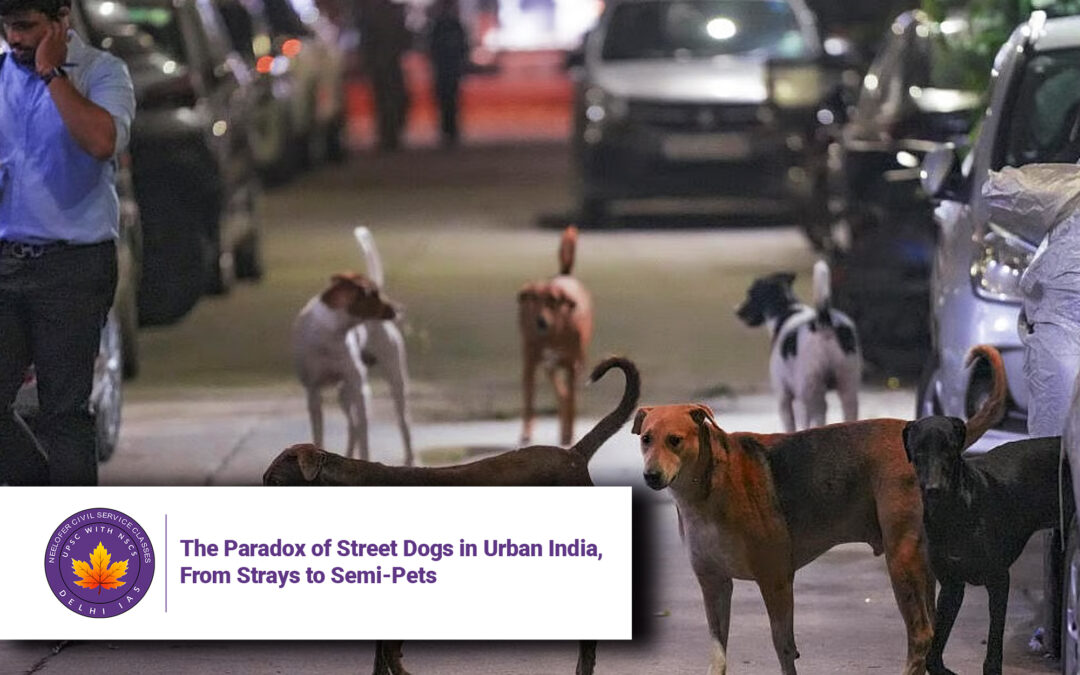
The Paradox of Street Dogs in Urban India, From Strays to Semi-Pets
Why in News?
The narrative of street dogs in India is undergoing a significant transformation, as illustrated by the personal account of Chutney, a street dog in Kolkata who transitioned from a life of hardship to becoming a “semi-pet.” This story reflects broader trends in urban India, where street dogs are increasingly being adopted or semi-adopted by households, challenging traditional perceptions of pet ownership. However, this shift also highlights critical issues such as animal welfare, urban infrastructure, and the cultural dynamics of human-animal relationships. This analysis explores the complexities of street dog management in India, the rise of indie (Indian native) dog adoption, and the societal implications of this evolving coexistence.
Introduction
Street dogs, or indie dogs, have long been an integral part of India’s urban and rural landscapes. Often viewed as nuisances or threats, they are also celebrated for their resilience and adaptability. Recent years have witnessed a growing movement towards adopting street dogs, fueled by awareness campaigns, changing attitudes, and the efforts of animal welfare organizations. Yet, this trend exists alongside persistent challenges: conflicts with humans, inadequate sterilization programs, and gaps in policy implementation. The story of Chutney—a street dog who became a beloved household member despite initial resistance—serves as a microcosm of these larger dynamics. This analysis delves into the socio-cultural, ethical, and practical dimensions of street dog management in India, examining the opportunities and obstacles in creating harmonious human-animal coexistence.
Key Issues
1. The Dual Perception of Street Dogs
-
Resilience and Intelligence: Street dogs are often praised for their hardiness, immunity, and intelligence. Initiatives like the Indian Police’s use of indie dogs in training programs underscore their potential.
-
Negative Stereotypes: Despite their strengths, street dogs are frequently stigmatized as aggressive, diseased, or unclean, leading to conflicts and even culling attempts.
2. The Rise of Indie Dog Adoption
-
Changing Attitudes: Increased awareness of animal rights and the efforts of NGOs have encouraged more people to adopt indie dogs. Social media campaigns and celebrity endorsements have further popularized this trend.
-
Semi-Adoption Practices: Many households, like Chutney’s family, practice semi-adoption—providing food and shelter without full integration into the home. This reflects a pragmatic approach to balancing compassion with constraints.
3. Challenges in Street Dog Management
-
Overpopulation and Sterilization: India has an estimated 35 million street dogs. While programs like Animal Birth Control (ABC) aim to sterilize and vaccinate them, implementation is uneven due to funding shortages, logistical issues, and public apathy.
-
Human-Dog Conflicts: Dog bites remain a serious concern, with over 17 million cases reported annually. Rabies, though preventable, causes thousands of deaths each year, highlighting the need for better vaccination drives.
-
Urban Infrastructure Issues: Rapid urbanization often encroaches on spaces where street dogs thrive, leading to increased encounters and conflicts. Poor waste management exacerbates the problem by providing easy food sources.
4. Policy and Legal Framework
-
Animal Birth Control Rules, 2023: These rules mandate sterilization and vaccination as the primary methods for population control, rejecting culling. However, enforcement is weak, and municipal bodies often lack resources.
-
Judicial Interventions: Courts have occasionally ordered mass removals of street dogs, as seen in Delhi’s recent controversial directive, which was later stayed. Such measures reflect societal tensions but ignore ecological and ethical considerations.
-
Role of NGOs: Organizations like People for Animals (PFA) and Humane Society International play a crucial role in ABC programs and advocacy, yet they operate in a challenging environment.
5. Cultural and Ethical Dimensions
-
Historical Coexistence: Street dogs have shared spaces with humans for centuries, often serving as informal watchdogs or scavengers. Their presence is woven into the fabric of Indian society.
-
Ethical Debates: Questions about animal rights, welfare, and the ethics of relocation or euthanasia are increasingly part of public discourse. The case of Chutney illustrates the moral dilemmas families face.
6. The Case of Chutney: A Symbol of Transition
-
From Street to Semi-Pet: Chutney’s journey from a vulnerable puppy to a semi-domesticated dog highlights the possibilities and limitations of informal adoption.
-
Behavioral Adaptations: Despite expectations of fierceness or intelligence, Chutney exhibits traits shaped by his environment—caution, selective learning, and dependency—challenging stereotypes about street dogs.
Alternative Approaches
-
Community-Led Initiatives:
-
Encourage resident welfare associations (RWAs) to collaborate with NGOs for localized ABC and feeding programs.
-
Create designated feeding zones to reduce conflicts and ensure dogs are not reliant on garbage.
-
-
Integrated Policy Frameworks:
-
Combine ABC programs with waste management reforms to address the root cause of street dog proliferation.
-
Incorporate animal welfare into urban planning, including shelters and green spaces.
-
-
Education and Awareness:
-
Launch public campaigns on responsible feeding, vaccination, and conflict resolution.
-
Introduce animal welfare topics in school curricula to foster empathy from a young age.
-
-
Technological Solutions:
-
Use mobile apps for reporting stray dog issues, tracking vaccinations, and coordinating ABC efforts.
-
Implement GPS tagging for sterilized dogs to monitor populations and movements.
-
-
Public-Private Partnerships:
-
Engage corporate sponsors for funding ABC programs and shelters.
-
Leverage veterinary colleges for large-scale sterilization drives.
-
Challenges and the Way Forward
-
Resource Constraints: Municipalities lack the funds and manpower for effective ABC programs.
-
Cultural Resistance: Deep-seated fears and prejudices against street dogs hinder progressive policies.
-
Legal Gaps: Weak enforcement of animal protection laws allows for neglect and abuse.
The Way Forward:
-
National Action Plan: Develop a comprehensive strategy for street dog management, involving all stakeholders—government, NGOs, communities, and experts.
-
Empower Local Bodies: Provide municipalities with technical and financial support for ABC and vaccination.
-
Promote Adoption: Incentivize indie dog adoption through tax benefits or subsidies for veterinary care.
-
Research and Data: Invest in studies on street dog ecology and behavior to inform policy decisions.
Conclusion
The story of Chutney is more than a heartwarming tale; it is a reflection of India’s complex relationship with its street dogs. As the country urbanizes and modernizes, finding a balance between human interests and animal welfare is increasingly urgent. The rise of indie dog adoption offers hope, but it must be supported by robust policies, community engagement, and a shift in societal attitudes. Street dogs like Chutney are not just strays; they are sentient beings sharing our urban spaces. Their well-being is intertwined with our own, and addressing their plight is essential for creating compassionate, sustainable cities. The journey from friction to coexistence requires empathy, innovation, and collective action.
5 MCQs Based on the Article
Q1. What is the primary method recommended for controlling street dog populations in India?
A) Culling
B) Relocation
C) Sterilization and vaccination
D) Imprisonment
Answer: C) Sterilization and vaccination
Q2. What are the Animal Birth Control Rules, 2023, aimed at?
A) Promoting culling of aggressive dogs
B) Mandating sterilization and vaccination as population control measures
C) Banning street dogs from urban areas
D) Encouraging adoption of foreign breeds
Answer: B) Mandating sterilization and vaccination as population control measures
Q3. Why are street dogs often in conflict with humans in urban areas?
A) Due to their inability to adapt to urban environments
B) Because of poor waste management and encroachment on their habitats
C) Lack of intelligence compared to foreign breeds
D) Over-adoption by households
Answer: B) Because of poor waste management and encroachment on their habitats
Q4. What is “semi-adoption” as described in the article?
A) Full integration of street dogs into households
B) Providing food and shelter without full indoor integration
C) Temporary fostering of dogs by NGOs
D) Training street dogs for police work
Answer: B) Providing food and shelter without full indoor integration
Q5. What role do NGOs play in street dog management?
A) Advocating for culling
B) Implementing ABC programs and raising awareness
C) Promoting the adoption of foreign breeds only
D) Enforcing legal penalties for feeding street dogs
Answer: B) Implementing ABC programs and raising awareness
