
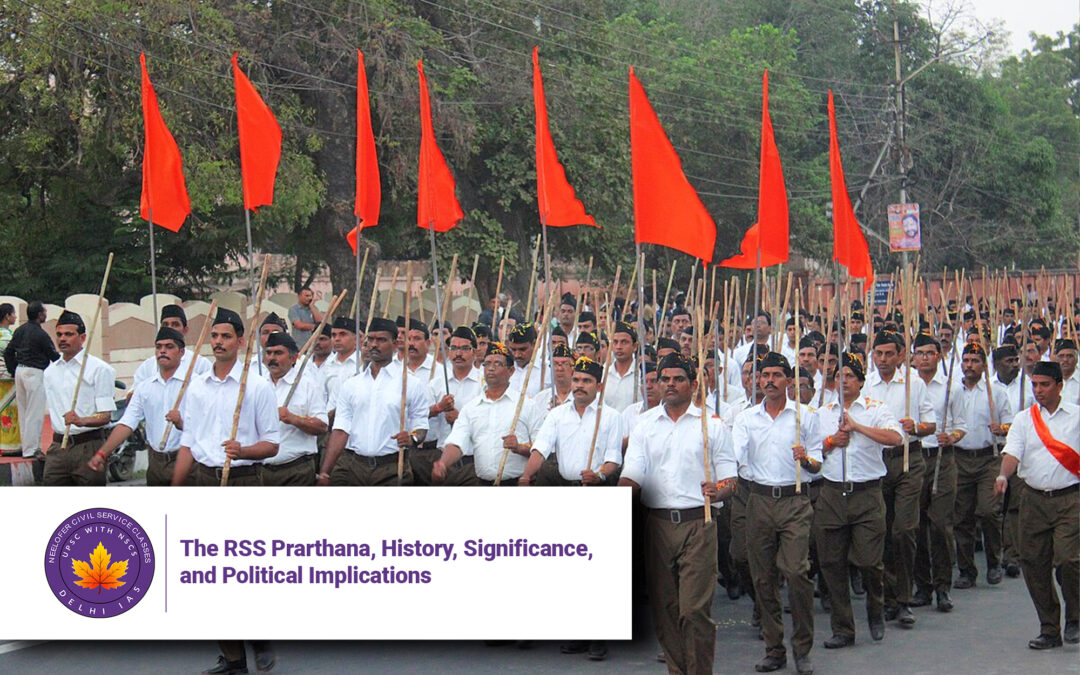
The RSS Prarthana, History, Significance, and Political Implications
Why in News?
Karnataka Deputy Chief Minister and Congress leader D K Shivakumar recently recited the Rashtriya Swayamsevak Sangh (RSS) prayer, “Namaste Sada Vatsale Matribhume,” in the state Assembly, sparking political reactions and bringing attention to the ideological and cultural symbolism of the RSS. This incident highlights the complex interplay between politics, ideology, and cultural identity in India. The RSS prayer, composed in Sanskrit and sung since 1939, is not merely a song but a profound expression of the organization’s ethos, dedicated to the service of the motherland. This analysis delves into the history, significance, and contemporary relevance of the RSS Prarthana, exploring its role in shaping nationalist discourse and its impact on India’s socio-political landscape.
Introduction
The Rashtriya Swayamsevak Sangh (RSS), founded in 1925, is one of India’s most influential socio-cultural organizations. Its prayer, “Namaste Sada Vatsale Matribhume,” is a cornerstone of its identity, recited daily in shakhas (branches) and at public events. The prayer embodies the RSS’s vision of a unified, strong, and culturally rooted India. The recent recitation by a senior Congress leader has ignited debates about political appropriation, ideological boundaries, and the evolving nature of Indian nationalism. This analysis examines the historical context of the prayer, its philosophical underpinnings, and its implications for contemporary politics.
Key Issues
1. Historical Context of the RSS Prayer
-
Origins and Composition: The prayer was written in 1939 by Professor Narahari Narayan Bhide, a close associate of RSS founder Dr. K.B. Hedgewar. Bhide, an English professor proficient in Sanskrit, crafted the prayer to reflect the RSS’s core values: devotion to the motherland, cultural pride, and organizational discipline.
-
Replacement of Regional Prayers: Initially, RSS shakhas used regional prayers in Hindi and Marathi, invoking figures like Samarth Ramdas. However, as the organization expanded nationally, Hedgewar sought a unified prayer to foster a pan-Indian identity.
-
Adoption and Practice: Since 1939, the prayer has been sung at the conclusion of daily shakhas and the beginning of public events. It is performed with specific gestures: standing with the right hand placed over the chest, palm facing downward, symbolizing respect and dedication.
2. Philosophical and Ideological Significance
-
Devotion to Motherland: The prayer begins with an invocation to Bharat Mata (Mother India), emphasizing unwavering devotion and service to the nation.
-
Cultural and Dharma-Based Nationalism: Lines like “Vidyasya dharmasya samrakshanam” (protection of knowledge and dharma) highlight the RSS’s focus on preserving India’s cultural and spiritual heritage.
-
Organizational Unity: The prayer reinforces the RSS’s emphasis on collective effort and discipline, with phrases like “vijayee cha nah sanhata karyashaktir” (may our united efforts be victorious).
3. Political Reactions and Symbolism
-
Shivakumar’s Recitation: The Congress leader’s unexpected recitation in the Karnataka Assembly was met with applause from BJP members and silence from Congress benches. This act has been interpreted as either a gesture of ideological reconciliation or a political strategy to appeal to nationalist sentiments.
-
Broader Political Implications: The incident reflects the blurring of ideological lines in Indian politics, where symbols of Hindutva and cultural nationalism are increasingly mainstreamed.
4. Cultural Integration and National Identity
-
Beyond Politics: The RSS prayer transcends political boundaries, serving as a cultural artifact that resonates with many Indians’ sense of patriotism.
-
Educational and Social Role: The prayer is taught in RSS-affiliated schools and organizations, shaping the worldview of millions of swayamsevaks (volunteers).
5. Controversies and Criticisms
-
Majoritarian Connotations: Critics argue that the prayer, while couched in universal terms, embodies a majoritarian vision of India that marginalizes religious and cultural minorities.
-
Political Appropriation: The use of RSS symbols by non-BJP politicians raises questions about the secularization of nationalist rhetoric.
Alternative Perspectives
-
Cultural Nationalism vs. Political Hindutva:
-
The prayer represents a form of cultural nationalism that can be separated from political Hindutva, allowing broader acceptance.
-
-
Inclusive Patriotism:
-
Some argue that the prayer’s emphasis on motherland and duty can be a unifying force beyond partisan politics.
-
-
Historical Revisionism:
-
Critics view the prayer as part of a project to redefine Indian nationalism along majoritarian lines, erasing pluralistic traditions.
-
Challenges and the Way Forward
-
Ideological Polarization: The RSS’s symbols remain contentious, often deepening political divisions.
-
Secularism vs. Cultural Identity: Balancing respect for cultural expressions with inclusive secularism is a ongoing challenge.
-
Mainstreaming RSS Ideology: The increasing acceptance of RSS symbols in public life reflects the organization’s growing influence.
The Way Forward:
-
Dialogue and Understanding: Encouraging open discussions about the historical and cultural significance of such symbols can foster mutual respect.
-
Political Neutrality of Cultural Symbols: Efforts to decultural symbols from partisan politics could reduce polarization.
-
Educational Integration: Incorporating diverse perspectives on nationalism in educational curricula can promote a more inclusive national identity.
Conclusion
The RSS prayer, “Namaste Sada Vatsale Matribhume,” is more than a ritual; it is a window into the organization’s soul, reflecting its dedication to nation-building cultural preservation. Its recitation by a Congress leader underscores the evolving dynamics of Indian politics, where ideological boundaries are increasingly fluid. As India navigates its complex identity landscape, understanding such symbols’ historical and cultural contexts is crucial for fostering a inclusive yet proud national discourse. The prayer reminds us that nationalism, in its purest form, is about love for the motherland—a sentiment that can transcend political divides if approached with empathy and wisdom.
5 MCQs Based on the Article
Q1. Who composed the RSS prayer “Namaste Sada Vatsale Matribhume“?
A) Dr. K.B. Hedgewar
B) Professor Narahari Narayan Bhide
C) Samarth Ramdas
D) D K Shivakumar
Answer: B) Professor Narahari Narayan Bhide
Q2. In which year was the RSS prayer first introduced?
A) 1925
B) 1939
C) 1947
D) 1950
Answer: B) 1939
Q3. What is the significance of the gesture during the recitation of the prayer?
A) Folding hands in prayer
B) Right hand placed over the chest, palm facing downward
C) Raising both hands to the sky
D) Bowing head to the ground
Answer: B) Right hand placed over the chest, palm facing downward
Q4. Which political leader recently recited the RSS prayer in the Karnataka Assembly?
A) B.S. Yediyurappa
B) D K Shivakumar
C) Siddaramaiah
D) H.D. Kumaraswamy
Answer: B) D K Shivakumar
Q5. What does the line “Vidyasya dharmasya samrakshanam” in the prayer emphasize?
A) Military strength
B) Protection of knowledge and dharma
C) Economic prosperity
D) Political unity
Answer: B) Protection of knowledge and dharma

