
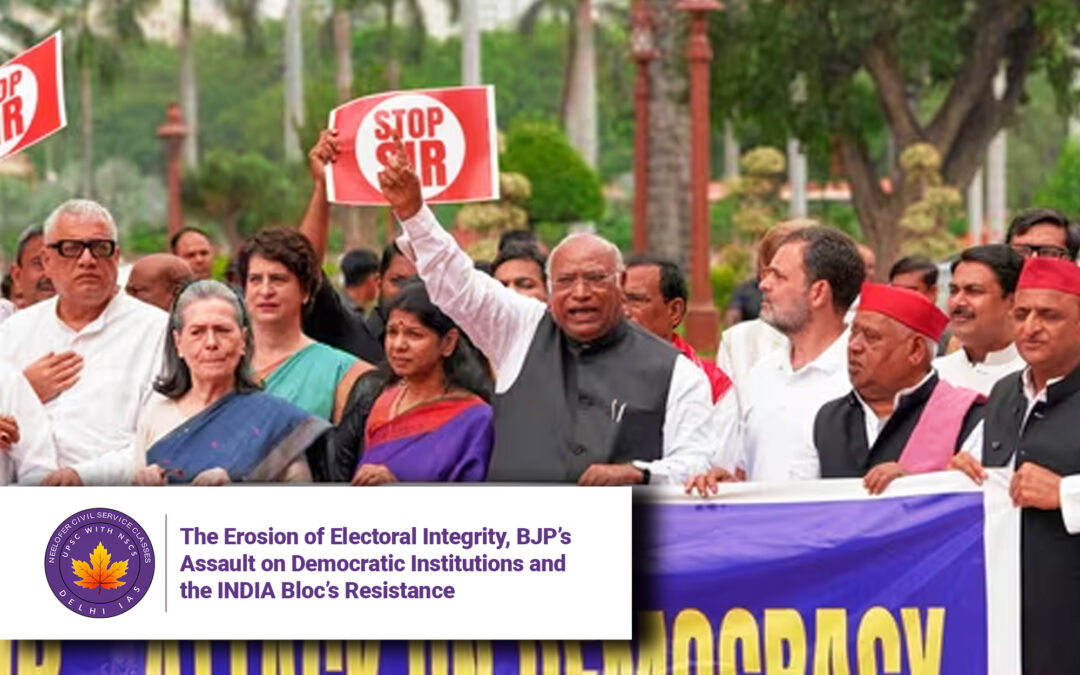
The Erosion of Electoral Integrity, BJP’s Assault on Democratic Institutions and the INDIA Bloc’s Resistance
Why in News?
The integrity of India’s electoral process is under unprecedented threat, with the ruling Bharatiya Janata Party (BJP) accused of systematically undermining the independence of the Election Commission of India (ECI). Recent legislative changes, including the 2023 law that altered the appointment process for the Chief Election Commissioner (CEC) and Election Commissioners (ECs), have raised alarms about the institutional impartiality of the ECI. Coupled with controversial actions such as the Special Summary Revision (SSR) of electoral rolls in Bihar—which allegedly removed 65 lakh voters—and the ECI’s dismissive response to opposition concerns, these developments have sparked a fierce political battle. The Indian National Democratic Inclusive Alliance (INDIA) bloc, led by the Congress party, has launched the Voter Tamasha Yatra to expose these issues and mobilize public opinion. This article delves into the historical context, legal changes, and political implications of this crisis, emphasizing the urgent need to safeguard democratic norms.
Introduction
The Election Commission of India, established under Article 324 of the Constitution, has long been regarded as the guardian of free and fair elections. Its autonomy and impartiality are foundational to India’s democratic ethos, as envisioned by Dr. B.R. Ambedkar. However, recent years have witnessed a steady erosion of the ECI’s independence, with the BJP government accused of converting it into a tool for partisan gain. From controversial appointments to the opaque handling of voter rolls, the ECI’s actions have drawn widespread criticism. The INDIA bloc’s resistance, exemplified by Rahul Gandhi’s Voter Tamasha Yatra in Bihar, highlights the growing concern over electoral integrity. This article examines the multifaceted assault on the ECI, the legal and institutional changes facilitating this decline, and the broader implications for Indian democracy.
Key Issues and Background
1. Historical Role of the Election Commission
The ECI was established to ensure that elections are conducted impartially, without interference from the executive or political parties. For decades, it enjoyed a reputation for integrity, overseeing complex electoral processes with fairness. Its autonomy was reinforced by Supreme Court judgments, such as in the S.S. Dhanoa case (1991), which emphasized the need for insulation from political influence.
2. The 2023 Legislative Changes
In 2023, the Modi government passed a law that overturned a Supreme Court ruling on the appointment of the CEC and ECs. The new legislation replaced the Chief Justice of India (CJI) with a Union minister in the selection committee, which also includes the Prime Minister and the Leader of the Opposition. This change effectively gives the executive disproportionate control over ECI appointments, undermining the principle of checks and balances.
3. Immunization of Election Commissioners
The new law grants the CEC and ECs immunity from civil or criminal proceedings, similar to protections afforded to judges. While intended to safeguard independence, critics argue that it creates a shield for impunity, allowing commissioners to avoid accountability for partisan actions.
4. The Special Summary Revision (SSR) in Bihar
The SSR conducted in Bihar ahead of the 2024 elections has been marred by allegations of mass voter deletions. Reports indicate that 65 lakh voters were removed from the rolls, many without due process. The timing—during floods—and the lack of transparency have raised suspicions of deliberate disenfranchisement of opposition supporters.
5. ECI’s Response to Criticism
The ECI’s dismissive attitude toward opposition concerns has further damaged its credibility. Instead of addressing allegations of voter list manipulation, it has been accused of deflecting criticism and even targeting opposition leaders like Rahul Gandhi for raising valid issues.
6. Data Breaches and Misinformation
BJP leaders have been accused of using illegally obtained electoral data to level false allegations against the Congress. In one instance, claims of “false voters” in Wayanad were proven fabricated after investigation.
7. Technological and Procedural Lapses
The ECI’s decision to delete CCTV footage from polling booths after 45 days and its reluctance to adopt Aadhaar-based voter identification have raised questions about its commitment to transparency.
Specific Impacts or Effects
1. On Democratic Trust
The erosion of the ECI’s impartiality threatens public trust in the electoral process. If voters believe that elections are rigged, they may disengage from democracy altogether, leading to apathy and cynicism.
2. On Political Competition
An biased ECI creates an uneven playing field, disadvantaging opposition parties and entrenching the ruling party’s power. This undermines competitive politics and reduces accountability.
3. On Institutional Integrity
The subversion of the ECI sets a dangerous precedent for other institutions, such as the judiciary and regulatory bodies, which may also face pressure to align with the government.
4. On Social Harmony
Electoral manipulation often targets marginalized communities, exacerbating social divisions and fueling unrest.
Challenges and the Way Forward
Challenges
-
Executive Overreach: The government’s control over ECI appointments compromises independence.
-
Lack of Transparency: Opaque processes in voter roll revisions and data management undermine credibility.
-
Political Polarization: The BJP’s dismissive attitude toward opposition concerns deepens political divides.
-
Legal Loopholes: Existing laws do not provide sufficient safeguards against partisan actions by the ECI.
Steps Forward
-
Reform Appointment Process: Revert to a system where the CJI is part of the selection committee to ensure neutrality.
-
Enhance Transparency: Implement robust mechanisms for voter roll management, including public audits and real-time updates.
-
Strengthen Accountability: Remove undue immunity for election commissioners and establish an independent oversight body.
-
Technological Safeguards: Use technology like blockchain for secure voter data management and ensure CCTV footage is preserved for longer periods.
-
Public Awareness: Encourage civic engagement through campaigns like the Voter Tamasha Yatra to educate voters about their rights.
-
Judicial Intervention: The Supreme Court should take suo moto cognizance of electoral malpractices and ensure compliance with constitutional principles.
Conclusion
The assault on the Election Commission of India represents one of the most significant threats to Indian democracy since Independence. By undermining the ECI’s autonomy, the BJP government is not only violating constitutional norms but also risking the very foundation of democratic governance. The INDIA bloc’s resistance, through initiatives like the Voter Tamasha Yatra, is a crucial effort to reclaim democratic space. However, lasting solutions require institutional reforms, judicial vigilance, and broad-based public mobilization. As Dr. Ambedkar warned, the franchise is the heart of democracy; its protection is non-negotiable. The battle for electoral integrity is a battle for India’s soul, and it must be fought with unwavering determination.
5 Questions and Answers
Q1: What changes did the 2023 law make to the appointment process of the CEC and ECs?
A: The law replaced the Chief Justice of India with a Union minister in the selection committee, giving the executive greater control over appointments.
Q2: What is the SSR, and why is it controversial?
A: The Special Summary Revision is a process for updating voter rolls. The SSR in Bihar is controversial because it allegedly removed 65 lakh voters without transparency, raising fears of disenfranchisement.
Q3: How has the ECI responded to allegations of bias?
A: The ECI has been dismissive of opposition concerns, deflecting criticism and even targeting leaders like Rahul Gandhi for raising issues.
Q4: What is the Voter Tamasha Yatra?
A: It is a campaign launched by the INDIA bloc in Bihar to expose electoral malpractices and educate voters about their rights.
Q5: What steps can restore the ECI’s impartiality?
A: Reforming the appointment process, enhancing transparency, strengthening accountability, and leveraging technology for better voter management are key steps.

