
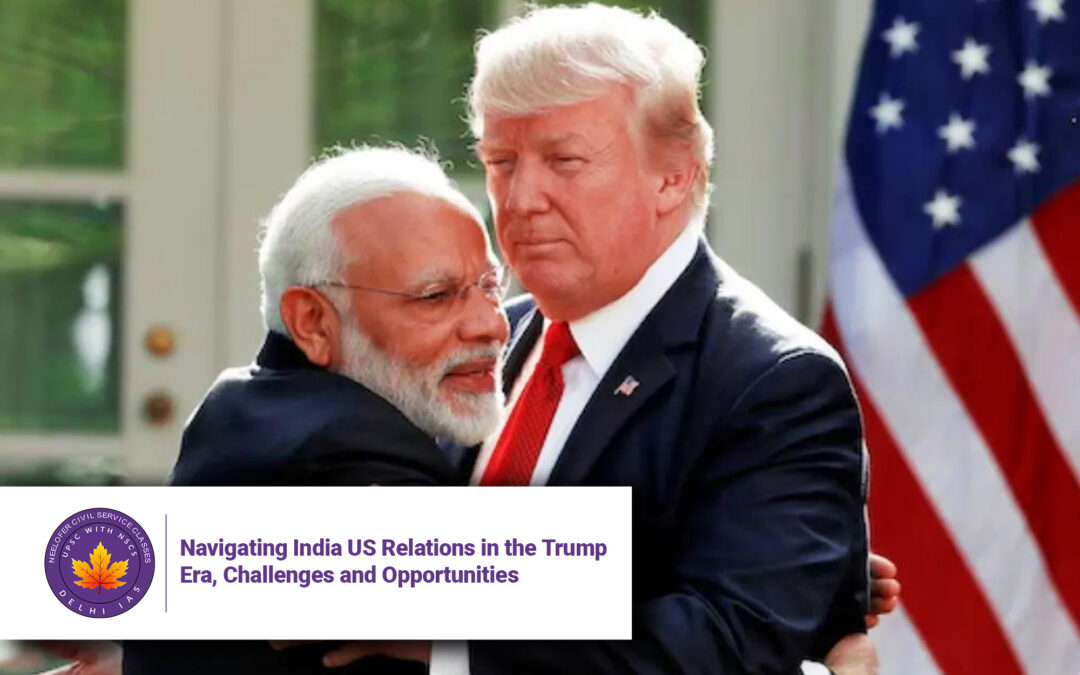
Navigating India US Relations in the Trump Era, Challenges and Opportunities
Why in News?
The India-US relationship, once hailed as a strategic partnership of the 21st century, is facing significant strain under the second term of President Donald Trump. Recent policy pronouncements, including punitive tariffs and demands for market access, have created friction in bilateral ties. However, the relationship is too critical to be derailed by short-term disagreements. With bilateral trade exceeding $131 billion, robust defense cooperation, and shared interests in Indo-Pacific security, both nations must navigate these challenges while preserving past gains and exploring new avenues for collaboration. This analysis examines the key issues, potential pathways, and broader implications for global geopolitics.
Introduction
The India-US relationship has evolved dramatically since the Cold War, transitioning from estrangement to engagement and, ultimately, to a strategic partnership. Foundations like the Civil Nuclear Agreement (2008) and defense pacts such as LEMOA (2016), COMCASA (2018), and BECA (2020) have strengthened ties. However, the Trump administration’s transactional approach to diplomacy, coupled with its “America First” agenda, has introduced new complexities. From trade imbalances to divergent views on multilateralism, the partnership is at a crossroads. Yet, the structural imperatives of countering China, ensuring regional stability, and fostering technological innovation necessitate continued cooperation. This analysis delves into the contours of this dynamic relationship, highlighting both tensions and opportunities.
Key Issues
1. Trade and Economic Relations
-
Volume and Imbalance: Bilateral trade reached $131.84 billion in 2024–25, with India enjoying a surplus of $41.18 billion. This surplus has drawn Trump’s ire, leading to threats of tariffs and demands for greater market access.
-
Sectoral Impacts:
-
MSMEs: Approximately 80% of India’s exports to the US are from MSMEs, which would be severely affected by tariffs.
-
Agriculture and Dairy: US demands for access to these sectors threaten the livelihoods of vulnerable Indian farmers.
-
Services: The US is a major destination for Indian IT services, with remittances from the diaspora accounting for 30% of India’s total remittances ($135 billion). Restrictions on work visas could disrupt this flow.
-
-
Student Visas: The number of F-1 visas for Indian students dropped by 44% in the first half of 2025, impacting both educational access and the US economy, which benefits from $12–17 billion annually spent by Indian students.
2. Defense and Security Cooperation
-
Foundational Agreements: Pacts like LEMOA, COMCASA, and BECA have enabled interoperability, intelligence sharing, and joint exercises. The recent Security of Supply Agreement (SOSA) and ongoing negotiations on Reciprocal Defense Procurement (RDP) aim to deepen defense industrial collaboration.
-
China Factor: The US views India as a critical counterweight to China in the Indo-Pacific. However, Trump’s expectations of alignment often clash with India’s commitment to strategic autonomy and its historical ties with Russia.
-
Military Hardware: India relies on US equipment to modernize its defense forces, especially as its domestic industry matures. Disruptions in supply could impair India’s capabilities.
3. Strategic Autonomy vs. Alignment
-
Multipolarity: India’s vision of a multipolar world contrasts with Trump’s insistence on US primacy. This divergence is evident in approaches to institutions like the UN and WTO.
-
Russia Relations: India’s purchase of Russian oil and military hardware remains a sticking point. While oil is fungible, legacy issues and strategic considerations make it difficult for India to sever ties with Moscow entirely.
-
Quad Dynamics: The Quadrilateral Security Dialogue (Quad) with the US, Japan, and Australia is central to Indo-Pacific stability. India’s recent naval exercises with the Philippines in the South China Sea signal its commitment to the grouping, but Trump’s unpredictability could test its cohesion.
4. Technology and Data Sovereignty
-
Initiatives: Programs like US-India COMPACT (Catalysing Opportunities for Military Partnering, Accelerated Commerce, and Technology) and TRUST (Transforming the Relationship Utilising Strategic Technology) aim to foster innovation. However, Trump’s techno-nationalism and US tech dominance challenge India’s digital sovereignty.
-
Data Localization: India’s data protection policies conflict with US corporate interests, creating another arena for negotiation.
5. Diplomatic Frictions
-
Pakistan Factor: Trump’s willingness to engage with Pakistan—including accepting its nomination for the Nobel Peace Prize—undermines India’s interests. However, US pressure on Pakistan during the Kargil War (1999) and recent ceasefire efforts shows that cooperation is possible.
-
Mediation vs. Facilitation: India rejects third-party mediation on Kashmir but appreciates facilitation through military channels, as seen in the May 2025 ceasefire.
Alternative Approaches
-
Negotiating a Trade Deal:
-
A limited trade agreement could address US concerns about market access while protecting India’s sensitive sectors. This would require compromises on both sides.
-
-
Strengthening Institutional Mechanisms:
-
Regular dialogues at the ministerial level can prevent misunderstandings and manage crises. The US-India Strategic Partnership Forum could play a mediating role.
-
-
Levering Middle Power Diplomacy:
-
India should engage with other middle powers (e.g., Japan, EU) to create coalitions that can influence US policy.
-
-
Focusing on Non-Controversial Areas:
-
Collaboration on climate change, health security, and space technology can build trust without triggering disputes.
-
Challenges and the Way Forward
-
Domestic Politics: Trump’s populist agenda and Modi’s focus on self-reliance (Atmanirbhar Bharat) constrain flexibility.
-
China’s Shadow: Beijing’s support for India’s strategic autonomy is designed to sow discord in the India-US relationship.
-
Global Uncertainty: The Ukraine war, energy volatility, and economic slowdown complicate bilateral coordination.
The Way Forward:
-
Dialogue Over Disengagement: Both sides must engage at the highest levels to preserve gains and explore new opportunities.
-
Balancing Autonomy and Partnership: India can maintain strategic autonomy while deepening cooperation with the US in areas of mutual interest.
-
Building Resilient Supply Chains: Collaborating on critical minerals, semiconductors, and pharmaceuticals can reduce dependencies on China.
-
Promoting People-to-People Ties: Encouraging student exchanges, tourism, and diaspora engagement can strengthen the foundation of the relationship.
Conclusion
The India-US relationship is too important to be held hostage to short-term tensions. While Trump’s policies have created challenges, the structural imperatives of geopolitics, economics, and security necessitate continued engagement. By focusing on common interests—countering China, ensuring Indo-Pacific stability, and fostering innovation—both nations can navigate this rough patch. As former Ambassador Sujan Chinoy notes, “A mutually acceptable trade deal could pave the way for an enduring partnership.” The path ahead requires pragmatism, patience, and a commitment to the broader strategic vision that has guided this partnership for decades.
5 MCQs Based on the Article
Q1. What was the approximate value of India-US bilateral trade in 2024–25?
A) $100 billion
B) $131.84 billion
C) $150 billion
D) $200 billion
Answer: B) $131.84 billion
Q2. Which sector accounts for 80% of India’s exports to the US?
A) Pharmaceuticals
B) IT Services
C) MSMEs
D) Agriculture
Answer: C) MSMEs
Q3. What was the percentage drop in F-1 visas for Indian students in the first half of 2025?
A) 30%
B) 44%
C) 50%
D) 60%
Answer: B) 44%
Q4. Which agreement is NOT part of the India-US defense foundational agreements?
A) LEMOA
B) COMCASA
C) BECA
D) NATO
Answer: D) NATO
Q5. What is India’s stance on third-party mediation in Kashmir?
A) Supports it
B) Rejects it
C) Ambivalent
D) Depends on the mediator
Answer: B) Rejects it

