
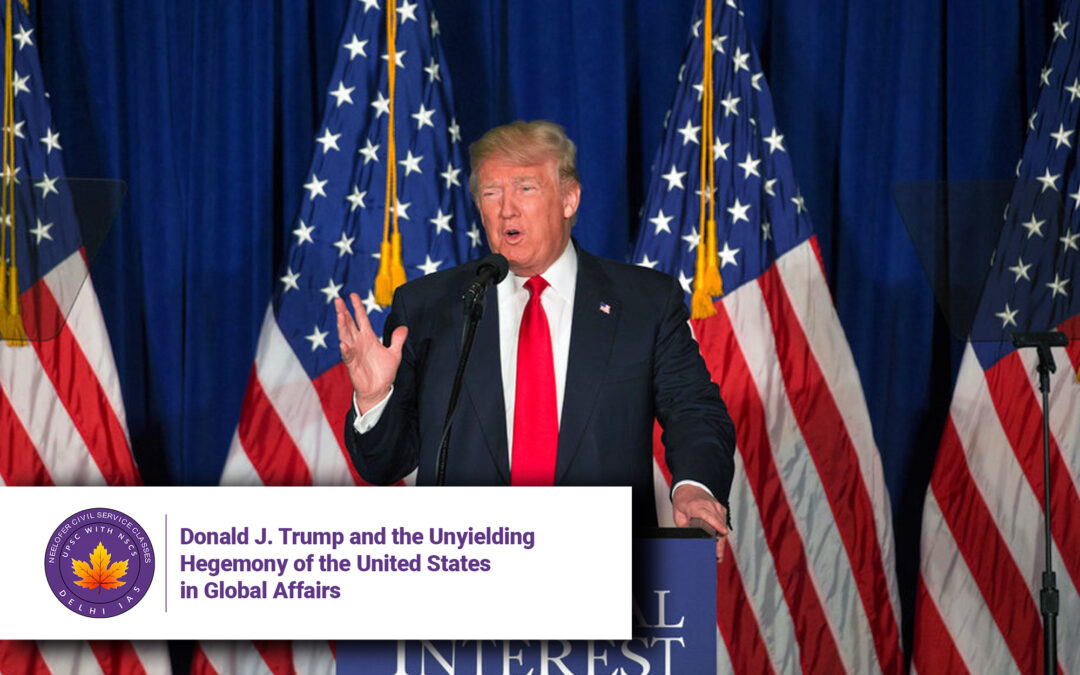
Donald J. Trump and the Unyielding Hegemony of the United States in Global Affairs
Why in News?
The resurgence of Donald J. Trump as the 47th President of the United States has reignited debates about America’s role in the world order. His unconventional diplomacy, assertive economic policies, and unapologetic pursuit of national interest have drawn both admiration and condemnation globally. Despite apocalyptic predictions about the decline of U.S. influence, Trump’s presidency underscores America’s enduring hegemony—militarily, economically, and diplomatically. From brokering ceasefires in conflict zones to recalibrating international trade rules, the U.S., under Trump, continues to shape global dynamics in ways that affirm its indispensability. This analysis examines the foundations of American power, the implications of Trump’s policies, and the future of U.S. leadership in a multipolar world.
Introduction
The concept of hegemony in international relations is often associated with the dominance of a single nation that possesses the economic, military, and ideological resources to influence global norms and institutions. For decades, the United States has played this role, anchoring the liberal international order through institutions like the United Nations, NATO, and the World Bank. However, the election of Donald Trump in 2016 and his return to power in 2024 have challenged conventional notions of leadership and soft power. His “America First” agenda, characterized by unilateralism, protectionism, and transactional diplomacy, has sparked fears of global instability. Yet, a closer look reveals that the U.S. remains the cornerstone of the international system, and Trump’s presidency, far from diminishing American influence, has reaffirmed its capacity to assert dominance when necessary. This analysis explores the paradox of Trump’s leadership: the tension between his disruptive tactics and the enduring reality of American hegemony.
Key Issues
1. The Theory of Hegemonic Stability
-
Foundations: The Hegemonic Stability Theory, pioneered by scholars like Charles Kindleberger, posits that a stable international system requires a dominant power to provide public goods such as security, economic stability, and rule-making. In the absence of a hegemon, the world risks descending into chaos, as seen during the interwar period (1918–1939).
-
Historical Precedents: The United Kingdom served as the hegemon in the 19th century, underpinning the gold standard and free trade. After World War II, the U.S. assumed this role, establishing the Bretton Woods system (1944) and promoting liberal democracy.
-
Trump’s Role: Despite his isolationist rhetoric, Trump’s actions—such as brokering ceasefires in the Middle East and engaging with rivals like Putin—demonstrate America’s continued commitment to hegemonic stability, albeit through unconventional means.
2. Military Dominance and Hard Power
-
Unmatched Capabilities: The U.S. military budget exceeds $800 billion annually, more than the next ten countries combined. Its arsenal includes advanced technologies like B-2 stealth bombers, aircraft carriers, and hypersonic missiles.
-
Strategic Interventions: Trump’s targeted strikes on Iranian nuclear facilities and his deployment of troops to conflict zones (e.g., Syria, Afghanistan) highlight the willingness to use hard power to protect national interests.
-
Deterrence and Diplomacy: The U.S. military presence in key regions (Asia-Pacific, Europe) deters aggression and enables diplomatic leverage, as seen in negotiations with North Korea and Russia.
3. Economic Hegemony
-
Size and Influence: The U.S. economy, valued at over $25 trillion, remains the largest in the world. The dollar’s status as the global reserve currency gives America unparalleled financial leverage.
-
Trade Policies: Trump’s tariffs on Chinese goods, renegotiation of NAFTA (now USMCA), and sanctions on adversarial nations (e.g., Iran, Russia) reflect the use of economic tools to enforce compliance.
-
Technology and Innovation: U.S. tech giants (Google, Apple, Amazon) dominate global markets, while American universities lead in research and development, attracting talent worldwide.
4. Soft Power and Ideological Leadership
-
Cultural Influence: Hollywood, music, and social media platforms propagate American values and lifestyles, shaping global perceptions.
-
Educational Appeal: Despite visa restrictions, U.S. universities continue to attract millions of international students, contributing $40 billion annually to the economy.
-
Democratic Ideals: Despite internal challenges, the U.S. remains a symbol of freedom and opportunity, inspiring movements for democracy and human rights globally.
5. Diplomatic Maneuvering
-
Unconventional Diplomacy: Trump’s direct engagements with adversaries (e.g., Kim Jong-un, Vladimir Putin) break with traditional diplomacy but often yield tangible outcomes, such as de-escalation in Korea and Middle East peace deals.
-
Alliance Management: While critical of NATO and other alliances, Trump’s pressure has spurred increased defense spending among partners, strengthening collective security.
-
Mediation in Conflicts: The U.S. played a key role in brokering ceasefires between India and Pakistan and mitigating tensions in the South China Sea.
6. Criticisms and Challenges
-
Erosion of Norms: Trump’s disregard for international institutions (e.g., WHO, Paris Agreement) and embrace of authoritarian leaders undermine democratic values.
-
Domestic Polarization: Political divisions within the U.S. weaken its moral authority and capacity to lead.
-
Rise of Challengers: China’s economic rise, Russia’s resurgence, and the assertiveness of regional powers (e.g., Iran, Turkey) test American hegemony.
Alternative Perspectives
-
Declinism vs. Resilience:
-
Declinists argue that America’s unipolar moment is over, citing the rise of China, internal strife, and strategic overreach.
-
Hegemonic Resilience proponents contend that the U.S. retains unique advantages—demographic vitality, energy independence, and institutional robustness—that ensure its longevity as the dominant power.
-
-
Trump as a Disruptor or Strategist:
-
Critics view Trump’s policies as erratic and short-sighted, damaging alliances and empowering rivals.
-
Supporters argue that his blunt tactics expose free-riding by allies and force a reckoning with unfair trade practices.
-
-
The Future of Multilateralism:
-
Reformists advocate for reforming international institutions to reflect contemporary power realities, giving greater voice to emerging economies.
-
Nationalists prioritize sovereignty over multilateralism, favoring bilateral deals and ad-hoc coalitions.
-
Challenges and the Way Forward
-
Sustaining Leadership: The U.S. must balance competition with cooperation, especially with China, to avoid a new Cold War.
-
Domestic Renewal: Investing in infrastructure, education, and technology is crucial to maintaining economic competitiveness.
-
Global Governance: The U.S. should lead efforts to address transnational challenges like climate change, pandemics, and cyber threats.
-
Ethical Leadership: Restoring faith in democracy and human rights is essential to retaining soft power.
The Way Forward:
-
Adaptive Hegemony: The U.S. should combine hard power with coalition-building, leveraging partnerships in Asia (Quad) and Europe (NATO).
-
Innovation and Influence: Investing in emerging technologies (AI, quantum computing) will ensure military and economic superiority.
-
Diplomatic Engagement: While pursuing national interest, the U.S. must reaffirm its commitment to global stability and rule-based order.
Conclusion
Donald Trump’s presidency exemplifies the paradox of American power: even as it faces unprecedented challenges, the U.S. remains the indispensable nation. Its military might, economic prowess, and cultural appeal continue to anchor the international system. Trump’s disruptive style may fray alliances and norms, but it also underscores America’s capacity to shape outcomes unilaterally when necessary. The future of U.S. hegemony will depend on its ability to adapt to a changing world—balancing assertiveness with diplomacy, competition with cooperation, and national interest with global responsibility. As the true hegemon, America is both loved and hated, but it cannot be ignored.
5 MCQs Based on the Article
Q1. What theory explains the need for a dominant power to ensure global stability?
A) Dependency Theory
B) Hegemonic Stability Theory
C) Realism
D) Constructivism
Answer: B) Hegemonic Stability Theory
Q2. Which historical event led to the U.S. assuming hegemonic leadership after World War II?
A) The Treaty of Versailles
B) The Bretton Woods Conference
C) The Yalta Conference
D) The Suez Crisis
Answer: B) The Bretton Woods Conference
Q3. What is a key tool of U.S. economic hegemony mentioned in the article?
A) The euro as a reserve currency
B) Tariffs on allied nations
C) The dollar’s status as the global reserve currency
D) Nationalization of industries
Answer: C) The dollar’s status as the global reserve currency
Q4. How does the article characterize Trump’s diplomatic style?
A) Multilateral and institutional
B) Unconventional and transactional
C) Isolationist and pacifist
D) Ideological and rigid
Answer: B) Unconventional and transactional
Q5. What is a major challenge to U.S. hegemony cited in the article?
A) Decline in military spending
B) The rise of China
C) Overreliance on soft power
D) Lack of natural resources
Answer: B) The rise of China

