
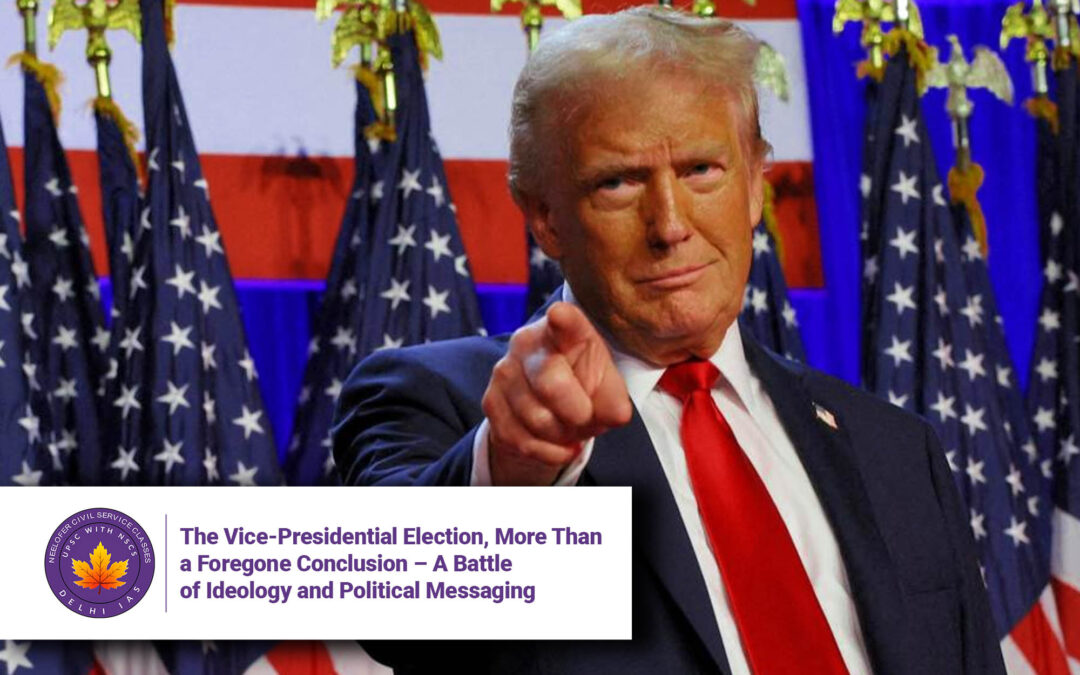
The Vice-Presidential Election, More Than a Foregone Conclusion – A Battle of Ideology and Political Messaging
In the grand theatre of Indian politics, few events are as ceremonially significant yet politically predetermined as the election of the Vice-President of India. Unlike the Lok Sabha battles that hinge on the unpredictable will of millions, the VP election is a cold, calculated numbers game played out in the electoral college comprising members of both Houses of Parliament. The outcome is almost always a foregone conclusion, dictated by the arithmetic of the ruling alliance in the central legislature.
The upcoming election, necessitated by the abrupt and intriguing resignation of Jagdeep Dhankhar on July 21, 2025, is no exception. The BJP-led National Democratic Alliance (NDA), with its clear majority, has nominated its candidate, C.P. Radhakrishnan. The Congress-led Opposition INDIA bloc has put forth its contender, retired Supreme Court Justice B. Sudershan Reddy. The numbers are unequivocally in the NDA’s favour. Yet, to dismiss this as a mere procedural formality would be to profoundly misread the high-stakes political and ideological contest that is unfolding. This election is not about securing a victory—the NDA has already done that. It is about sending a message, scoring political points, and laying the groundwork for future battles, particularly the impending State Assembly elections. It is a symbolic war where the trophy is less important than the statement it makes.
The Contenders: A Study in Contrasting Profiles
The choice of candidates by both alliances is a deliberate and telling act of political communication, revealing their core priorities and ideological compass.
C.P. Radhakrishnan: The Ideological Purist
The NDA’s candidate, C.P. Radhakrishnan, is a veteran Rashtriya Swayamsevak Sangh (RSS) activist from Tamil Nadu. His political credentials include two terms as a Member of Parliament from 1998 to 2004, and he currently holds the constitutional post of Governor of Maharashtra. However, his most significant attribute, and the one the BJP is keen to highlight, is his lifelong, unwavering commitment to the Hindutva ideology and the Sangh Parivar.
His nomination is a stark ideological statement. It signals a return to a purist, hardline approach after the tenure of Jagdeep Dhankhar, who was perceived as a late entrant to the Sangh fold and never quite managed to fully integrate into its core ethos. By elevating a lifelong swayamsevak to the second-highest constitutional office in the country, the BJP is performing a powerful act of solidarity with its ideological “mother ship,” the RSS. It reinforces the message that state power, which the BJP controls, is being wielded in a systematic and effective manner to advance the Hindutva project. Radhakrishnan’s candidacy is a reward for ideological fidelity and a signal to the party’s base that its core values occupy the highest offices of the land.
Justice B. Sudershan Reddy: The Institutional Counterweight
In response, the INDIA bloc has chosen a candidate designed to present a sharp contrast: Retired Supreme Court Justice B. Sudershan Reddy. Hailing from undivided Andhra Pradesh, Justice Reddy represents a figure of institutional integrity and legal scholarship. His recent role adds significant weight to his candidacy: he headed the 11-member independent expert working group that analysed the vast data from the Telangana Congress government’s pioneering Socio, Economic, Education, Employment, Political and Caste (SEEEPC) Survey 2024.
The Opposition’s choice is a multi-layered strategic move. Firstly, it is an assertion of resistance against the hegemony of the Sangh Parivar. By nominating a respected jurist, the INDIA bloc positions itself as the guardian of constitutional propriety and institutional independence, standing in opposition to the politically committed ideologue. Secondly, it is a direct appeal to the social justice plank. Justice Reddy’s association with the monumental caste survey directly ties him to the Opposition’s core slogan of conducting a nationwide caste census, a potent political weapon aimed at consolidating OBC and marginalized community votes. His candidacy is meant to amplify this message on a national stage.
The Number Game and Regional Political Calculus
While the national outcome is certain, the election has triggered a fascinating ripple effect in regional politics, particularly in the southern states of Andhra Pradesh and Tamil Nadu.
Andhra Pradesh and Telangana: A Game of Alignments
The election has forced regional parties to reveal their cards. The YSR Congress Party (YSRCP), locked in a bitter and existential rivalry with the NDA’s partner, the Telugu Desam Party (TDP), in Andhra Pradesh, has intriguingly pledged its support to the NDA’s Radhakrishnan. This move is likely a pragmatic calculation to maintain a working relationship with the central government, despite state-level antagonisms.
Conversely, Justice Reddy’s candidacy has ignited regional pride in both Andhra Pradesh and Telangana. The INDIA bloc is leveraging this sentiment to put pressure on parties like the Bharat Rashtra Samithi (BRS) and to galvanize its own base, using the candidacy of a distinguished native son as a rallying point for a broader anti-BJP front.
Tamil Nadu: A Defensive Play for the NDA
In Tamil Nadu, the BJP has long struggled to make significant inroads against the powerful Dravidian parties, the DMK (an INDIA bloc member) and the AIADMK. Mr. Radhakrishnan’s nomination from the state is a clear attempt to gain some political mileage and legitimacy in Tamil Nadu ahead of the crucial State Assembly election. The BJP hopes that having a Tamilian in the Vice-President’s office will help soften its image as a North Indian-Hindi belt party and provide a talking point for its campaign.
However, this move has also provided an opportunity for the INDIA bloc. The DMK has successfully pushed back against the NDA’s narrative, using the election to reinforce its own Dravidian identity politics and portray the BJP’s outreach as opportunistic. The VP election has thus become a proxy war, setting the tone for the much larger electoral battle to come in the state.
The Larger Implications: Office of the Vice-President and Democratic Health
Beyond the immediate political skirmishing, this election raises important questions about the role of the Vice-President and the health of India’s democratic institutions.
The Vice-President serves as the ex-officio Chairman of the Rajya Sabha, the Council of States. This role requires immense impartiality, a deep understanding of parliamentary procedure, and a commitment to fostering reasoned debate while ensuring the rights of both the treasury and opposition benches. The Chairman is the guardian of the house’s dignity.
The choice of a deeply ideological political figure for this role, as opposed to a more neutral institutional personality, signals a potential shift in how this office is viewed. It risks further politicizing a position that traditionally, though not always, has been seen as above the fray. The concern is whether an ideologically committed Chairman can effectively manage a fractious and opposition-heavy Rajya Sabha with the necessary fairness, or whether the government is prioritizing ideological alignment over institutional decorum and bipartisan respect.
For the opposition, this election is a critical test of unity. It is a chance for the INDIA bloc to demonstrate cohesion, rally around a common symbol of resistance, and use the platform to articulate a coherent alternative vision for the country. A strong, unified show of strength in the voting, even in a lost cause, can provide much-needed momentum for the larger battles ahead.
Conclusion: The Symbolism of a Certain Outcome
The election of C.P. Radhakrishnan as the next Vice-President of India is a near certainty. The NDA’s numbers, bolstered by support from parties like the YSRCP and a drive to woo unattached MPs, are insurmountable.
But the true significance of this election lies not in its result, but in its campaign. It is a condensed, high-voltage preview of the key themes that will define Indian politics in the coming years: Ideology vs. Institutionalism; Hindutva consolidation vs. Social Justice consolidation; central power vs. regional identity.
The BJP is using its victory to tighten its ideological grip on the highest echelons of the state and to make inroads in the South. The Opposition is using its defeat to solidify its narrative, champion its core issues, and present itself as a united front defending constitutional values. In the end, the Vice-Presidential election is a battle of narratives where both sides are fighting for a prize much larger than the office itself: the soul of the Indian electorate.
Q&A Section
1. Q: Since the ruling alliance always has the numbers to win, why do opposition parties even bother putting up a candidate?
A: Opposition parties contest despite the predictable outcome for several crucial reasons:
-
Political Messaging: It provides a powerful, nationally televised platform to articulate an alternative vision and critique the ruling party’s ideology and policies.
-
Testing Unity: It serves as a litmus test for the cohesion and discipline of the opposition alliance. A unified vote demonstrates strength and organizational capability to their supporters and the public.
-
Setting the Agenda: The campaign allows the opposition to bring its key issues (e.g., social justice, caste census, institutional integrity) to the forefront of national discourse.
-
Moral Stand: It is a symbolic act of resistance, showing their constituents that they are willing to fight every battle, even unwinnable ones, on principle.
2. Q: What is the significance of the Vice-President’s role as Chairman of the Rajya Sabha?
A: The role is critically important for India’s democracy. The Chairman:
-
Controls Proceedings: They regulate the business of the house, decide who gets to speak, and maintain order and decorum during debates.
-
Upholds Rights: They are the guardian of the rights and privileges of all members, ensuring the opposition has a fair chance to question the government and hold it accountable.
-
Cast a Vote: The Chairman has a casting vote in the case of a tie, which can be decisive on important legislation.
-
Symbol of Impartiality: Ideally, the Chairman operates above party politics, ensuring the smooth functioning of the upper house as a deliberative body.
3. Q: Why did the YSRCP, which opposes the NDA’s ally TDP in Andhra, support the NDA’s candidate?
A: This is a classic example of pragmatic politics trumping ideological alignment. The YSRCP’s support for the NDA candidate is likely driven by:
-
Pragmatic Central Relations: Despite state-level rivalry, maintaining a working relationship with the central government is advantageous for securing funds, projects, and avoiding political harassment from central agencies.
-
Isolating the TDP: By supporting the NDA directly, the YSRCP may be attempting to drive a wedge between the BJP and its ally, the TDP, or to gain favour with the BJP at the TDP’s expense.
-
Party Interests: It is a calculation that aligning with the winning side on a national issue serves their long-term interests better than siding with the opposition.
4. Q: How does a caste survey, which Justice Reddy was involved with, become a central issue in this election?
A: The demand for a nationwide caste census is arguably the principal agenda around which the opposition hopes to consolidate its OBC and Dalit vote bank. By fielding a candidate who chaired the analysis of a major state-level survey (Telangana’s SEEEPC), the INDIA bloc is:
-
Credibility: Leveraging Justice Reddy’s credentials to lend expert legitimacy to their demand.
-
Symbolism: Making him a living symbol of their commitment to the cause.
-
Amplification: Using the vice-presidential campaign as a megaphone to broadcast the “social justice” message to a national audience, far beyond the confines of a state election.
5. Q: What does Jagdeep Dhankhar’s “abrupt and intriguing” resignation suggest about the office?
A: While the specific reasons are undisclosed, such a resignation fuels speculation and analysis:
-
Pre-Planned Move: It suggests the resignation was not spontaneous but a calculated political move, possibly to open the door for a more ideologically aligned candidate ahead of key political cycles.
-
Undermining the Office: The abruptness can be seen as diminishing the dignity of the office, treating it as a political pawn to be vacated at the convenience of the ruling party rather than as a stable constitutional post.
-
Lack of Transparency: The “intriguing” nature points to a lack of transparency, which can erode public trust in the stability and neutrality of high constitutional offices.
