
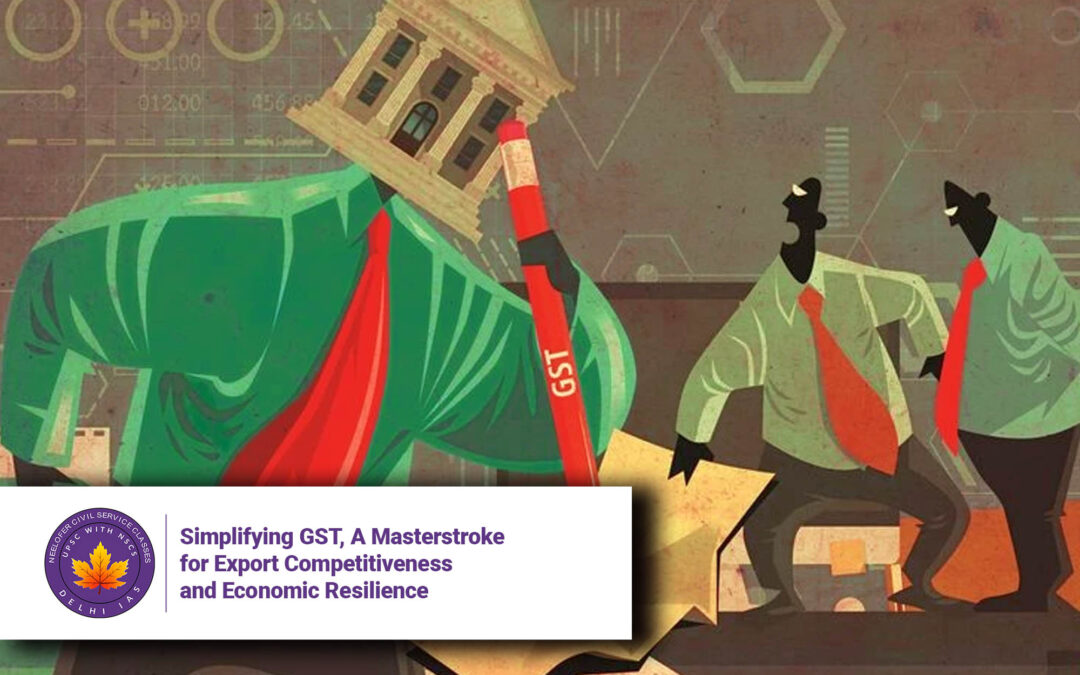
Simplifying GST, A Masterstroke for Export Competitiveness and Economic Resilience
In a move that has sparked widespread discussion among economists and industrialists, Prime Minister Narendra Modi has proposed a landmark reform to India’s Goods and Services Tax (GST) regime. The proposition is to simplify the current multi-tiered structure into a streamlined two-rate system, a shift poised to recalibrate the nation’s economic trajectory. This reform, far from being a mere fiscal adjustment, is a strategic intervention designed to bolster export competitiveness, stimulate domestic consumption, and fortify the Indian economy against global headwinds, such as the trade disruptions anticipated from potential Trump-era tariffs.
The existing GST framework, with its four primary slabs of 5%, 12%, 18%, and 28%, alongside special rates for precious metals and a cess on “sin goods,” has often been criticized for its complexity. While it was a monumental achievement in federal tax cooperation, its multi-layered nature has led to operational inefficiencies, classification disputes, and unintended cascading of taxes due to issues like the inverted duty structure. The proposed simplification to two main rates—5% and 18%—aligns India with best practices observed in developed nations like Australia, Canada, New Zealand, and Japan, which typically employ a single, standard rate.
This overhaul is not just about simplification; it’s about stimulus. By lowering the tax burden on a wide range of goods and services, the government aims to put more money in the hands of consumers, thereby boosting demand. This increased consumption has a multiplier effect, stimulating production, creating jobs, and fostering a virtuous cycle of economic growth. The proposal specifically targets key sectors including textiles and apparel, agricultural machinery, automotive components, healthcare, insurance, and Fast-Moving Consumer Goods (FMCG)—all critical for job creation and everyday household budgets.
The Textile Conundrum: Unravelling the Inverted Duty Knot
The Indian textile and apparel industry stands as a testament to the nation’s manufacturing prowess and cultural heritage. As the largest producer of cotton globally, this sector is a cornerstone of the economy, employing approximately 40 million people and contributing significantly to exports. However, its potential has been hamstrung by the current GST structure.
Currently, apparel items priced below ₹1,000 attract a 5% GST, while those above are taxed at 12%. While these rates seem low, the devil lies in the details of the inverted duty structure (IDS). An IDS occurs when the tax rate on inputs (raw materials and services) is higher than the tax rate on the final output. For textile manufacturers, this is a crippling reality.
Manufacturers invest heavily in value-added services (VAS) essential for modern business: marketing, warehousing, logistics, courier services, and payment gateways. These services attract an average GST rate of 18%. However, the final garment is taxed at only 5% or 12%. This inversion creates a problem: the manufacturer pays more GST on inputs than he can collect on outputs, leading to an accumulation of Input Tax Credit (ITC). While this ITC is technically eligible for a refund, the process is notoriously slow, cumbersome, and often subject to bureaucratic delays.
As the detailed table in the source material illustrates, for a product selling for ₹1,200 (12% GST), the GST on various input services (marketing, logistics, etc.) amounts to a significant sum. The inability to claim a swift and full refund on this higher input tax effectively becomes an additional cost of doing business. This cost, estimated to increase the net sale price by up to 7-8%, is inevitably passed on to the buyer, rendering Indian apparel less competitive in the cut-throat international market.
Although the government introduced the Rebate of State and Central Taxes and Levies (RoSCTL) scheme in March 2019 to address this refund issue, industry players consistently report challenges due to a lack of coordination between the Ministry of Finance and the Ministry of Textiles. Delays lead to blocked working capital, interest costs, and a severe liquidity crunch, particularly for MSMEs that dominate the sector. A simplified two-rate structure, ideally with a lower rate on these crucial input services, would largely eliminate this inversion, freeing up capital and slashing production costs overnight.
The Automotive Component Sector: Driving Against the Wind
The story of GST-induced challenges is echoed in the manufacturing of aluminium automotive components. Here, the problem is twofold: high input costs and a prohibitive tax rate on the final product.
To protect domestic primary aluminium producers, the government imposes a customs duty exceeding 7.5% on raw aluminium imports. With additional duties, the total import levy can cross 10%. This policy, while aimed at import substitution, inadvertently penalizes downstream manufacturers who use aluminium to make finished goods like automotive parts and agricultural machinery. It raises their raw material costs compared to international competitors.
Compounding this issue is the GST rate on the final aluminium automotive products, which is placed in the highest slab of 28%. This exorbitant rate drastically squeezes the trade margins for manufacturers. The high cost structure makes their business unsustainable not only in the export market but even within the domestic market, where they struggle to compete with cheaper imports.
The contrast with China is stark and revealing. Chinese manufacturers of similar final aluminium products receive substantial government subsidies, estimated at around 16%. This state support allows them to price their goods aggressively, dominating global markets and outcompeting Indian firms that receive no such direct fiscal support. The proposed GST reduction to a top rate of 18% would be a significant step towards levelling the playing field, reducing the cost burden on domestic manufacturers and enhancing their viability both at home and abroad.
The Ripple Effects: Insurance, FMCG, and The Common Citizen
The benefits of GST simplification extend far beyond manufacturing and exports. The health insurance sector, for instance, currently attracts an 18% GST rate. For a country where an estimated 40 crore Indians lack any form of health coverage, this rate is a significant barrier to adoption. Lowering this rate would make health insurance premiums more affordable, encouraging millions of middle-class and lower-income families to secure financial protection against medical emergencies. This would not only provide social security but also reduce the out-of-pocket healthcare expenditure that pushes many into poverty.
Similarly, the FMCG and retail sectors, which comprise items of daily consumption, are poised for a boost. A reduction in GST rates on these goods would directly translate into lower prices on supermarket shelves. For a population sensitive to price changes, this effective increase in disposable income will stimulate demand, drive volume growth for companies, and create a positive feedback loop in the economy. The simplified compliance associated with a two-rate system would also reduce the administrative burden on countless small retailers and businesses, allowing them to focus on growth rather than navigating complex tax filings.
A Strategic Counter to Global Turbulence
The timing of this proposed reform is particularly astute. The global trade environment is bracing for potential volatility, with the possibility of a returning Trump administration in the US threatening a new wave of protectionist tariffs. In such a scenario, enhancing domestic cost competitiveness is not just beneficial—it is essential for survival.
A lower and simpler GST structure will act as a powerful counter-tariff measure. By reducing the embedded tax cost in Indian products, it will make them more attractive in international markets. This strategic fiscal dexterity will help Indian exporters navigate turbulent global trade waters, safeguard the millions of jobs dependent on exports, and position India as a reliable and competitive alternative in global supply chains.
Conclusion: From Complex Compliance to Competitive Edge
The proposal to simplify GST is a visionary step towards realizing India’s ambition of becoming a global manufacturing hub and an economic powerhouse. It addresses long-standing grievances of industries plagued by inverted duty structures and high compliance costs. It promises relief to the common citizen by making essential goods and services more affordable. Most importantly, it enhances the innate competitiveness of “Made in India” products on the world stage.
While the final decision rests with the GST Council, and the journey to consensus among states may require nuanced negotiation, the direction is unequivocally positive. This reform has the potential to unlock investment, spur job creation, and build a more resilient, efficient, and equitable tax system that fuels India’s growth for decades to come. It is a testament to the evolving nature of the GST regime, learning from its initial complexities and maturing into a powerful tool for economic transformation.
Q&A Section
1. Q: What exactly is an “inverted duty structure” (IDS) and why is it so harmful?
A: An inverted duty structure (IDS) occurs when the tax rate on inputs (raw materials and services needed to manufacture a product) is higher than the tax rate on the final output (the finished product). This is harmful because it creates a situation where a manufacturer pays more GST on their purchases than they collect on their sales. This leads to an accumulation of Input Tax Credit (ITC), which they must then apply for as a refund from the government. The refund process can be slow, blocking the company’s working capital, increasing borrowing costs, and effectively adding to the overall cost of production. This makes the final product more expensive and less competitive.
2. Q: The article mentions that a two-tier GST system could help counter “Trump tariffs.” What does this mean?
A: “Trump tariffs” refer to the high import duties imposed on goods from various countries, including potentially India, during the previous Trump administration. If such tariffs are reinstated, Indian exporters would find their products becoming more expensive for American buyers. A simplified and lower GST structure acts as an internal counter-measure by reducing the production cost of Indian goods before they are exported. This lower base cost allows Indian exporters to absorb some of the impact of foreign tariffs or price their products more competitively despite them, helping to maintain their market share.
3. Q: How would a lower GST on health insurance help the average Indian family and the economy?
A: A lower GST on health insurance premiums (currently 18%) would make them more affordable, encouraging more families to buy coverage. This has a dual benefit:
-
For Families: It provides financial security against medical emergencies, preventing them from falling into debt or poverty due to high out-of-pocket hospital expenses.
-
For the Economy: It reduces the burden on public healthcare systems. It also fosters a larger private health insurance market, creating jobs and making the overall healthcare ecosystem more robust and efficient.
4. Q: Besides tax rates, what other benefits would a two-slab system bring to businesses?
A: The benefits extend beyond just the tax liability:
-
Simplified Compliance: With only two main rates, classifying products and filing returns becomes much simpler and less prone to errors and litigation. This reduces the administrative burden and costs for businesses, especially SMEs.
-
Reduced Logistics Costs: A simpler tax structure minimizes the need for complex warehousing strategies built around tax rates (e.g., storing goods in different states for tax advantages), leading to more efficient logistics and supply chains.
-
Easier Input Tax Credit Claims: A less complex system ensures smoother flow and utilization of Input Tax Credit, improving business liquidity.
5. Q: The aluminium components example shows a problem with high customs duties on raw materials. Wouldn’t lowering these duties be a better solution than changing GST?
A: This is a classic policy dilemma. Lowering customs duties on raw aluminium would indeed help component manufacturers by reducing their input costs. However, the government also has an objective to protect domestic primary aluminium producers from cheap imports. Therefore, a holistic approach is needed. While a review of customs duties is always an option, reforming the GST is a powerful complementary tool. By reducing the high 28% GST on finished components, the government can directly alleviate the cost pressure on manufacturers without immediately undermining its policy of protecting the upstream primary metal industry. It offers a more politically feasible and targeted solution to support the downstream value-added manufacturing sector.

