
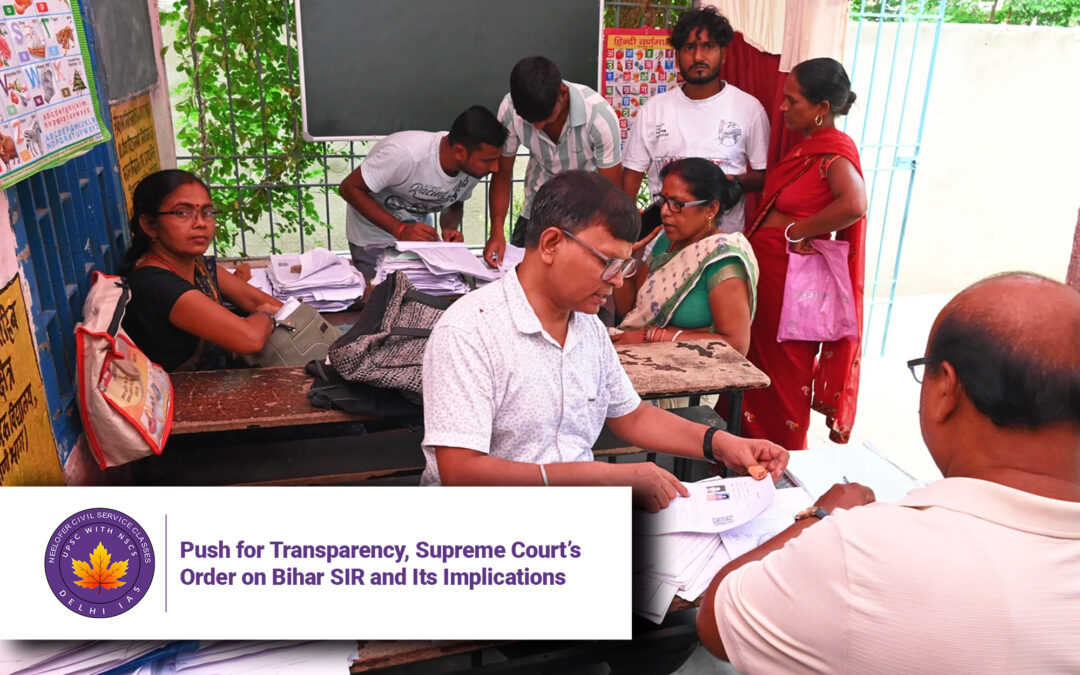
Push for Transparency, Supreme Court’s Order on Bihar SIR and Its Implications
Why in News?
On August 14, the Supreme Court of India issued an interim order directing the Election Commission of India (ECI) to publish a searchable online list of approximately 65 lakh voter names that were omitted from the draft electoral rolls in Bihar. These deletions were made under the ongoing Special Intensive Revision (SIR) process, citing reasons such as death, migration, or duplication. The Court’s order emphasized transparency and accountability in the electoral process, particularly as Bihar heads into elections in November.
Introduction
The integrity of the electoral roll is fundamental to the functioning of Indian democracy. With Bihar preparing for polls, the Election Commission launched a Special Intensive Revision (SIR) to ensure accuracy in the state’s voter list. However, the exclusion of nearly 65 lakh names raised serious concerns among political parties, civil society groups, and affected citizens. Many feared arbitrary deletions, misuse of data, and violations of privacy rights.
The Supreme Court’s interim order attempts to strike a balance between the ECI’s responsibility to maintain credible rolls and the citizens’ fundamental right to vote. By mandating the publication of a searchable database of deleted names along with reasons for deletion, the Court has reinforced the principle of transparency in electoral governance.
This article explores the background of the case, challenges to the SIR, the SC’s directions, and their broader implications for democracy, privacy, and voter rights.
Background: The Bihar SIR
Ahead of the upcoming state polls in November, the ECI initiated the Special Intensive Revision (SIR) in Bihar to clean up electoral rolls. This decision stemmed from demographic changes observed over the past two decades, which resulted in repeated entries in voter lists. The ECI argued that the situation necessitated a thorough verification drive to ensure that every listed voter was genuine.
The exercise aimed to identify ineligible voters and remove duplications. It also tested the inclusion of Aadhaar as a supporting document for voter identity and residence. However, this move sparked heated debates. Civil rights groups argued that Aadhaar, originally designed for welfare schemes, should not become a mandatory criterion for voting rights.
Challenge to SIR
Petitions were filed against the SIR, challenging both its substantive and procedural validity.
-
Substantive Grounds – Critics questioned whether the ECI even had the power to conduct such a massive exercise without explicit parliamentary sanction. Was the SIR legally sustainable, or did it go beyond the scope of the Representation of the People Act?
-
Procedural Grounds – Questions were raised about the methodology of the revision process. For example:
-
Could the ECI demand documents like Aadhaar to prove “citizenship”?
-
Was the 2003 voter list a valid reference point?
-
Would Aadhaar be recognized as a valid proof of identity and residence for inclusion in voter rolls?
-
The Supreme Court, while allowing the process to continue, made it clear that these deeper legal questions remain open for adjudication in the future.
SC’s Interim Order
The Supreme Court observed that citizens have a fundamental right to know whether their names have been included or deleted from the electoral rolls. The Court emphasized that transparency in the SIR process was necessary to give comfort to citizens and avoid a crisis of trust.
Key Directions of the Court:
-
Searchable List of Deletions – The Court directed the ECI to publish booth-wise lists of deleted names, searchable by EPIC number, along with reasons for deletion.
-
Transparency in Procedure – These lists must be displayed at Panchayat Bhavans, Block Development Offices, and other local notice boards.
-
Citizen Remedies – Individuals whose names were deleted could submit Form 6 (the ECI’s voter registration form) by September 1, to seek re-enrollment.
-
Use of Aadhaar – While the Court allowed citizens to submit Aadhaar as proof of identity and residence, it refrained from making Aadhaar compulsory, noting that the matter would be addressed later.
-
Protection Against Arbitrary Action – The Court noted that while the ECI has powers for preliminary voter verification, these powers must be exercised in a reasonable manner without infringing upon citizens’ rights.
Recourse after Deletion
According to the ECI, out of the 65 lakh individuals excluded, around 22 lakh were confirmed deceased. The remaining deletions were attributed to duplication, migration, or data mismatches.
For those wrongly excluded, the Court clarified the following:
-
They can file Form 6 to re-register as voters.
-
Aadhaar can be submitted as proof, though its acceptance as a definitive identity/residence document remains a legal question.
-
Electoral Registration Officers (EROs) must verify the information in Form 6 and add the applicant to the voter roll if found eligible.
This recourse aims to prevent disenfranchisement and ensures that no legitimate voter is permanently excluded due to administrative errors.
Transparency vs. Privacy Concerns
While the Court leaned toward transparency, privacy concerns remain significant. Critics argue that publishing such a massive dataset—65 lakh names with reasons for deletion—could expose personal information. There are fears that political parties might misuse this data for targeted campaigns.
The ECI, too, expressed apprehensions that publishing deletions could violate privacy rights. Yet, the Court balanced these concerns by recognizing that the citizen’s right to know outweighs speculative risks, especially when fundamental voting rights are at stake.
Political and Social Impact
The SIR has become a politically sensitive issue in Bihar. With 7.9 crore total voters, the exclusion of 65 lakh names is substantial and could potentially influence electoral outcomes. Political parties are wary of large-scale exclusions disproportionately affecting certain communities.
Civil society groups have welcomed the Court’s intervention but remain cautious about the implications of Aadhaar linkage. They fear that using Aadhaar for voter verification may create systemic biases, disenfranchising marginalized groups who may lack documentation.
Challenges and the Way Forward
-
Legal Clarity – The SC has left the larger question of the ECI’s powers to conduct such extensive revisions open. This uncertainty may fuel future litigation.
-
Aadhaar Debate – Whether Aadhaar can serve as a mandatory proof for voting remains unresolved. The issue will likely reach a constitutional bench.
-
Data Security – Protecting sensitive voter information from misuse remains a challenge. Strong safeguards are needed.
-
Voter Awareness – Citizens must be made aware of their rights, deadlines for re-enrollment, and the grievance redressal mechanism.
-
Political Accountability – The SIR’s impact on constituencies must be carefully monitored to prevent voter suppression.
Conclusion
The Supreme Court’s interim order on the Bihar SIR underscores a crucial principle: transparency is the foundation of electoral democracy. By mandating a public, searchable list of deletions, the Court has empowered citizens to hold the Election Commission accountable. At the same time, it has left the door open for deeper legal debates on Aadhaar, privacy, and the scope of the ECI’s powers.
As Bihar prepares for elections, the success of the SIR will depend on how effectively the ECI implements the Court’s directives, safeguards citizen rights, and ensures that no legitimate voter is disenfranchised.
Q&A Section
Q1. What is the Bihar Special Intensive Revision (SIR)?
The SIR is a voter list verification exercise launched by the Election Commission of India ahead of the Bihar elections. It seeks to update the electoral rolls by removing duplications, deceased voters, and migrants, while verifying existing entries.
Q2. Why did the Supreme Court intervene in the SIR process?
The SC intervened after petitions challenged the legality and fairness of the SIR. Concerns were raised about arbitrary deletions, lack of transparency, and potential misuse of Aadhaar. The Court ordered the publication of a searchable list of deletions to ensure citizen oversight.
Q3. How can a voter whose name has been deleted get re-enrolled?
Such voters can file Form 6 before the deadline (September 1) with proof of identity and residence. Aadhaar may be used as proof, but its final status as valid identity for voting is still under judicial consideration.
Q4. What are the main concerns regarding Aadhaar in voter verification?
Critics argue that Aadhaar was designed for welfare delivery, not voting. Using it for electoral purposes may disenfranchise marginalized groups and raise privacy risks. The Supreme Court has yet to decide if Aadhaar can be a mandatory requirement for voter rolls.
Q5. What is the broader significance of the SC’s order?
The order strengthens electoral transparency, ensures citizens’ right to know about deletions, and provides remedies for wrongful exclusions. It also highlights ongoing constitutional debates on privacy, Aadhaar, and the powers of the ECI.

