
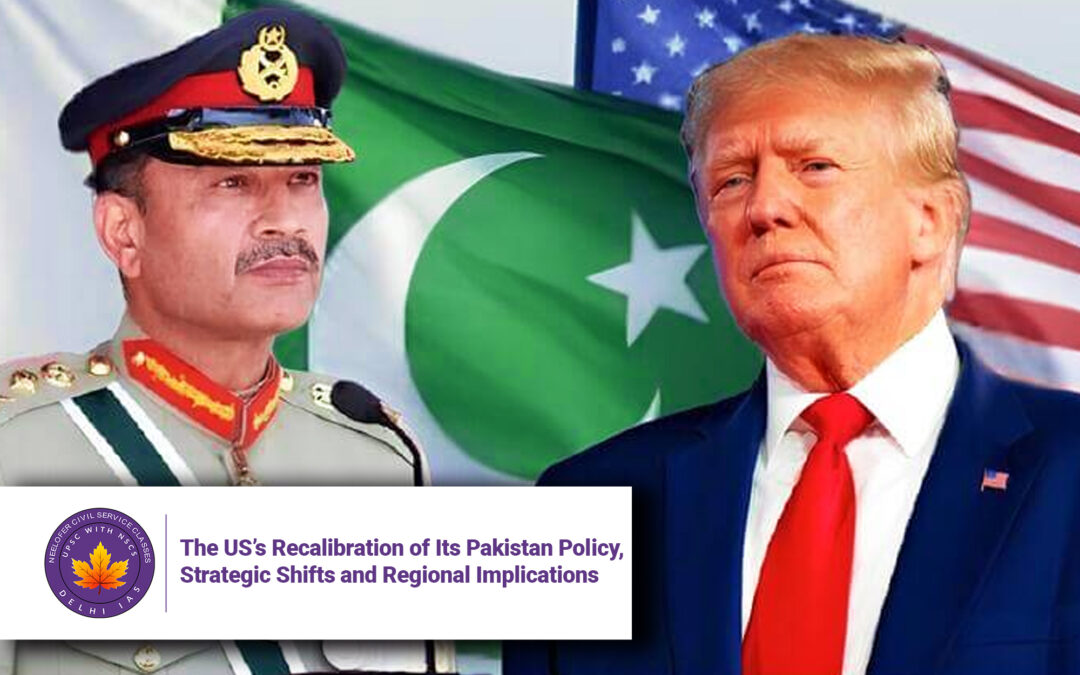
The US’s Recalibration of Its Pakistan Policy, Strategic Shifts and Regional Implications
Introduction
US–Pakistan relations have always been a mixture of cooperation, mistrust, and strategic convenience. For decades, Washington and Islamabad have oscillated between being close allies and reluctant partners, depending on shifting geopolitical needs. After a sharp downturn during Donald Trump’s presidency — when Trump publicly accused Pakistan of giving the US “nothing but lies and deceit” in return for billions of dollars in aid — the two countries now appear to be undergoing a strategic realignment.
Recent developments, including high-level visits, diplomatic gestures, and policy moves by the US, signal a recalibration of its approach towards Pakistan. This shift is taking place in a complex regional environment, where India–Pakistan relations remain tense, Afghanistan continues to be unstable, and China’s presence in South Asia is growing.
Background: The Trump Era Low Point
In January 2018, then-President Donald Trump triggered a diplomatic storm by accusing Pakistan of harbouring terrorists and failing to act decisively against militant groups despite receiving substantial US aid. He claimed Pakistan had given Washington “nothing but lies and deceit” in exchange for billions of dollars.
Following this accusation, US aid to Pakistan was significantly reduced, military cooperation cooled, and the relationship slipped into one of the lowest phases in recent decades.
At that time:
-
The US was frustrated by Pakistan’s perceived lack of cooperation in tackling the Afghan Taliban and Haqqani Network.
-
Pakistan accused the US of scapegoating it for failures in Afghanistan.
-
China–Pakistan strategic cooperation deepened, especially through the China–Pakistan Economic Corridor (CPEC).
Signs of Realignment Under the Biden Administration
Fast forward to the present, and there are visible signs of renewed engagement between the two nations. The most notable indicators include:
1. High-Level Military Engagement
Pakistan’s Army Chief, Field Marshal Asim Munir, has visited the United States twice in as many months. Such frequent high-level visits are rare and signify intensified military-to-military contact.
During his visits, Munir was not just meeting Pentagon officials but was also hosted at the White House — a significant gesture signalling political willingness to engage.
2. Diplomatic Gestures
The US has recently designated the Balochistan Liberation Army (BLA) and its proxy, the Majeed Brigade, as foreign terrorist organisations. This move aligns with Pakistan’s long-standing demand for international recognition of these groups as threats to its security.
3. Counter-Terrorism Dialogue
A joint statement issued after a counter-terrorism dialogue in Islamabad praised Pakistan’s “continued successes in containing terrorist entities that pose a threat to the region.” The US’s public acknowledgment of Pakistan’s role in counter-terrorism represents a marked shift in tone from the Trump-era criticism.
The Missing Specifics in US Praise
While Washington lauded Islamabad’s counter-terrorism efforts, the absence of concrete examples has raised eyebrows — particularly in India.
At a time when anti-India groups like Jaish-e-Mohammed (JeM) and Lashkar-e-Taiba (LeT) maintain extensive networks in Pakistan, New Delhi views US praise for Pakistan’s efforts as diplomatic over-generosity.
This gap between what Pakistan claims and what independent observers note — especially regarding militant groups targeting India — continues to fuel scepticism about the sincerity and effectiveness of Pakistan’s counter-terrorism measures.
Complications for India–US Relations
Trump’s Ceasefire Claim
Earlier this year, Trump claimed that he had played a role in brokering a ceasefire between India and Pakistan in May. Such remarks, though vague, have not gone down well in New Delhi, which is wary of any third-party intervention in its disputes with Pakistan.
Munir’s Nuclear Brinkmanship
Munir’s recent visit to the US reportedly came after a period of nuclear brinkmanship in his rhetoric. India has accused Pakistan of using nuclear threats irresponsibly, thereby undermining stability in South Asia.
Perception in New Delhi
From India’s perspective, Washington’s willingness to reward Islamabad — through diplomatic engagement, counter-terrorism praise, and recognition of BLA as a terrorist group — appears contradictory. India argues that Pakistan continues to:
-
Use militant proxies in Kashmir.
-
Maintain terrorist infrastructure on its soil.
-
Fail to bring to justice those responsible for major attacks like the 2008 Mumbai carnage and the 2016 Uri attack.
Pakistan’s Strategic Position
Pakistan’s relationship with the US is influenced by several overlapping factors:
-
Geography and Geopolitics
Located between China, India, Iran, and Afghanistan, Pakistan remains a geographically strategic partner for Washington, particularly for counter-terrorism operations and regional monitoring. -
Afghanistan Factor
Even after the US withdrawal from Afghanistan in 2021, Pakistan retains influence over the Taliban and other Afghan political dynamics, making it a useful — if sometimes frustrating — interlocutor. -
Countering China’s Influence
As China expands its Belt and Road Initiative (BRI) projects in Pakistan, especially through CPEC, Washington sees renewed engagement as a way to balance Beijing’s sway.
Criticism of the US Approach
Critics argue that the US’s current tilt towards Pakistan:
-
Sends the wrong message by rewarding a state that continues to host militant groups.
-
Undermines counter-terrorism credibility by overlooking Pakistan’s selective action against certain groups.
-
Risks alienating India at a time when Washington is deepening strategic cooperation with New Delhi through platforms like the Quad.
Moreover, the perception that the US is turning a blind eye to Pakistan’s use of terrorism as statecraft could weaken regional trust in American commitments.
Pakistan’s Use of Terror as State Policy
Pakistan’s military establishment has, over decades, been accused of perfecting the art of using militant proxies to achieve its strategic objectives:
-
In Kashmir, groups like LeT and JeM have carried out attacks against Indian security forces and civilians.
-
In Afghanistan, Islamabad has been accused of providing sanctuary to Taliban factions.
-
Against Baloch insurgents, Pakistan seeks to delegitimise them internationally by branding them as terrorist groups — a move now endorsed by the US with the BLA designation.
This dual approach — cracking down on some groups while tolerating or even supporting others — complicates any genuine counter-terrorism narrative.
Regional Implications of the US Shift
For India
The recalibration could:
-
Create friction in India–US ties.
-
Reinforce India’s belief that the US still follows a “Pakistan balancing policy” despite deeper strategic cooperation with New Delhi.
-
Push India to rely more on self-reliant security measures rather than expecting consistent diplomatic alignment from Washington.
For Afghanistan
US–Pakistan cooperation might facilitate counter-terrorism in Afghanistan, but it could also embolden Islamabad to influence Kabul’s policies in ways that suit Pakistan’s security calculus.
For China
Beijing may view US–Pakistan rapprochement as a potential challenge to its dominant role in Islamabad’s foreign policy, though Pakistan is likely to continue balancing both powers.
The Strategic Logic Behind the Recalibration
The US appears to be motivated by:
-
Counter-terrorism needs in Afghanistan and the broader region.
-
Maintaining leverage in South Asia amid growing China–Pakistan ties.
-
Securing regional stability by keeping communication channels open with Pakistan’s military.
However, these strategic benefits must be weighed against the cost of signalling tolerance for Pakistan’s selective counter-terrorism record.
Conclusion
The US’s recalibration of its Pakistan policy represents a classic case of realpolitik — prioritising strategic and security needs over strict adherence to stated principles. While the renewed engagement offers potential advantages in counter-terrorism coordination and regional diplomacy, it also risks undermining trust with India and emboldening Pakistan’s military establishment.
For India, this development is a reminder that in global geopolitics, alliances are often situational rather than absolute. For Pakistan, it represents an opportunity to reassert its relevance to Washington. For the US, it is a calculated gamble — one that could pay off in securing its regional objectives, or backfire if Pakistan’s double game continues.
5 Exam-Oriented Q&As
Q1. What were the main reasons for the US–Pakistan relationship reaching a low during the Trump presidency?
A:
-
Trump accused Pakistan of giving the US “nothing but lies and deceit” despite receiving billions in aid.
-
The US was frustrated by Pakistan’s perceived failure to act against the Afghan Taliban and Haqqani Network.
-
Aid cuts and reduced military cooperation followed.
Q2. What recent moves indicate a US–Pakistan strategic realignment?
A:
-
Pakistan Army Chief Asim Munir’s two visits to the US in two months, including meetings at the White House.
-
US designation of the Balochistan Liberation Army (BLA) and Majeed Brigade as terrorist organisations.
-
A joint counter-terrorism statement praising Pakistan’s “successes” against terrorist threats.
Q3. Why has India reacted cautiously to this US shift?
A:
-
India believes Pakistan continues to host anti-India groups like Jaish-e-Mohammed and Lashkar-e-Taiba.
-
Concerns that the US is rewarding Pakistan despite its selective counter-terrorism approach.
-
Fears of third-party mediation claims, such as Trump’s “ceasefire” statement.
Q4. What are the strategic benefits for the US in re-engaging Pakistan?
A:
-
Maintaining influence in South Asia amid China’s growing presence.
-
Securing cooperation for counter-terrorism operations in Afghanistan.
-
Keeping leverage over Pakistan’s military and political decisions.
Q5. How does Pakistan’s approach to counter-terrorism affect its credibility?
A:
-
Pakistan takes strong action against groups that threaten its own state security (e.g., Baloch insurgents).
-
It is accused of tolerating or supporting groups that serve its strategic interests, such as anti-India militants.
-
This selective approach undermines trust in its counter-terrorism commitments.

