
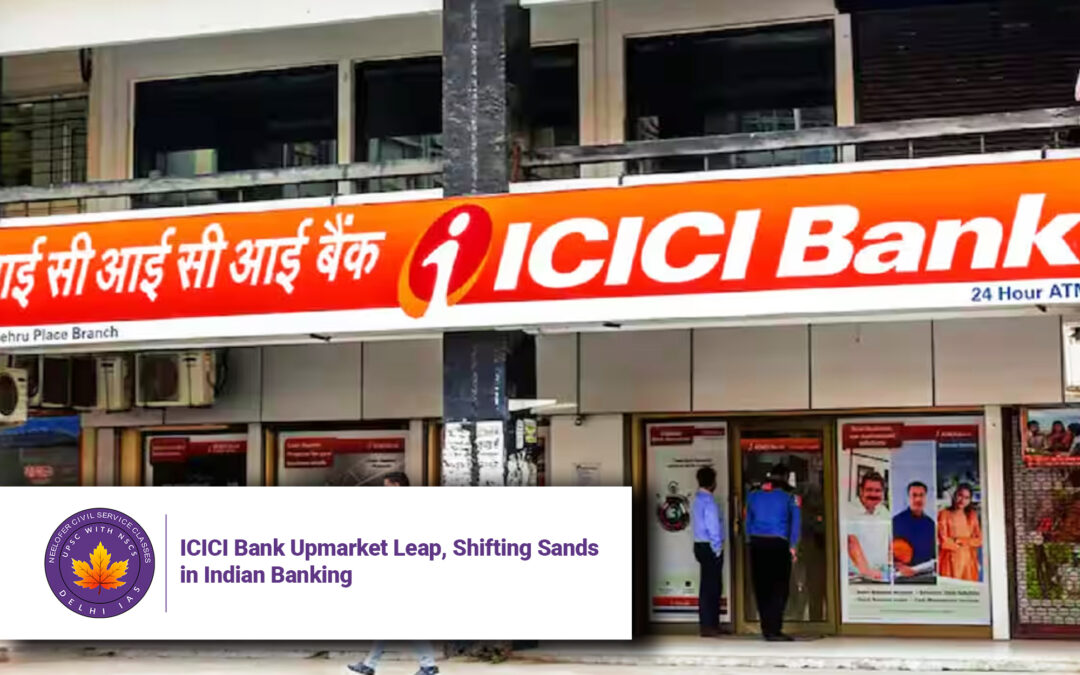
ICICI Bank Upmarket Leap, Shifting Sands in Indian Banking
A Bold Strategic Shift Raises Questions Over Access, Equality, and the Future of Retail Banking
In a move that has reignited a decades-old debate over inclusivity in banking, ICICI Bank, India’s second-largest private sector bank, has sharply increased the minimum balance requirements for new savings accounts. Effective from August 1, urban bank branches will require a steep minimum balance of ₹50,000 for new accounts—five times higher than the previous ₹10,000 requirement. For semi-urban and rural accounts, the thresholds have also risen dramatically, from ₹5,000 to ₹25,000, and from ₹2,000 to ₹10,000 respectively.
The change applies only to new savings accounts opened on or after August 1, with several exemptions in place for certain categories such as salary accounts, PM Jan Dhan accounts, and basic savings bank deposit accounts, all of which are zero-balance options. However, for customers falling under the new rule, the penalty for non-compliance is steep—6% of the shortfall amount or ₹500, whichever is lower.
The decision is emblematic of a broader transformation taking place in India’s financial sector, where private sector banks are increasingly segmenting their customer base and redefining their service strategies. Whether this shift is a sign of progress or regression depends on one’s perspective.
The Historical Backdrop: A Full Circle Since Nationalization
The move is particularly striking when placed against the historical backdrop of Indian banking reforms. In July 1969, then Prime Minister Indira Gandhi nationalized 14 major banks with the explicit argument that private banks were “too elitist” and catered primarily to large borrowers, sidelining small depositors and borrowers. The policy was designed to democratize access to financial services, bringing banking into rural and underserved areas while prioritizing small borrowers.
For decades, the ethos of Indian banking—especially in the public sector—was centered on financial inclusion and service equality. Minimum balance requirements for savings accounts were modest or even non-existent, particularly in state-owned banks. This approach aimed to ensure that banking was not a privilege of the wealthy but a necessity accessible to all.
ICICI Bank’s latest move, however, signals a departure from this inclusivity-driven mindset, particularly in the private banking sphere. It brings the conversation back to the same philosophical fork in the road that India confronted in the late 1960s: should banks cater to all citizens equally, or should they be free to focus on profitability and upmarket clientele?
The Rationale Behind the Move
From ICICI Bank’s perspective, the decision is a business strategy aimed at aligning services with its target market. By raising the minimum balance requirement, the bank effectively signals its intent to prioritize higher-income customers who are more likely to maintain substantial deposits and avail themselves of premium banking services.
The advantages for ICICI Bank include:
-
Reduced Account Maintenance Costs: Low-balance accounts often generate minimal revenue but incur similar operational costs as high-balance ones.
-
Increased Liquidity for Lending: Larger balances mean greater availability of low-cost funds for lending, reducing dependence on volatile wholesale funding markets.
-
Improved Customer Segmentation: By setting a high entry threshold, the bank can focus on offering specialized, higher-margin products to affluent clients.
There is also a strategic angle: according to a Mint report, ICICI Bank wants to be the primary bank for its customers, not the secondary or tertiary account they maintain with minimal funds. This aligns with the growing global trend where banks prefer fewer, more engaged customers over a high volume of inactive or low-value accounts.
Public Reaction: Discrimination or Smart Targeting?
The backlash has been swift and pointed. Critics have accused ICICI Bank of fostering exclusivity in a sector that plays a crucial role in financial inclusion. Jay Kotak, son of Uday Kotak (promoter of Kotak Mahindra Bank), noted that 90% of Indians have less than ₹25,000 in monthly income, making the new threshold inaccessible to most.
Consumer rights advocates argue that the move is discriminatory, potentially marginalizing lower-income individuals who may wish to open accounts in a private bank for better service quality but cannot meet the stringent minimum balance requirements.
Others, however, view the decision as a pragmatic business call. Private banks, they argue, are not public utilities and should be free to cater to their preferred market segments. Moreover, with public sector banks continuing to offer low or zero minimum balance accounts, customers still have options.
Regulatory Position: RBI Stays Neutral
The Reserve Bank of India (RBI) has thus far refrained from intervening in the matter. RBI Governor Shaktikanta Das, via statements from senior officials like Governor Sanjay Malhotra, has clarified that the regulator does not set minimum balance requirements. Instead, banks have full discretion to determine the thresholds for their savings deposit accounts.
This regulatory neutrality reflects a policy stance that encourages market competition and allows institutions to differentiate themselves. However, it also raises questions about whether financial inclusion goals could be undermined if more private banks follow ICICI Bank’s lead.
The Class Divide in Banking: A Stability Risk?
One of the more nuanced criticisms of ICICI Bank’s move relates to systemic stability. The broader banking philosophy suggests that having a large number of customers with small balances is more stable than relying on a few customers with large balances. This is because small depositors tend to keep their money parked in banks longer, whereas large depositors may move funds quickly in search of better returns or due to market volatility.
The cautionary tale here is Northern Rock, a UK-based mortgage lender that collapsed during the 2007-08 global financial crisis. Its downfall was partly attributed to an over-reliance on wholesale funding rather than a broad base of small, stable deposits.
While ICICI Bank’s strategy may boost profitability in the short term, critics worry that it could lead to a less diversified deposit base in the long run.
Impact on Public vs. Private Banking
The move also underscores the growing divergence between public and private sector banks in India. Public sector banks have either lowered their minimum balance requirements or removed them entirely to attract more customers and fulfill government mandates for financial inclusion.
Private banks, by contrast, are increasingly positioning themselves as providers of premium services, targeting customers with higher disposable incomes. This segmentation means that public banks may become the default choice for low-income individuals, while private banks focus on the urban middle and upper classes.
Such bifurcation could create a “two-tier” banking system, raising concerns about equitable access to quality financial services.
The Mule Account Factor
An often-overlooked angle in this decision is the issue of “mule accounts”—bank accounts used to facilitate illegal transactions, including money laundering and cyber fraud. These accounts are often maintained with minimal balances to avoid detection until they are activated for illicit purposes.
By imposing a high minimum balance, ICICI Bank may be aiming to deter such accounts, which are typically unattractive to maintain if they require substantial funds to be locked in. This could enhance the bank’s compliance posture and reduce regulatory risk.
Looking Ahead: A Bellwether for the Sector?
The most pressing question is whether ICICI Bank’s move signals a trend that other private sector banks will follow. If the market rewards ICICI Bank with higher profitability and better customer engagement, competitors may adopt similar policies. Conversely, if the move leads to significant customer attrition, it could serve as a cautionary tale.
In either case, the decision highlights the delicate balance between profitability, customer inclusivity, and systemic stability in banking. It also underscores the different mandates of public and private institutions—one aiming for universal service, the other for shareholder value.
Conclusion: A Sign of the Times?
ICICI Bank’s upmarket leap is not just a banking policy change; it is a reflection of broader socio-economic shifts in India. Rising incomes, urbanization, and the expanding affluent class provide fertile ground for banks to target higher-value customers. At the same time, the persistence of widespread income inequality makes such moves controversial.
Whether this decision proves to be a masterstroke of market positioning or a misstep in alienating a large customer base will only become clear over time. For now, it has reignited an important national conversation about the role of banks in society and the balance between inclusivity and profitability.
Q&A Section
1. Why did ICICI Bank increase its minimum balance requirement so sharply?
ICICI Bank’s decision is driven by a strategy to target more affluent customers who are likely to maintain higher deposits and use premium services. This helps reduce account maintenance costs, improves liquidity for lending, and aligns with the bank’s goal of becoming the primary bank for its customers.
2. How does this move relate to India’s banking history?
The change contrasts sharply with the ethos of the 1969 bank nationalization, which aimed to democratize banking access. Back then, the focus was on serving small borrowers and depositors. ICICI Bank’s policy shift revives the old debate about elitism in banking.
3. What has been the reaction from the public and industry?
Reactions are mixed. Critics argue that the policy is discriminatory, as it excludes lower-income customers. Supporters see it as a smart business decision within the rights of a private institution. Notably, 90% of Indians earn less than ₹25,000 per month, making the new thresholds unattainable for most.
4. Does the Reserve Bank of India have a say in this matter?
No, the RBI does not regulate minimum balance requirements for savings accounts. Banks in India have the freedom to decide these thresholds. The RBI has thus far maintained a neutral stance, leaving the matter to market dynamics.
5. Could this policy influence the broader banking sector?
Yes, the decision could set a precedent. If ICICI Bank benefits from the move, other private banks might adopt similar strategies. This could further polarize the banking landscape, with public banks serving low-income customers and private banks focusing on affluent segments.

