
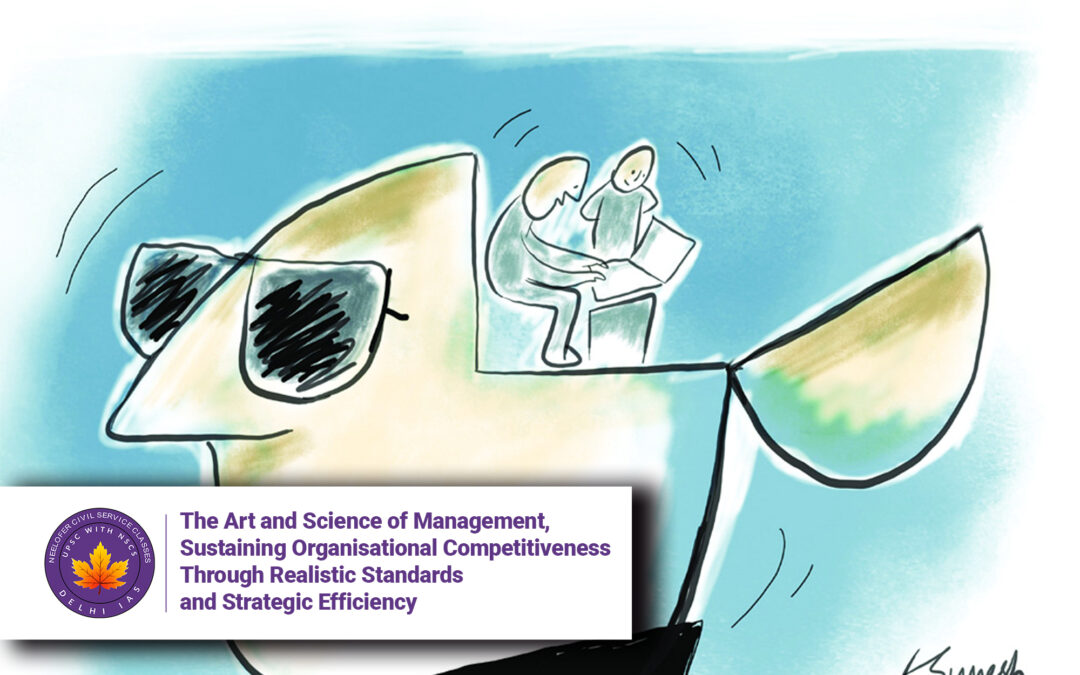
The Art and Science of Management, Sustaining Organisational Competitiveness Through Realistic Standards and Strategic Efficiency
Why in News
The conversation around organisational efficiency and competitiveness has taken centre stage in contemporary business discourse. As the global corporate environment becomes increasingly volatile and competitive, leaders are finding themselves under constant pressure to balance realistic operational standards with sustained high performance. Vinayshil Gautam’s recent piece in The Pioneer titled “The Art and Science of Management” sheds light on this delicate balance, discussing the psychological, strategic, and structural aspects of organisational management. His insights offer a timely reflection on how companies can maintain resilience without compromising standards, even amid shifting market dynamics and resource constraints.
Introduction
Sustaining organisational competitiveness requires more than just setting ambitious targets. It demands a thoughtful alignment between realistic expectations, adaptive strategies, and an unwavering commitment to operational efficiency. Gautam explores how leaders can harmonise the “art” of judgment with the “science” of data-driven decision-making to create conditions for organisational growth.
The core premise rests on two truths:
-
Lowering operational standards may temporarily ease internal pressures, but risks long-term decline.
-
Unbending rigidity in upholding unrealistic standards can create systemic stress and diminish morale.
Management thus becomes a balancing act—rooted in psychological understanding, flexibility, and a structured framework that supports both efficiency and sustainability.
Key Issues and Background
1. The Psychological Aspect of Efficiency
Gautam notes that while efficiency is universally sought, it carries an underappreciated psychological dimension. Many employees expect others to be efficient, yet desire a more lenient standard for themselves. Leaders, too, face the challenge of balancing empathy with accountability, often bending rules to accommodate varying competencies among team members.
2. The Temptation of Lowering Standards
In times of stress, loosening standards may appear practical. It can momentarily boost morale or productivity, but this can quickly erode an organisation’s credibility. A culture of suboptimal performance, if sustained, can lead to a gradual decline in competitiveness, market position, and profitability.
3. The Art of Judgement in Operations
Operational decisions are not solely data-driven. While statistical tools provide critical insights, they rarely capture the full operational reality. Deep judgment—founded on experience, situational awareness, and understanding of team capabilities—remains essential.
4. Governance as a Science
Governance involves structured processes and a clear framework for decision-making. It thrives on integrating various disciplines—political science, sociology, history—into strategic operations. A strong governance system ensures that even when short-term compromises are made, they do not derail the organisation’s long-term vision.
5. The Ongoing Challenge
The modern workplace is marked by rapid change. New ideas and technologies are emerging at a pace that challenges traditional organisational structures. Leaders must not only adapt but also maintain the integrity of the organisation’s core principles.
Specific Impacts or Effects
1. Impact on Employee Morale and Culture
Frequent adjustments to standards can create confusion, leading to reduced accountability and inconsistent performance expectations. This erodes trust in leadership and affects the organisation’s internal culture.
2. Market Competitiveness
Lowering standards may provide short-term relief but risks losing competitive edge to rivals maintaining stricter operational practices. Market perception can shift quickly, and regaining credibility can be a long process.
3. Decision-Making Quality
When statistical inputs are insufficient, reliance on judgment becomes inevitable. Leaders with inadequate understanding of operational realities risk making flawed decisions that have cascading effects on the organisation.
4. Financial Performance
As operational quality declines, profitability follows suit. Lower standards can lead to inefficiencies, higher error rates, and reduced customer satisfaction—all impacting the bottom line.
5. Organisational Resilience
Resilience is built through systems that can adapt without compromising core performance standards. A focus on both tangible and intangible assets—including brand reputation and workforce competence—is critical for long-term sustainability.
Challenges and the Way Forward
Challenges:
-
Balancing empathy and accountability – Leaders often struggle to enforce standards while accommodating varying employee capabilities.
-
Avoiding complacency – Comfort with suboptimal performance can become a habit, leading to systemic decline.
-
Adapting to rapid change – Fast-paced innovation requires agility without sacrificing operational integrity.
-
Integrating art and science – Effective management requires blending intuitive judgment with quantitative analysis, a skill not easily mastered.
-
Maintaining governance credibility – Any deviation from standards must be transparent, justified, and aligned with long-term goals.
Way Forward:
-
Set clear yet realistic standards – Define expectations in measurable terms while considering practical constraints.
-
Invest in leadership training – Equip leaders with both analytical skills and emotional intelligence to make balanced decisions.
-
Develop adaptive governance systems – Ensure flexibility without undermining credibility.
-
Strengthen decision-making frameworks – Use statistical tools as a foundation, but refine strategies with experiential judgment.
-
Promote a culture of continuous improvement – Encourage teams to exceed minimum standards rather than merely meeting them.
Conclusion
Management is both an art and a science—requiring the precision of data analysis and the intuition of human judgment. Gautam’s perspective reminds us that sustaining organisational competitiveness is not about relentless pursuit of unattainable ideals, nor about lowering the bar for convenience. Instead, it is about cultivating resilience, maintaining credibility, and creating a balanced operational ecosystem that can thrive under both stable and challenging conditions.
The ultimate takeaway is clear: leaders must navigate between rigidity and leniency, ensuring that every decision aligns with both present realities and future aspirations. The organisations that master this equilibrium will not only survive but excel in an increasingly complex world.
5 Questions and Answers
Q1. What is the central dilemma discussed by Vinayshil Gautam in “The Art and Science of Management”?
A1. The central dilemma is whether organisations should lower standards to make them more realistic, which can ease immediate pressures but risks long-term decline, or maintain high standards that may create operational stress but ensure competitiveness.
Q2. Why is judgment essential in management despite the availability of statistical tools?
A2. Statistical tools provide limited and tentative insights; judgment is essential to interpret these insights within the broader operational context, factoring in human and situational variables that data alone cannot capture.
Q3. How can lowering operational standards impact an organisation’s market position?
A3. Lowering standards can lead to decreased competitiveness, loss of market credibility, and ultimately reduced profitability, making it harder for the organisation to retain or grow its market share.
Q4. What role does governance play in sustaining organisational competitiveness?
A4. Governance ensures structured decision-making, integrates diverse perspectives, and maintains the organisation’s credibility and long-term vision even when short-term compromises are necessary.
Q5. What is the recommended way forward for leaders facing the challenge of balancing standards and efficiency?
A5. Leaders should set realistic yet high standards, invest in leadership development, create adaptive governance systems, blend data with judgment in decision-making, and promote a culture of continuous improvement.

