
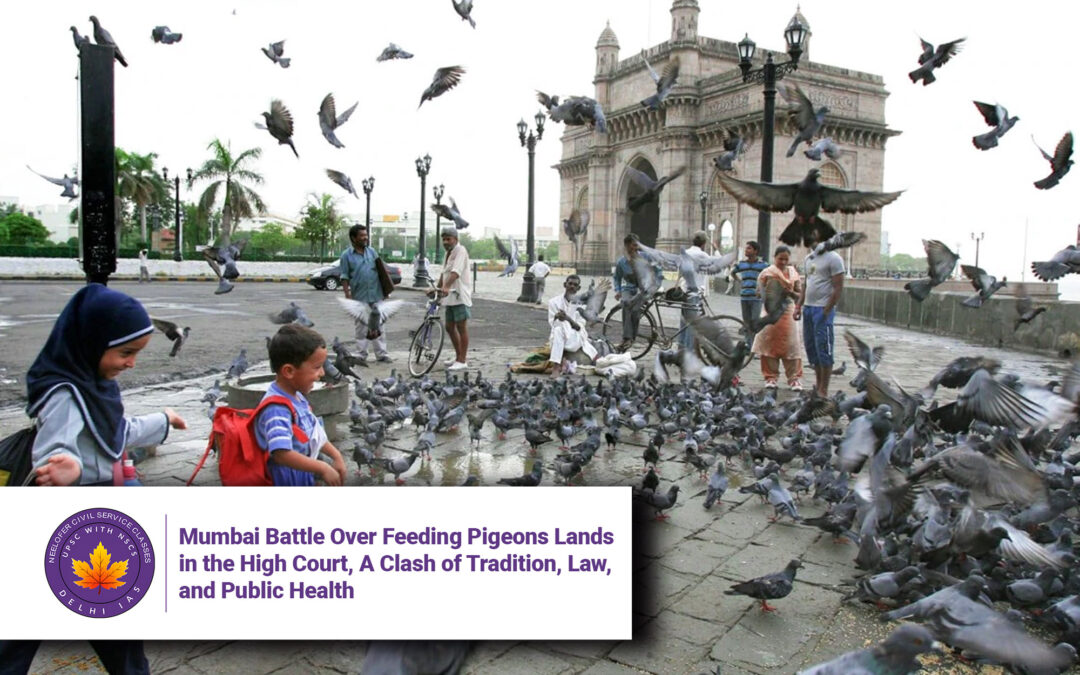
Mumbai Battle Over Feeding Pigeons Lands in the High Court, A Clash of Tradition, Law, and Public Health
Introduction: A City Torn Between Faith and Health
Mumbai is witnessing a heated public debate over an age-old practice—feeding pigeons at public spots, especially at kabutarkhanas (designated pigeon-feeding areas). On August 6, tensions escalated when hundreds of people clashed with police after the Brihanmumbai Municipal Corporation (BMC) covered the Dadar Kabutarkhana’s pigeon-feeding site with tarpaulin to stop the practice.
While for many in the Jain community, feeding pigeons is a pious act rooted in religious belief and compassion for living beings, authorities argue that unchecked pigeon feeding in public places creates health risks and environmental challenges. The issue has now moved to the Bombay High Court (HC), which is being asked to weigh competing claims of tradition, public safety, and civic order.
Religious Roots of Pigeon Feeding
Feeding pigeons has deep significance in Jainism, where it is seen as an act of jiv daya—compassion for all living beings. Many Jains believe that providing food to pigeons is a spiritual duty that brings merit.
Historically, the Jain community has erected pigeon shelters (kabutarkhanas) across Mumbai and other cities. These structures often feature feeding platforms that can rise up to 7 meters in height, with grain scattered daily to attract flocks.
Mumbai currently has at least 51 kabutarkhanas, many near temples and busy public spaces. At these sites, community members, particularly bird lovers, feed large numbers of pigeons—sometimes thousands at once. Dadar Kabutarkhana, located near a prominent Jain temple, is one of the city’s most notable sites, drawing pigeons and devotees alike.
A Brief History of the Dadar Kabutarkhana
The tradition of feeding pigeons at the Dadar Kabutarkhana stretches back decades. In 1937, the Jain temple’s trustees approached the erstwhile Bombay Municipality to seek permission to construct an enclosure to protect pigeons and other birds. By 1948, the trustees also sought approval to install a water trough to aid the birds.
In 1954, the Bombay Municipal Corporation officially allowed the temple to block traffic near the kabutarkhana for feeding activities. Over the years, the site became both a religious and cultural landmark.
However, this status has not insulated it from criticism. As the city has grown denser and concerns over air quality, hygiene, and public space management have intensified, the practice has increasingly come under civic and judicial scrutiny.
The Health and Safety Concerns
Critics of public pigeon feeding point to a number of hazards:
-
Health Risks: Pigeon droppings can carry fungi and bacteria that may cause diseases such as histoplasmosis, cryptococcosis, and psittacosis.
-
Overpopulation of Pigeons: Constant feeding encourages unnatural population growth, concentrating large flocks in urban areas.
-
Public Nuisance: Pigeons often roost and defecate on buildings, monuments, and vehicles, creating cleaning and maintenance burdens.
-
Traffic Disruptions: Large gatherings of pigeons and feeders at busy intersections or near public transport hubs can cause congestion and accidents.
These arguments gained legal traction in 2018, when the Bombay High Court remarked that human health should be prioritized over feeding birds. The court stressed the need to balance animal welfare with public safety.
The BMC’s August Action
On August 4, 2024, the BMC erected bamboo poles around the Dadar Kabutarkhana and covered the feeding site with tarpaulin to prevent pigeon feeding. The move was in line with directives from the Bombay High Court and the Maharashtra state government.
The action triggered immediate backlash from the Jain community. Over 1,000 members gathered at the site to protest, arguing that the BMC’s step was an attack on religious freedom. They maintained that pigeon feeding was a time-honored religious duty that should not be curtailed without dialogue.
Events Leading to the High Court Showdown
The conflict began brewing earlier this year. In the Legislative Assembly on July 3, MLA Manisha Kayande asked the state government to ensure that the BMC would not restrict kabutarkhana activities. However, the BMC soon initiated enforcement drives, penalizing those feeding pigeons in prohibited zones.
On July 14, the Bombay High Court ruled that feeding pigeons should be restricted to designated kabutarkhanas to prevent nuisance in public spaces. The court also instructed the BMC to issue guidelines and, if needed, use police to stop illegal feeding.
Escalation and FIRs
The BMC’s enforcement intensified in late July and early August:
-
Between July 13 and August 3, the civic body collected ₹68,700 in fines from violators.
-
On August 1, an FIR was filed against an unknown person for feeding pigeons at Dadar Kabutarkhana despite restrictions.
-
On August 2, the BMC covered the feeding site to physically block the activity.
These measures angered the Kabutarkhana Trust, which reported that 980 pigeons in the area had died in three days—allegedly from starvation. They called for an urgent peace meeting with the BMC.
Attempts at Resolution
On August 3, the crisis deepened. Chembur MLA Mangal Prabhat Lodha wrote to the BMC asking for alternative feeding locations. On August 5, Deputy Chief Minister Devendra Fadnavis met with Jain community leaders, urging the BMC to allow feeding at public spaces in a “controlled manner” to ensure bird health.
However, the Trust canceled its planned meeting with the BMC, citing lack of notice. Meanwhile, unaware of the canceled meeting, hundreds of people arrived at the site, removed the tarpaulin, and resumed feeding.
The Legal Arguments
The matter now lies before the Bombay High Court. The Kabutarkhana Trust argues that:
-
Feeding pigeons is integral to their religious practice.
-
Restricting it violates their constitutional right to religious freedom.
-
The BMC’s actions were excessive and failed to provide viable alternatives.
The BMC counters that:
-
Public health takes precedence over tradition when the two conflict.
-
Large-scale pigeon feeding in crowded areas poses significant hygiene and safety risks.
-
The High Court has already directed that feeding should be limited to designated areas and managed to prevent overpopulation.
Where Things Stand
The BMC is considering a compromise: allowing feeding at staggered times and in controlled quantities, in line with the Chief Minister’s directive. The High Court has agreed to hear the Advocate General of Maharashtra on the issue.
For now, the Dadar Kabutarkhana remains a flashpoint. The court’s ruling will likely set an important precedent for balancing religious customs with public health and urban governance in India’s megacities.
5 Questions and Answers on the Dadar Kabutarkhana Controversy
Q1. Why did the BMC take action against feeding pigeons at Dadar Kabutarkhana?
A1. The BMC acted following directives from the Bombay High Court and the Maharashtra government, citing public health risks, traffic disruptions, and nuisance caused by uncontrolled pigeon feeding.
Q2. What is the religious significance of feeding pigeons for the Jain community?
A2. In Jainism, feeding pigeons is considered an act of jiv daya (compassion for all living beings) and is believed to earn spiritual merit. Kabutarkhanas have been maintained for decades as part of this tradition.
Q3. How did the Kabutarkhana Trust respond to the BMC’s actions?
A3. The Trust protested, claiming that the BMC’s restrictions caused the deaths of hundreds of pigeons and violated their religious rights. They sought alternative feeding arrangements and engaged political leaders to mediate.
Q4. Has the High Court previously ruled on pigeon feeding?
A4. Yes. In earlier orders, the High Court stated that human health should take precedence and directed that pigeon feeding be restricted to designated kabutarkhanas to reduce public nuisance.
Q5. What potential compromise is being discussed?
A5. The BMC is exploring allowing feeding at staggered times in controlled quantities to balance the needs of religious practitioners with public health concerns.
