
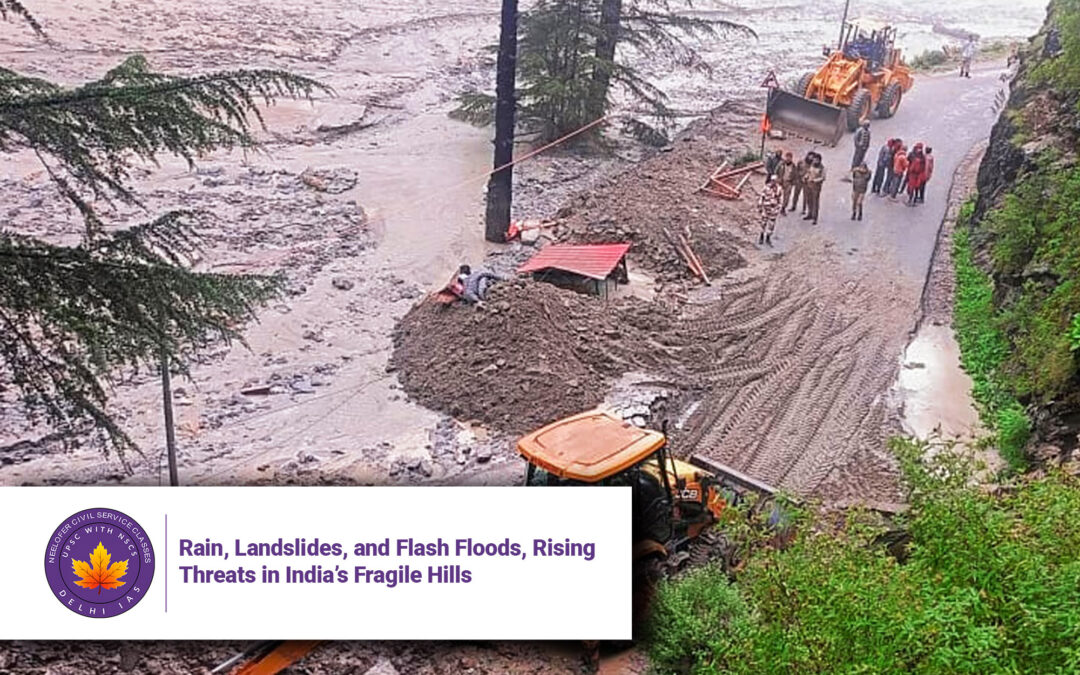
Rain, Landslides, and Flash Floods, Rising Threats in India’s Fragile Hills
Introduction: A Disaster That Repeats Itself
On August 5, the small village of Dharali in Uttarakhand’s Uttarkashi district was struck by a devastating flash flood that claimed at least four lives and left many missing. Homes were destroyed, infrastructure damaged, and hundreds stranded. The incident has brought into sharp focus, once again, the growing threat of extreme weather events in India’s hill states—events that often combine heavy rain, landslides, and sudden floods into a deadly mix.
The Uttarkashi event is far from isolated. In the last month alone, Himachal Pradesh has faced several similar disasters, where landslides and flash floods have killed dozens and displaced thousands. These repeated tragedies point to an unsettling truth: India’s ecologically fragile hill regions are becoming increasingly vulnerable to such events, and our understanding—and preparation—still lag behind.
The Dharali Flash Flood: Unanswered Questions
Flash floods in the Himalayan region are typically triggered by extreme rainfall events, which loosen soil and rock, leading to landslides or mudslides. The debris often flows down steep slopes, entering streams and rivers with immense force, sweeping away anything in its path—homes, roads, vehicles, and vegetation.
In Dharali’s case, the exact trigger remains unclear. The area had been receiving monsoon rainfall, but nothing unusually heavy for the season. Some experts suggest that a glacial lake breach upstream could be a cause—an occurrence where melting ice creates or enlarges a glacial lake, which suddenly releases water when its ice or moraine dam breaks. Others note that the rainfall in Uttarkashi on August 5 measured 32 mm—double the district’s normal daily average, yet not extreme by meteorological standards.
The complexity lies in the fact that flash floods are not always directly tied to record-breaking rainfall. Sometimes, it’s the combination of multiple environmental and climatic factors that triggers the disaster.
The Cloudburst Question
Many flash floods in the Himalayas are linked to cloudbursts—sudden, intense bursts of rainfall, often exceeding 100 mm within an hour, over a very small geographical area (about 10 km x 10 km). Such events are concentrated and hyperlocal, meaning they can be missed by rain gauges if no measuring station is within the affected zone.
Cloudbursts are notorious for triggering landslides and flash floods. Recent incidents in Himachal Pradesh, for example, have been directly linked to cloudburst-like events. But in Dharali, there is no evidence that such an event occurred. Instead, moderate but persistent rainfall over several days may have saturated the soil, making the terrain more prone to landslides, which in turn could have blocked and then released water suddenly into the river.
A Web of Factors
Flash floods in the hills are rarely caused by one single factor. They require a combination of conditions:
-
Heavy Rainfall: Even moderate rainfall can trigger floods if it falls on already saturated ground.
-
Landslides: Slopes weakened by rain or human activity can collapse, blocking rivers temporarily before giving way.
-
Glacial Activity: Melting glaciers can cause sudden breaches in glacial lakes, releasing millions of cubic meters of water.
-
Topography: Steep gradients increase water velocity, making floods more destructive.
-
Human Interference: Road construction, deforestation, and unplanned settlements near riverbanks worsen the situation.
In Dharali’s case, experts point out that extreme events can happen even with relatively small amounts of rainfall if the slope is steep, the soil cannot absorb more water, or seismic activity destabilizes the ground.
The Himalayan Context
The Himalayan mountains are uniquely vulnerable for several reasons:
-
Geological Youth: The Himalayas are still rising and are relatively unstable compared to older mountain ranges like the Aravalis.
-
Seismic Activity: Earthquakes are frequent in the region, further weakening slopes.
-
High Rainfall Variability: While some years see deficits, short bursts of extreme rainfall can still occur, often unpredictably.
-
Human Pressure: Road-widening projects, hydroelectric dams, and expanding tourist infrastructure increase slope instability.
-
Glacial Changes: Climate change is accelerating glacier melt, increasing the likelihood of glacial lake outburst floods (GLOFs).
The Difficulty of Early Warnings
Predicting heavy rainfall is relatively straightforward with today’s meteorological tools. However, predicting which rainfall events will trigger flash floods is far more difficult. Even with landslide susceptibility maps and monitoring systems, the exact location and timing of such events are highly uncertain.
The Dharali incident illustrates this challenge vividly. The rainfall on August 5 was not extraordinary in meteorological terms, yet the impact was catastrophic. This unpredictability complicates the development of effective early warning systems for flash floods.
Mitigation Measures: What Can Be Done
While we cannot prevent extreme weather events, there are strategies to reduce their impacts:
-
Avoid Construction Near Rivers: Infrastructure projects should maintain a safe buffer from riverbanks to avoid being swept away.
-
Planned Relocation: Populations in high-risk areas should be moved further from flood-prone zones.
-
Controlled Land Use: Large boulders and construction debris should be stored in ways that prevent them from entering rivers during floods.
-
Eco-Sensitive Development: Road construction and hydropower projects should incorporate geological assessments to minimize slope destabilization.
-
Community Preparedness: Local communities should be trained in evacuation procedures and basic disaster response.
Why This Matters Now
The Dharali flash flood is a stark reminder that climate change and unsustainable development are combining to make the Himalayan region more hazardous. Even without record-breaking rainfall, the fragile terrain and human-induced vulnerabilities can turn a moderate weather event into a deadly disaster.
These events are becoming more frequent, and their human and economic toll is growing. With the added risks of glacial lake breaches, increased tourist activity, and ongoing infrastructure expansion, the urgency to develop robust disaster management strategies cannot be overstated.
5 Questions and Answers on the Dharali Flash Flood
Q1. What caused the Dharali flash flood?
A1. The exact cause remains uncertain. While heavy rainfall in the days leading up to August 5 may have saturated the soil and triggered landslides, other possibilities include a glacial lake breach upstream. However, no cloudburst was recorded in the area.
Q2. What makes the Himalayan region particularly vulnerable to such events?
A2. The Himalayas are geologically young, seismically active, and prone to slope instability. Climate change-driven glacier melt, intense rainfall, and human activities like construction further increase the risks.
Q3. How is a cloudburst defined in meteorology?
A3. According to the India Meteorological Department (IMD), a cloudburst is an extreme rainfall event where at least 100 mm of rain falls within an hour over a small area of roughly 10 km x 10 km.
Q4. Can flash floods occur without extreme rainfall?
A4. Yes. Flash floods can result from moderate rainfall if other conditions are present, such as saturated soil, steep slopes, landslides, or glacial lake breaches.
Q5. What mitigation steps can reduce the impact of flash floods?
A5. Key measures include avoiding construction in flood-prone areas, relocating vulnerable communities, controlling deforestation and slope destabilization, storing debris away from rivers, and training communities in disaster preparedness.

