
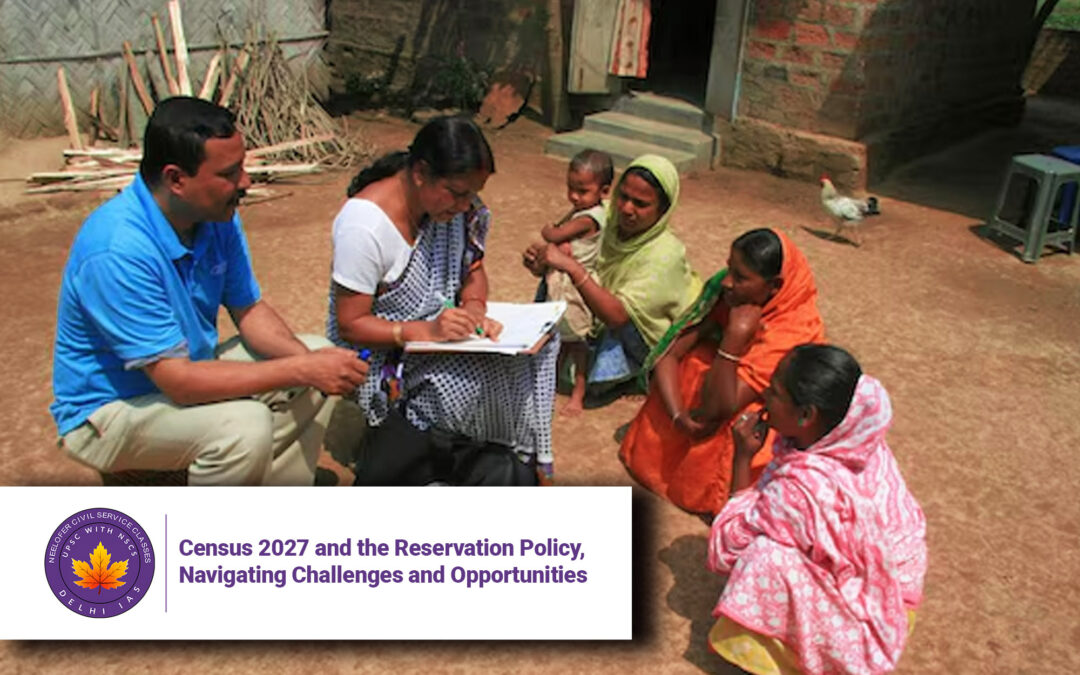
Census 2027 and the Reservation Policy, Navigating Challenges and Opportunities
The announcement of Census 2027 by the Government of India on 16 June 2025 has sparked fresh debates on the methodology, scope, and political implications of the largest enumeration exercise in the country. This declaration came more than six years after the original notification for Census 2021 was issued on 26 March 2019. That earlier notification has now been cancelled, ending a historical streak of uninterrupted census-taking that India had maintained for over 150 years. The decision to delay the census represents not only a break in tradition but also raises questions about how caste-based data will be handled in the upcoming exercise.
Historical Context of the Indian Census
The Census in India is a massive, decennial exercise undertaken to gather comprehensive demographic, social, and economic data. Under Section 3 of the Census Act 1948, the Union Government holds the power to determine when a census should be conducted, although the Act does not define the word “census” itself. The traditional approach has been to conduct the census in the first year of each decade. This continuity was disrupted for the first time due to the COVID-19 pandemic, which delayed Census 2021.
In 2027, the government faces a dual challenge—how to restore this institutional rhythm and how to address the increasingly urgent demand for detailed caste data.
The Caste Enumeration Debate
At the heart of current discussions is whether the census will include comprehensive caste enumeration. Presently, the government maintains two lists for caste classification:
-
The Central List of State-wise OBC groups, covering 2,633 entries.
-
The State List that contains caste groups recognized at the state level but not necessarily included in the Central List.
Conducting caste enumeration is not a simple administrative task—it has deep socio-political implications. If the Central Government chooses to only enumerate those already on the Central List, large numbers of caste groups not included will be excluded from the dataset. On the other hand, including all caste groups would demand greater coordination between State and Central authorities, while also requiring robust mechanisms to verify and process the data efficiently.
The Reservation Framework: Then and Now
When India’s reservation policy was launched, it covered Scheduled Castes (SCs) and Scheduled Tribes (STs). The concept of Other Backward Classes (OBCs) as a formal category did not exist. It was only after the Mandal Commission submitted its report on 31 December 1980 that the political discourse shifted. The Mandal Commission recommended, among other things, a 27% reservation for OBCs in Central Government jobs.
This recommendation was implemented in 1990 through an Office Memorandum. However, the decision was challenged, leading to the landmark Indra Sawhney vs Union of India judgment of 16 November 1992. The nine-judge bench upheld the constitutional validity of OBC reservations but imposed a 50% cap on the total reservation quota.
Discrepancies in Quota and Population
One of the key debates is the mismatch between caste population sizes and their allocated reservation quotas. For example:
-
In Andhra Pradesh (2011 census figures), SCs formed 16.41% of the population and STs 7.0%, but their job reservation quotas were 16% and 7%, respectively.
-
In Gujarat, SCs and STs made up 6.74% and 14.75% of the population, but reservation quotas were fixed at 7% and 15%, respectively.
While these numbers appear proportionate, the absence of recent caste census data means that such figures are based on old assumptions, not updated realities.
Why the 2027 Census Matters More Than Ever
In the absence of updated caste data, policymaking has relied on projections. For instance, the NSSO 55th Round (1999–2000) estimated that OBCs constituted 36% of the population, while the NSSO 68th Round (2011–12) placed this figure at 43.1%. However, these are sample-based estimates, not a complete enumeration.
The Socio-Economic and Caste Census (SECC) of 2011 attempted to address this gap but suffered from data inconsistencies and lack of public release for caste figures.
The 2027 Census thus presents a rare opportunity to generate accurate, updated caste data that could shape affirmative action policies for decades to come.
Balancing Social Justice and Political Strategy
The inclusion of caste enumeration in Census 2027 is not merely a statistical issue—it is deeply political. Proponents argue that updated data is essential to ensure reservations are fairly distributed and proportional to current population sizes. Critics, however, warn that caste enumeration could deepen identity politics and exacerbate social divisions.
Moreover, the results could influence future elections, as they would provide a clear picture of the demographic strength of various communities. This is especially relevant given recent political mobilizations by OBC groups demanding greater representation.
The Administrative Challenge
Conducting a census of over 1.4 billion people is already a colossal task. Adding detailed caste data collection would significantly increase complexity:
-
Training and manpower: Enumerators must be adequately trained to ask sensitive caste-related questions and record them accurately.
-
Verification mechanisms: Ensuring the authenticity of self-reported caste data would require cross-checking with official caste lists.
-
Data processing: The volume of information would require advanced digital systems for classification, analysis, and public dissemination.
Legal and Policy Considerations
The legal foundation for conducting caste enumeration lies in the Census Act 1948 and associated rules under the Citizenship Act 1955. However, the process must also comply with provisions of the Constitution, especially in matters of equality, affirmative action, and protection of marginalized communities.
Section 8(1) of the Census Act mandates that the government notify the schedules for data collection, while Rule 5(1) specifies the required particulars. If caste is included, the schedule would need to list all recognized castes across states, making coordination between the Registrar General of India (RGI) and State Governments essential.
Looking Ahead: The Stakes of Census 2027
If executed effectively, Census 2027 could become a watershed moment for India’s social justice framework. Updated caste data could help recalibrate reservation policies, address underrepresentation, and ensure resources are targeted more effectively. However, failure to manage this process transparently and efficiently could erode public trust and intensify caste-based polarization.
The government will need to strike a careful balance—leveraging the census as a tool for equity and development, while safeguarding against its misuse for divisive political ends.
Five Key Questions and Answers on Census 2027
Q1: Why is Census 2027 significant compared to previous censuses?
A: Census 2027 is the first census after a break of over 150 years of uninterrupted data collection. It comes at a time when there is an urgent demand for updated caste data to guide reservation policies and social justice measures. It could reshape India’s affirmative action framework for decades.
Q2: What is the main challenge in including caste enumeration?
A: The biggest challenge lies in accurately recording caste data for over a billion people, ensuring consistency with official caste lists, and processing the massive dataset without errors or delays. Political sensitivities around caste identities add to the complexity.
Q3: How did the Mandal Commission influence OBC reservations?
A: The Mandal Commission, in its 1980 report, recommended 27% reservation for OBCs in Central Government jobs. This was implemented in 1990, upheld in principle by the Supreme Court in the 1992 Indra Sawhney case, but with a cap of 50% total reservation.
Q4: What are the risks of conducting caste enumeration?
A: Risks include potential misuse of data for political mobilization, reinforcement of caste divisions, and disputes over classification. Poorly executed enumeration could undermine trust in the census process.
Q5: How could accurate caste data benefit policymaking?
A: Reliable caste data would allow for proportional allocation of reservations, better targeting of welfare schemes, and more equitable distribution of resources, ensuring that affirmative action benefits those who need it most.

