
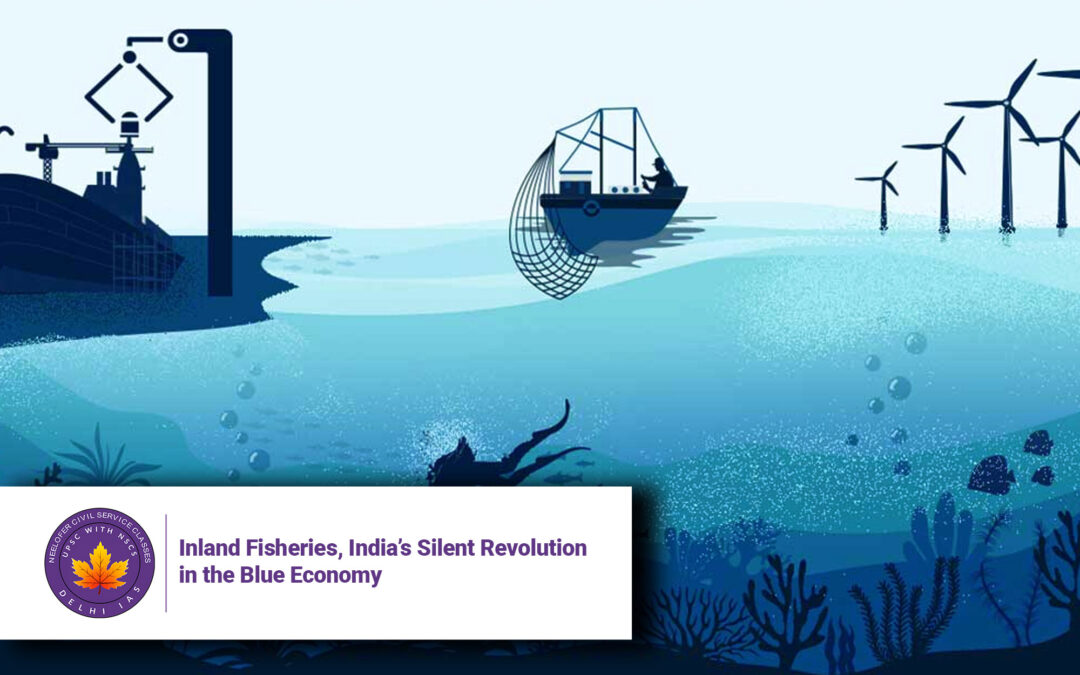
Inland Fisheries, India’s Silent Revolution in the Blue Economy
In the vast and complex story of India’s economic and cultural evolution, fish have always held a place that transcends the dinner plate. From ancient art to modern livelihoods, the story of inland fisheries is a journey of silent resilience, gradual transformation, and the untapped potential of the blue economy.
For thousands of years, fish have been more than just a source of protein in India. In the Harappan civilization, pottery depicted water deities, echoing humankind’s deep connection with aquatic life. In Hindu mythology, the fish avatar of Vishnu—Matsya—finds a prominent place in the Matsya Purana. Classical Sanskrit literature, such as Kalidasa’s works, used royal fish imagery, while in Bengal, matrimonial customs have incorporated fish as symbols of prosperity and good fortune.
The cultural connection extends to artistic and cinematic expressions—Madhubani paintings often portray fish as motifs of abundance, while films like Chemmeen, the 1965 Malayalam classic, capture the human drama of fishing communities. For Indians, fish evoke not just taste, but longing, heritage, and the delicate web of life sustained by water.
From Periphery to Priority: The Policy Shift
For decades, despite this cultural richness, fisheries—especially inland fisheries—remained on the margins of India’s economic agenda. That changed after 2014, when the country began to reposition freshwater aquaculture not just as a source of nutrition but also as a strategic driver for rural livelihoods, income generation, and regional economic renewal.
The real turning point arrived with the Pradhan Mantri Matsya Sampada Yojana (PMMSY), launched in 2020 with an ambitious ₹20,050 crore outlay. Unlike earlier schemes that focused narrowly on inputs such as seeds and feed, PMMSY sought to modernise the entire fisheries value chain—from hatcheries to markets. Investments targeted cold storage, transport infrastructure, and better market linkages, laying the foundation for a more resilient, integrated aquaculture sector.
The results over the past decade have been remarkable. Fish production has nearly doubled, with inland fisheries now accounting for more than 75% of India’s total fish output.
Insurance, Investment, and the Rise of Aquaculture
In February 2024, a landmark policy reform extended crop insurance to fish farmers under the PM Matsya Kisan Samridhi Sah Yojana, officially classifying fish stock as insurable. This was more than just a bureaucratic change—it mitigated risks for marginal farmers, attracted private investment, and accelerated the pace of inland aquaculture’s expansion.
India’s inland fisheries sector has since been growing at an 8.58% average annual rate, outpacing all other agri-allied domains. Government-backed institutional support has strengthened trust among fish farmers through disease surveillance programmes and biosecurity protocols.
Yet, not all challenges have been overcome. A significant portion of inland fish farming still relies on traditional practices, with low adoption of scientific feed formulations, modern hatchery technologies, or species diversification. Post-harvest processing remains minimal, limiting value addition and market competitiveness.
Export Potential and Gaps
India’s seafood exports have been a major success story, reaching ₹60,524 crore in 2023 and spreading across 132 countries. However, much of this success has been powered by marine production. Inland aquaculture’s contribution to these export figures remains modest, suggesting that the sector’s potential is far from fully realised.
Without a robust retail and export supply chain tailored to inland fish, the sector risks remaining an untapped driver of India’s blue economy. Regional disparities add to the complexity—states like Uttar Pradesh and Bihar have surged ahead in inland fisheries, while Uttarakhand and Arunachal Pradesh lag behind due to chronic underinvestment, poor infrastructure, and inadequate extension services. Climate variability further adds unpredictability, threatening livelihoods in vulnerable regions.
Gender Roles and Ownership Gaps
Inland fisheries provide livelihoods to nearly three crore Indians, with women comprising 30% of the workforce. Despite their critical roles in hatcheries, processing, and marketing, women’s access to training, credit, and ownership remains limited. Closing this gender gap will be essential for sustaining the sector’s growth momentum and ensuring equitable participation in the blue economy.
The Road Ahead: Innovation, Infrastructure, and Integration
The next stage for India’s inland fisheries is not reinvention but consolidation. Experts recommend the creation of Inland Fisheries Infrastructure Corridors in key aquaculture districts, equipped with mobile cold storage and mini-processing hubs.
States should launch Aquaculture Acceleration Missions, combining credit, insurance, and technical support to promote modern practices like Recirculating Aquaculture Systems (RAS) and cage culture.
Digital transformation can also be a game changer. A proposed Digital Blue India platform, powered by IoT and blockchain, could revolutionise pond monitoring, disease tracking, and product traceability. Real-time linking of state laboratories to a national dashboard would provide critical disease surveillance data, helping protect both livelihoods and national food security.
A Strategic Window of Opportunity
With less than two decades left to fully capitalise on India’s demographic dividend, inland fisheries stand at a crucial juncture. Integrating them into the national economic strategy would do more than boost GDP—it would reshape rural economies, address nutritional deficits, and enhance export competitiveness.
India’s blue economy must no longer be confined to its oceans. It must embrace the vast network of ponds, tanks, and reservoirs that sustain millions of rural households. Inland fisheries, once overlooked, are now emerging as a central pillar of food security, livelihood creation, and export growth.
Awakened and surging forward, this sector carries the quiet momentum of rural economic resurgence, signalling that India’s next big growth story may very well be written in its waters.
Key Takeaways
-
Inland fisheries now contribute over 75% of India’s fish production.
-
The sector has grown faster than all other agri-allied sectors in recent years.
-
Policy reforms like PMMSY and fish stock insurance have reduced risks and boosted investments.
-
Significant export potential remains untapped due to infrastructure and market gaps.
-
Digital innovation and infrastructure corridors could propel inland fisheries into a global leadership role.
Q&A Section
Q1. What role has the Pradhan Mantri Matsya Sampada Yojana played in transforming inland fisheries?
A: The PMMSY, launched in 2020 with ₹20,050 crore funding, modernised the fisheries value chain by investing in cold storage, transport infrastructure, and market linkages. It shifted focus from merely providing inputs to building an integrated, resilient aquaculture system.
Q2. Why was the classification of fish stock as ‘insurable’ significant for the sector?
A: This reform, introduced in 2024 under the PM Matsya Kisan Samridhi Sah Yojana, mitigated financial risks for farmers, encouraged private investment, and boosted confidence in scaling inland aquaculture operations.
Q3. What are the major challenges still facing inland fisheries?
A: Challenges include reliance on traditional farming practices, limited adoption of scientific techniques, underdeveloped processing facilities, regional disparities in infrastructure, and restricted access for women to credit and ownership.
Q4. How can technology help revolutionise inland fisheries in India?
A: IoT and blockchain can enhance pond monitoring, disease tracking, and traceability of products. Linking local labs to a national dashboard would enable real-time disease surveillance, improving both productivity and safety.
Q5. Why is integrating inland fisheries into India’s economic strategy crucial now?
A: With a limited window to leverage the demographic dividend, inland fisheries can significantly contribute to rural employment, nutrition security, and export earnings—helping diversify and strengthen India’s blue economy.

