
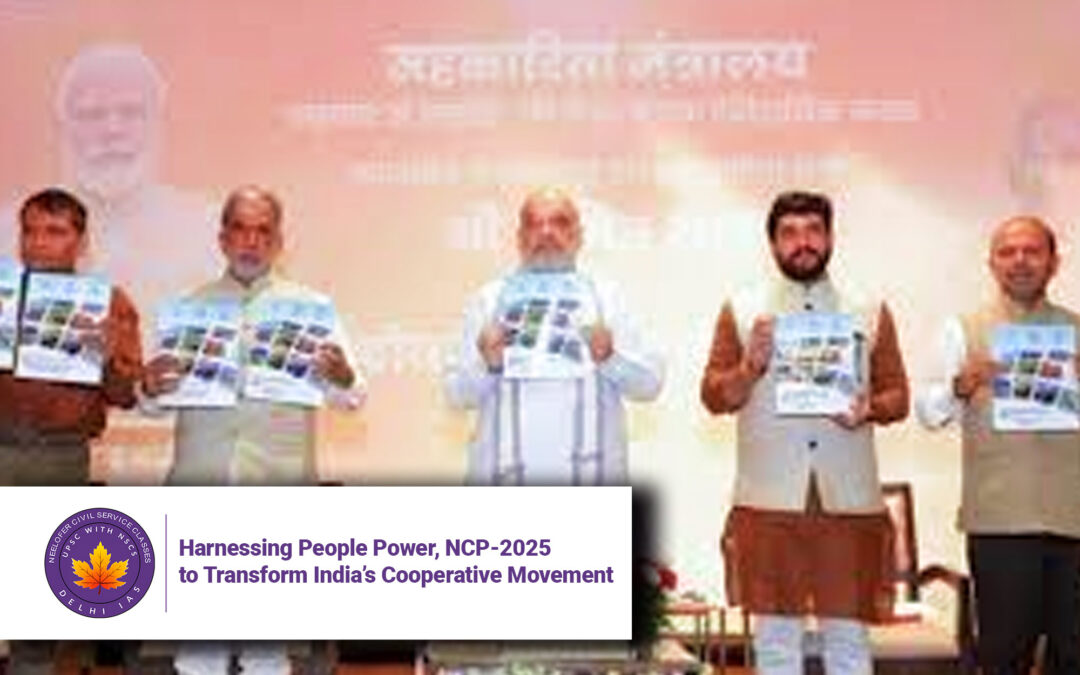
Harnessing People Power, NCP-2025 to Transform India’s Cooperative Movement
Why in News?
The Ministry of Cooperation (MoC) has unveiled the National Cooperation Policy 2025 (NCP-2025), an ambitious, all-encompassing policy framework aimed at revitalising and modernising India’s cooperative sector. This is the first comprehensive cooperative policy in over 23 years, marking a major milestone in the country’s economic governance. The new policy seeks to strengthen grassroots economic structures, diversify cooperative activities, and transform community-based enterprises into globally competitive, profitable, and sustainable ventures. It is a key part of the government’s strategy to achieve Viksit Bharat @2047 — a vision for an inclusive, self-reliant, and prosperous India.
Introduction
India’s cooperative movement has historically been a cornerstone of rural economic empowerment. From agricultural credit societies to dairy cooperatives, these community-driven organisations have provided millions with access to finance, resources, and market opportunities. However, the movement has faced challenges such as outdated laws, limited innovation, poor infrastructure, and lack of professional governance.
NCP-2025 represents a major step forward. It offers a holistic vision for modernising cooperatives, expanding their scope beyond traditional sectors, and empowering them to compete in both domestic and global markets. The policy draws inspiration from Prime Minister Narendra Modi’s call for Sahakar Se Samriddhi — prosperity through cooperation — and aligns with the broader national mission to ensure equitable economic growth across regions and communities.
Unlike past policy updates, NCP-2025 is not just a reform document but a strategic blueprint. It lays out detailed objectives, timelines, and enabling provisions, covering everything from legal frameworks and infrastructure to leadership development and international collaboration.
Key Issues and Background
1. Policy Gap in Cooperative Development
-
India’s last national cooperative policy was issued over two decades ago, during which time the economy and market environment have undergone rapid transformation.
-
The lack of updated guidelines and frameworks left many cooperatives struggling to remain competitive in an increasingly globalised and technology-driven economy.
-
Governance in several cooperative bodies became ineffective, and in some cases, these institutions lost credibility among members due to political interference and operational inefficiencies.
2. NCP-2025 Objectives
The new policy outlines a range of objectives to revitalise the cooperative movement:
-
Inclusive Growth: Ensure that cooperatives serve as vehicles for equitable distribution of wealth and opportunities across rural and urban areas.
-
Youth Participation: Encourage younger generations to actively join and lead cooperative ventures, ensuring long-term sustainability and innovation.
-
Business Diversification: Move beyond the traditional cooperative focus on agriculture to include sectors such as retail, manufacturing, services, logistics, and renewable energy.
-
Governance Reform: Promote transparency, accountability, and professionalism in management practices.
3. Strategic Reforms Introduced
NCP-2025 includes several transformative measures:
-
Adoption of model bye-laws for Primary Agricultural Credit Societies (PACS) to allow them to undertake multi-purpose activities.
-
Introduction of enabling provisions for cooperatives to establish their own support infrastructure, legal frameworks, and financing mechanisms.
-
Integration of Farmer Producer Organisations (FPOs) with cooperatives to enhance marketing reach, supply chain efficiency, and farmer incomes.
-
Incentives for producing pulses, oilseeds, and other critical crops to reduce import dependency.
Specific Impacts or Effects
Business Diversification and Economic Empowerment
One of the most significant changes in NCP-2025 is the formal provision allowing PACS to run petrol and diesel dealerships, LPG distribution centres, and other retail outlets. This diversification aims to transform cooperatives into multi-revenue enterprises, reducing reliance on a single income stream and creating additional employment in rural areas.
By integrating into the energy and retail supply chains, cooperatives will not only increase local economic activity but also offer affordable services to their members. The resulting boost in revenue can be reinvested into infrastructure, training, and expansion.
Global Integration and Competitiveness
NCP-2025 positions Indian cooperatives within the framework of a global economy. By encouraging digital adoption, quality certification, and international partnerships, the policy aims to open new markets for cooperative products. This aligns with the national vision of Sabka Saath, Sabka Vikas, Sabka Vishwas, Sabka Prayas and strengthens the country’s Vasudhaiva Kutumbakam (the world is one family) approach to economic cooperation.
Social Equity and Wealth Distribution
Cooperatives have traditionally been powerful tools for reducing inequality. By directing benefits to local members, they ensure that wealth generated from collective enterprises remains within the community. NCP-2025 reinforces this role by prioritising underrepresented groups and disadvantaged areas, and by encouraging inclusive leadership that reflects the diversity of the membership.
Infrastructure and Market Strengthening
The policy focuses on building physical infrastructure — such as storage facilities, processing units, and distribution hubs — as well as soft infrastructure like digital platforms, training programs, and cooperative networks. This dual approach is intended to boost efficiency, reduce operational costs, and improve competitiveness in both domestic and export markets.
Challenges and the Way Forward
Challenges
-
Infrastructure Deficits: Many cooperatives lack modern infrastructure and technological capabilities, making it harder to compete with private-sector enterprises.
-
Governance Issues: Political interference, lack of accountability, and outdated management practices continue to hinder the growth of several cooperatives.
-
Awareness and Education: In rural areas, many members are not fully aware of the opportunities and rights available under cooperative structures, limiting their engagement.
-
Integration with State Policies: Since cooperatives are a state subject, successful implementation of NCP-2025 requires strong cooperation from State and Union Territory governments.
Steps Forward
-
Education and Leadership Development: Establish dedicated training institutions for cooperative management, focusing on entrepreneurship, governance, and financial literacy.
-
Digital Transformation: Encourage adoption of e-commerce, digital payments, and blockchain-based supply chain systems to improve transparency and market access.
-
Policy Harmonisation: Work with states to align local cooperative laws with the national framework for smoother implementation.
-
Community Engagement: Conduct awareness campaigns to inspire more people, especially youth and women, to participate in and lead cooperative ventures.
-
Monitoring and Evaluation: Set up independent audit and review mechanisms to track progress, identify bottlenecks, and ensure accountability.
Conclusion
The National Cooperation Policy 2025 is more than a reform; it is a strategic mission to position India’s cooperative sector as a key driver of economic and social transformation. By addressing structural weaknesses, encouraging innovation, and expanding into new business domains, NCP-2025 offers a path for millions of grassroots enterprises to thrive.
If implemented effectively, this policy could redefine how communities across India participate in and benefit from economic growth. Cooperatives will no longer be seen merely as small-scale rural initiatives but as dynamic, multi-sectoral enterprises capable of competing in the global marketplace.
As India marches towards its Viksit Bharat @2047 vision, the cooperative movement — guided by NCP-2025 — could emerge as one of the most powerful engines of inclusive, sustainable, and people-powered development.
5 Questions and Answers
Q1: What is NCP-2025?
A: The National Cooperation Policy 2025 is a comprehensive policy framework designed to modernise and empower India’s cooperative sector, making it competitive, sustainable, and inclusive.
Q2: How does NCP-2025 support Viksit Bharat @2047?
A: By empowering cooperatives to diversify, innovate, and create local employment, the policy contributes directly to the government’s vision of a prosperous, self-reliant India by 2047.
Q3: What are the major reforms in the policy?
A: Key reforms include model bye-laws for PACS, diversification into sectors like energy retail, integration of FPOs with cooperatives, and incentives for critical crop production.
Q4: What challenges could hinder NCP-2025’s success?
A: Inadequate infrastructure, governance issues, lack of awareness, and the need for strong state-level cooperation could pose challenges to effective implementation.
Q5: How will NCP-2025 improve wealth distribution?
A: By ensuring that economic benefits remain within member communities, supporting underrepresented groups, and creating equitable opportunities for growth and income generation.

