
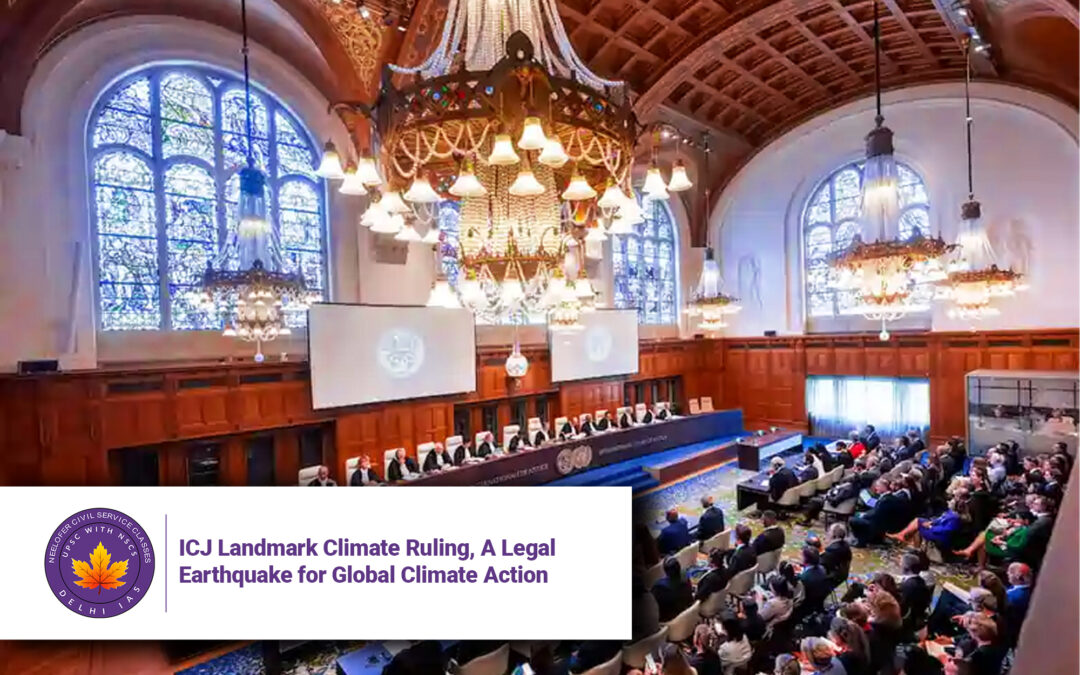
ICJ Landmark Climate Ruling, A Legal Earthquake for Global Climate Action
Introduction
In a historic move that could reshape international climate policy, the International Court of Justice (ICJ) issued a groundbreaking advisory opinion clarifying nations’ legal obligations to combat climate change. While advisory opinions are non-binding, this ruling—triggered by small island nations facing existential threats—carries immense moral and political weight. It declares that:
-
The 1.5°C warming limit is now a legal benchmark (not just aspirational).
-
Developed nations must provide climate finance/tech transfers as a binding duty.
-
No country can hide behind “self-contained” climate treaties to evade responsibility.
This article examines:
-
The ICJ’s key rulings and their legal implications
-
How this empowers vulnerable nations (like Pacific islands)
-
India’s dilemma: Balancing development vs. climate justice
-
The future of climate litigation (including cases in India)
-
A 5-point action plan for compliance
Why in News?
-
ICJ’s first-ever climate advisory opinion (July 2024).
-
Unanimous verdict: States must protect the climate system under international law.
-
Key directives:
-
1.5°C is the legal threshold (overriding vague Paris Agreement language).
-
Rich nations must fund Global South’s climate efforts (mitigation + adaptation).
-
Climate action = human rights obligation (especially for vulnerable groups).
-
-
India impacted: Must ramp up NDCs, faces pressure on coal reliance.
Key Issues and Analysis
1. Decoding the ICJ’s Landmark Rulings
**A. From “Well Below 2°C” to 1.5°C as Law
-
Paris Agreement used flexible terms; ICJ locked in 1.5°C based on IPCC science.
-
Now legally risky for nations to submit weak NDCs (e.g., Australia’s coal expansion).
B. Climate Finance: No More Empty Promises
-
Developed nations (U.S., EU) must pay—not as charity, but as legal duty.
-
$100B/year pledge (2009) still unmet; ICJ says this violates “good faith.”
C. Rejecting the “Self-Contained Regime” Argument
-
India, China argued climate treaties override other laws. ICJ said no—customary international law still applies.
-
Implication: Even if U.S. quits Paris again, it’s still liable for emissions.
2. Global South vs. North: The Equity Battle
| Issue | Global North’s Stance | Global South’s Leverage Now |
|---|---|---|
| Climate Finance | “Voluntary contributions” | Legally enforceable obligation |
| Historical Emissions | “Move forward, not blame past” | ICJ recognizes CBDR-RC principle |
| Tech Transfers | Patent protections > sharing | Court mandates “duty of cooperation” |
Case Study: Small Island States
-
Marshall Islands, Tuvalu (population: < 100k) drove this ICJ request.
-
Now can sue big emitters (e.g., G20) for climate damages under international law.
3. India’s Tightrope Walk
A. Pressure Points
-
Coal dependence: 70% of India’s electricity; ICJ says must align with 1.5°C.
-
NDC loopholes: Current targets still align with 2°C warming (Climate Action Tracker).
B. Strategic Opportunities
-
Demand $1T from developed nations for solar/wind transition.
-
Lead Global South bloc in COP29 negotiations.
4. The Litigation Tsunami: Courts as Climate Warriors
-
India’s Supreme Court: Hearing Ridhima Pandey v. India (youth suing for stronger climate action).
-
Europe: Swiss women won at ECHR (April 2024) over govt’s climate failures.
-
U.S.: Juliana v. U.S. could revive using ICJ opinion.
Precedent Set: Climate inaction = human rights violation.
5-Point Action Plan for Compliance
1. Revise NDCs Urgently
-
India must upgrade 2030 targets (e.g., 50% renewables → 65%).
2. Sue for Climate Finance
-
Lead G77 to file ICJ cases against defaulting nations (U.S./EU).
3. Just Transition Law
-
Protect coal workers via Green Jobs Act (modeled on Germany’s).
4. South-South Climate Bloc
-
India + Africa + island states = united COP29 front.
5. Corporate Accountability
-
Mandate emission cuts for top 100 Indian companies.
Conclusion: The End of Climate Impunity?
The ICJ’s opinion is a turning point—it lifts climate action from political promises to legal obligations. While enforcement remains tricky, the moral weight is undeniable. For India, the choice is clear: resist and lag, or lead and transform.
The Road Ahead:
✔ Global South must weaponize this ruling in COP29.
✔ Domestic courts must enforce ICJ principles.
✔ Fossil fuel era’s legal reckoning has begun.
As the Marshall Islands’ envoy declared:
“This is the day climate justice became law.”
5 Key Questions & Answers
Q1: Is the ICJ ruling legally binding?
A1: No, but sets precedent—courts/governments will use it to pressure states.
Q2: How does this help small island nations?
A2: They can now sue for damages (e.g., rising seas drowning territories).
Q3: What’s India’s biggest challenge post-ruling?
A3: Balancing coal jobs vs. 1.5°C compliance while demanding climate cash.
Q4: Can the U.S. ignore this?
A4: Short-term yes, but faces trade/legal isolation if it does.
Q5: What’s the #1 takeaway?
A5: Climate inaction is now a punishable legal failure—not just bad policy.

