
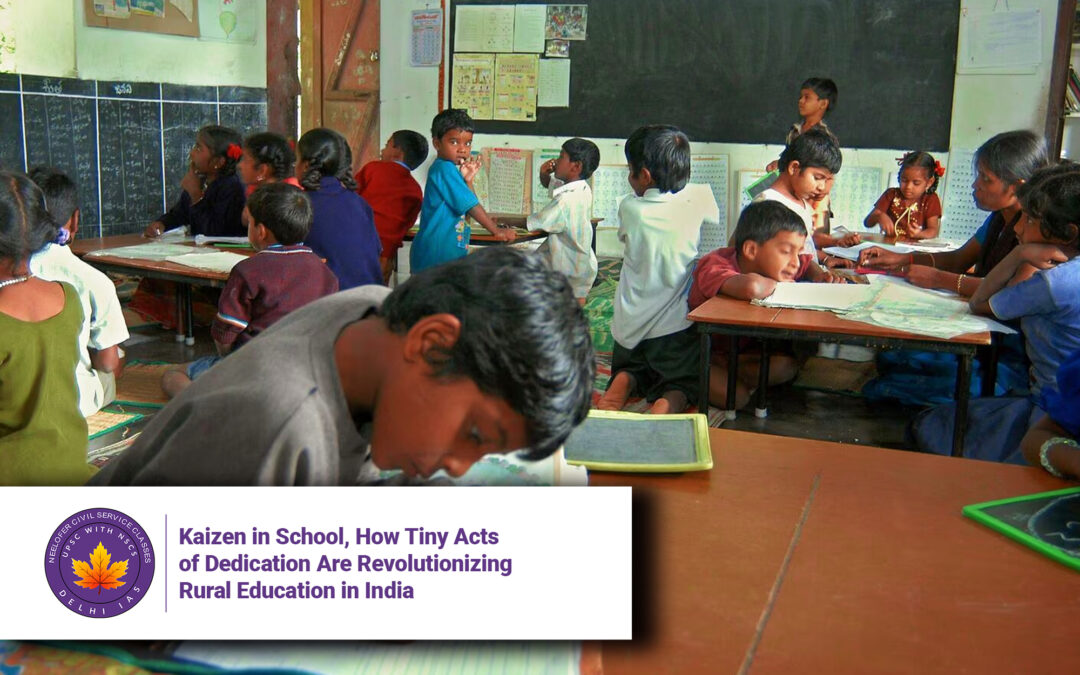
Kaizen in School, How Tiny Acts of Dedication Are Revolutionizing Rural Education in India
Introduction
In an age where sweeping educational reforms often dominate policy debates, a quiet revolution is taking place in the heartlands of India—rooted not in grand visions or massive financial investments, but in tiny, sustained improvements made by people deeply committed to their mission. These are stories of Kaizen—a Japanese philosophy of continuous, incremental improvement—being practiced in Indian classrooms, where each thoughtful act by a teacher or community member is bringing about profound transformation.
One such story, narrated by Anurag Behar, CEO of the Azim Premji Foundation, illustrates how a small rural school, tucked away in what many would consider a remote and underdeveloped part of India, underwent a complete cultural and educational transformation—all sparked by a seemingly trivial change: students moving between classrooms instead of staying put all day.
What followed was a living testament to the power of dedicated individuals, incremental thinking, and the relentless pursuit of improvement, often without any formal institutional backing or recognition. This story is not an isolated case but a representation of the possibility of systemic improvement in schools across India, especially in marginalized and underserved communities.
The Setting: A Modest Rural School
Located in a remote village, the school in question doesn’t follow the typical “one room, one class” structure. In most Indian government schools, rooms are designated for classes—Class 1 to Class 5, for example—where the students remain static, and teachers rotate in and out. However, in this school, the rooms are not assigned to specific grades but to subjects. The school calls them ‘subject rooms’.
This unconventional layout began with a memory sparked by monotony. The head-teacher, a local who had studied in the same school since its founding 18 years ago, was struck by how little had changed in its functioning. After returning to the school years later, now as a teacher, he recalled how boring it was to stay in the same classroom all day.
Driven by this reflection, he decided to experiment with mobility within the school. Hindi, Mathematics, and English each got their own rooms. With only three physical classrooms available, a fourth space was created for Environmental Studies—outdoors, shaded by trees. This new arrangement gave each subject its own identity and each room a specialized purpose.
Excitement in Motion: The Children’s Response
The children’s response was immediate and enthusiastic. Movement between rooms brought a sense of freedom, excitement, and anticipation—a welcome contrast to the otherwise still, unchanging environment of traditional classrooms. The students felt as though something special was happening. It disrupted the monotony and added a layer of novelty that improved focus and engagement.
Over time, the teachers themselves began reimagining their roles. No longer were the rooms just empty shells—they became their rooms, infused with their own teaching styles, posters, tools, and innovations. The spaces turned into subject-specific resource centers, with corners filled with games, models, and teaching aids tailored to each discipline. Materials that once sat unused began to thrive in this new, energizing environment.
This gradual evolution didn’t just change the classroom; it shifted the entire school culture.
The Impact: More Than Just Academic Gains
When Anurag Behar visited the school years later, he discovered that what began as a simple logistics solution had grown into a deep, systemic change. The children had exceeded expectations for their grade level. Students in Class 3 displayed proficiency in Hindi, Mathematics, and even English—a subject that is often introduced later and poses considerable challenges in rural India.
But what truly stood out was the children’s attitude—they were confident, joyful, and free of fear. In a region grappling with poverty and social discrimination, the students showed no signs of hesitation or inferiority. The environment had become one where learning was joyful, not forced; where children were not merely present, but truly thriving.
Pedagogical Innovation Without Formal Training
The head-teacher’s approach wasn’t based on any formal pedagogy, academic theory, or government directive. When asked how he managed to reimagine the school so fundamentally, he responded with simplicity and humility: he had no theories or plans—just a daily commitment to doing a little better.
Each day, he and his team would gather, reflect, tweak, and try again. The approach mirrors the Kaizen philosophy—continuous, incremental change rooted in reflection and collaboration.
This wasn’t about revolutionizing the school system overnight. It was about taking small, thoughtful steps with consistency and dedication.
Systemic Reflections and Broader Learnings
This story serves as a case study in how micro-level educational reform, led by people on the ground, can yield macro-level impact. It teaches us that:
-
First, resource-poor schools are often perceived as incapable of reform. But with committed educators, even these schools can become beacons of change.
-
Second, a group of dedicated teachers, without high-level planning or funds, can create learning environments that are rich, dynamic, and effective.
-
Third, the role of teachers as change agents must be recognized. A teacher who takes initiative can reshape the learning culture of an entire school.
-
Fourth, even under constraints, joyful learning environments can be created where students thrive without fear, competition, or pressure.
-
Fifth, the most important lesson: change in education is possible without sweeping reforms. Small steps, taken daily, with clarity of purpose, can lead to extraordinary transformations.
Conclusion: The Real Heroes of Education Reform
The story isn’t just about one school or one teacher. It reflects a wider pattern of quiet educational heroism happening across India. These are unsung reformers, working without headlines or recognition, slowly bending the arc of the system toward excellence and equity.
These educators do not wait for large-scale policies to change. They act now, with whatever they have, wherever they are. They model what is possible, inspiring others not by words, but by action. Their methods may be simple, but their impact is profound.
As Behar aptly writes, those who create such quiet miracles in our schools are the real heroes, and they teach us that small, persistent changes can change the world—one classroom at a time.
5 Key Questions and Answers
Q1: What was the main change introduced by the head-teacher in the school, and why was it significant?
Answer: The head-teacher restructured the school by designating separate rooms for each subject instead of having students remain in the same classroom all day. This allowed for mobility, brought excitement into the school day, and made each room feel like a dynamic, purpose-driven space. Over time, this small logistical change transformed the teaching and learning culture, enabling deeper engagement and better academic outcomes.
Q2: How did teachers and students respond to this new system of ‘subject rooms’?
Answer: Both students and teachers responded enthusiastically. Students enjoyed the physical movement and variety, which broke the monotony of the traditional school day. Teachers began to ‘own’ their subject rooms, decorating them with posters, teaching aids, and games. These rooms evolved into subject-specific resource centres, encouraging deeper learning and creativity.
Q3: What were the broader educational outcomes observed after this transformation?
Answer: Students, particularly in Class 3, exceeded academic expectations. They gained competence in key subjects like English, Maths, and Hindi and showed strong foundational understanding. More importantly, they exhibited confidence, joy, and freedom from fear, which are rarely seen in children from impoverished or remote areas. The culture of learning had become vibrant and inclusive.
Q4: What does this story tell us about the nature of educational reform in India?
Answer: The story shows that meaningful educational reform doesn’t always require massive funding, policy shifts, or systemic overhauls. Instead, consistent, thoughtful, and small changes, led by committed individuals, can lead to massive improvement in outcomes. It’s a reminder that those closest to the problems—teachers, principals, and communities—often hold the best solutions.
Q5: How does this case reflect the philosophy of Kaizen, and why is it relevant today?
Answer: The school’s transformation is a textbook example of Kaizen—the practice of making continuous, small improvements over time. Without grand theories or plans, the head-teacher and his team implemented small changes every day. This incremental approach is highly relevant today because it offers a scalable, sustainable path for educational change, especially in resource-constrained environments.

