
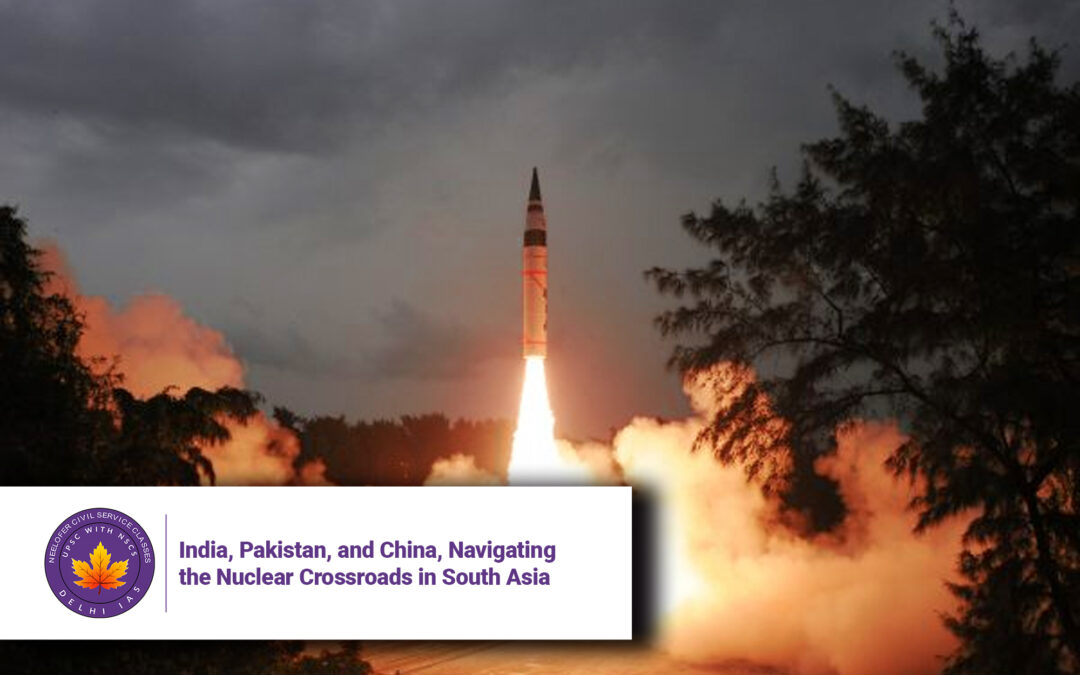
India, Pakistan, and China, Navigating the Nuclear Crossroads in South Asia
Introduction
South Asia today sits on a precarious edge—tightly roped between history, geopolitics, and nuclear brinkmanship. The echoes of military operations like Operation Sindoor have resurrected concerns about the stability of the subcontinent, especially with recent references by Indian leadership to “nuclear threats” and “nuclear blackmail”. These statements, paired with Pakistan’s habitual brandishing of its nuclear deterrent, mark a disturbing shift in the region’s nuclear discourse.
India’s changing posture reflects a significant recalibration of its deterrence strategy, perhaps a response to evolving threats from both Pakistan and China. However, these adjustments must be paired with robust dialogue mechanisms, particularly when the danger of dual-capable systems, accidental escalation, and non-transparent doctrines looms large.
In the wake of these challenges, there is a strong and urgent need to remove politics from the nuclear equation and bring in sustained, rational, and transparent communication frameworks.
Changing Doctrines in a Changing World
At the heart of India’s post-Operation Sindoor rhetoric lies a calculated shift in deterrence doctrine. Prime Minister Narendra Modi’s sharp references to Pakistan’s “nuclear blackmail” during the debate following the operation marked not just a domestic political signal, but a clear message to both adversaries and allies: India is ready to act against terrorism without being cowed by nuclear threats.
This move echoes a broader shift in India’s strategic framework—one that seeks to challenge Pakistan’s use of its nuclear status as a cover for cross-border terrorism. By signalling that “bluffing” with nukes will not deter retaliation, India appears to be redefining its red lines, complicating the calculus of potential adversaries.
Simultaneously, China’s nuclear trajectory is pushing boundaries at a global scale. With projections estimating 1,000 nuclear warheads by 2030, Beijing’s push for parity with superpowers like the US is reshaping strategic dynamics in Asia. Its dual-capable missile systems like the DF-41 and DF-17 hypersonics—capable of carrying both conventional and nuclear warheads—blur the lines between conventional warfare and atomic escalation.
Pakistan, on the other hand, has been innovating too—albeit with narrower goals. Its nuclear doctrine, veiled in ambiguity, remains focused on deterring Indian conventional military superiority. Concepts like “minimum credible deterrence” and “full-spectrum deterrence” are aimed at neutralizing Indian advances such as the Cold Start doctrine. Yet, Pakistan continues to avoid officially declaring a nuclear doctrine or adopting transparency in arsenal capabilities.
The Threat of Dual-Use Technologies
One of the most pressing dangers in the contemporary nuclear landscape is the rise of dual-capable systems and emerging technologies. Advanced computing, AI-enabled weapons, and hypersonic delivery systems could render conventional-nuclear distinctions almost meaningless.
For instance, a precision-guided surface-to-surface missile could carry either a conventional or nuclear payload. In the fog of war, discerning the intent behind such an incoming projectile becomes nearly impossible. A defender faced with a missile heading toward a strategic target—such as a nuclear command center—might assume the worst, opting to retaliate pre-emptively.
The implications of such ambiguity are terrifying. Not only does it increase the chances of misinterpretation, but it also lowers the nuclear threshold, making atomic warfare more thinkable during a conventional crisis.
The “Dial-a-Yield” Dilemma and Escalation Risks
Another technological development threatening strategic stability is the availability of “dial-a-yield” nuclear warheads—devices whose explosive power can be adjusted depending on the intended target. These can range from sub-kiloton “tactical” nukes to multi-hundred-kiloton city-busters.
While the technical appeal of such flexibility may be evident to military planners, its impact on deterrence stability is disastrous. By making nukes usable in a conventional setting, it further weakens the traditional barrier between nuclear and non-nuclear war. In conflict scenarios, this could embolden a state to employ smaller nukes without fearing full-scale retaliation—triggering a catastrophic ladder of escalation.
Past Confidence-Building Measures: Not Enough
To mitigate such risks, India, Pakistan, and China have, over the years, entered into limited Nuclear Risk Reduction Measures (NRRMs):
-
The 1999 Lahore Memorandum of Understanding, aimed at reducing the risk of accidental nuclear conflict.
-
The 2005 Agreement on Pre-Notification of Missile Tests, encouraging transparency in missile launches.
-
The 2007 Agreement to Reduce Nuclear Risks, focusing on avoiding miscommunication and accidental war.
However, these mechanisms remain sporadic, insufficient, and unsustained. Despite their initial promise, the region continues to lack a robust, consistent, and non-political forum for nuclear dialogue.
Operation Sindoor and the New Escalation Ladder
The aftermath of Operation Sindoor illustrates how real the risks of escalation are. Speculative intelligence suggested that Indian airstrikes may have targeted nuclear-capable air bases like Sargodha and Rawalpindi in Pakistan. Although the Indian Air Force denied any intention to strike nuclear assets, the mere perception that India demonstrated its ability to do so has raised red flags among analysts.
If interpreted as a warning strike or a pre-emptive signal, such moves could destabilize fragile deterrence dynamics. A conventional attack on a nuclear facility—even if unintentional—could provoke retaliation, panic, or miscalculated launches. That is a nightmare scenario for a region with three nuclear powers.
Why We Need Dialogue Without Political Rhetoric
There are manifold reasons why India and Pakistan need a sustained nuclear dialogue, detached from the baggage of daily politics:
-
Ambiguity breeds paranoia: The lack of clarity around doctrines, capabilities, and intent increases misperception risks.
-
Accidents are not theory: Past incidents globally—such as U.S. false alarms during the Cold War—demonstrate how close humanity has come to accidental apocalypse.
-
Conventional attacks may misfire: A missile strike on a dual-use target could be misread as the opening salvo of a nuclear war.
-
Emerging technologies add uncertainty: Hypersonic missiles, AI-based systems, and cyber threats may disable second-strike capabilities, provoking first-strike temptations.
These issues demand open-source intelligence sharing, direct hotlines, joint simulations, and a non-aggression pact on nuclear sites—not just political theatrics during crises.
Three Recommendations for the Way Forward
1. Institutionalize Nuclear Dialogue Mechanisms
India, Pakistan, and China must form a South Asian Nuclear Risk Reduction Forum, facilitated perhaps by the United Nations or a neutral third party. It should have the mandate to:
-
Enforce transparency on nuclear posture updates.
-
Review technological developments affecting strategic stability.
-
Design protocols for de-escalation during crises.
2. Reaffirm “No First Use” Commitments
India’s official doctrine of No First Use (NFU) must be preserved and re-emphasized in diplomatic engagements. At the same time, India should push for regional acceptance of NFU by China and Pakistan to reinforce the barrier against first strikes.
3. Define Nuclear Redlines Publicly
All three states should articulate what constitutes a nuclear redline. This would help reduce ambiguity in case of conventional operations, preventing accidental crossing of thresholds.
Conclusion
The nuclear landscape of South Asia has become increasingly complex. With modern technologies threatening to outpace existing doctrines, and with trust at an all-time low, the risk of intentional or accidental escalation has never been higher.
While India’s assertive stance post-Operation Sindoor may have bolstered its deterrence image, it also raised the stakes in a region where three nuclear powers stare each other down.
The way forward lies in clear communication, sustained dialogue, and political maturity. A nuclear exchange in South Asia would not only devastate the subcontinent—it would destabilize the entire world.
Q&A: Understanding South Asia’s Nuclear Crossroads
Q1: Why is there a heightened nuclear risk in South Asia today?
A1: The risk has increased due to multiple factors: rising tensions after Operation Sindoor, ambiguity around nuclear doctrines, growing arsenals (especially China’s), development of dual-use systems, and the absence of sustained nuclear dialogue mechanisms. All of these elements heighten the possibility of misperception or accidental escalation.
Q2: What are “dual-capable” delivery systems, and why are they dangerous?
A2: These are missiles or platforms that can carry either conventional or nuclear warheads. In conflict, it’s nearly impossible to tell which type of payload is being used. This ambiguity can lead adversaries to assume the worst, potentially triggering a nuclear retaliation even in response to a conventional attack.
Q3: How has India’s nuclear posture evolved post-Operation Sindoor?
A3: India has signaled a more assertive stance, suggesting that it will not be deterred by Pakistan’s nuclear threats when responding to terrorism. This represents a shift from restraint to more active deterrence. However, this also increases the risks of confrontation if not paired with strategic communication.
Q4: What steps can reduce the risk of nuclear escalation in the region?
A4: Key steps include: resumption of formal nuclear dialogues, establishment of crisis communication channels, reaffirmation of No First Use (NFU) doctrines, clarification of nuclear redlines, and transparency in arsenal capabilities. Additionally, avoiding targeting nuclear facilities with conventional weapons is critical.
Q5: Why is a non-political nuclear dialogue necessary?
A5: Political rhetoric often inflames rather than calms tensions. A non-political forum allows military planners, strategic analysts, and diplomats to discuss nuclear issues based on facts, risks, and future scenarios without the distortion of electoral or ideological agendas. This can help slow down the arms race and prevent misunderstandings during crises.

