
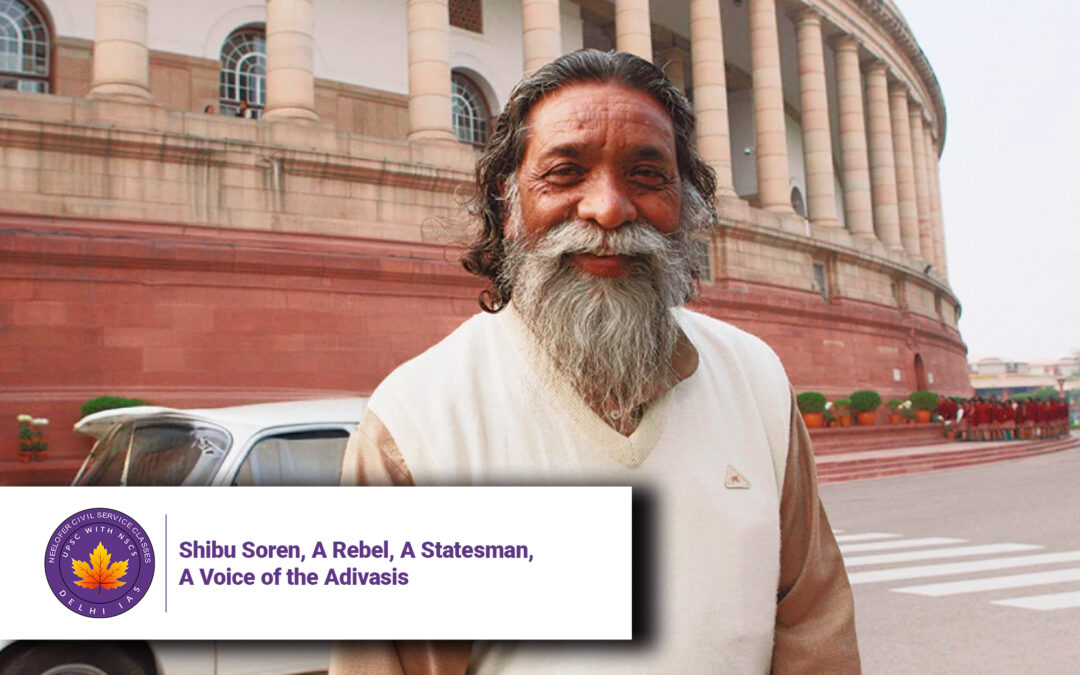
Shibu Soren, A Rebel, A Statesman, A Voice of the Adivasis
Introduction
With the passing away of Dishom Guru Shibu Soren, India has lost one of its most iconic and impactful tribal leaders. A figure who rose from grassroots struggles to become the three-time Chief Minister of Jharkhand, Shibu Soren was not just a political leader—he was a movement in himself. His life story is one of rebellion, resistance, accommodation, and political transformation.
His legacy transcends electoral victories. It is deeply etched in the socio-political consciousness of the tribal communities of Jharkhand, West Bengal, and Odisha. Shibu Soren’s contributions laid the foundational stone for the creation of Jharkhand, giving voice to the aspirations of Adivasis, fighting exploitation, and pushing the boundaries of mainstream politics to accommodate indigenous realities.
Early Life: Trauma and Awakening
Born in Nemra, a village in Ramgarh district, Shibu Soren lost his father, Sobran Manji, at a very young age. His father was killed by moneylenders, a brutal incident that left an indelible mark on Soren’s psyche. The injustice of this act—common in Adivasi areas where land grabbers and moneylenders exploited tribals—ignited a lifelong flame of resistance in him.
Rather than moving to the cities or adopting the ways of mainstream India, Soren chose a different path: the path of political rebellion. He aligned himself with the grassroots, becoming the voice of the oppressed. He didn’t just inherit a legacy of resistance; he transformed it into a movement.
Birth of a Rebel: From Sonot Santal Samaj to Jharkhand Mukti Morcha
In 1972, Soren took a major step forward by establishing the Sonot Santal Samaj, a platform for fighting against the oppression of Adivasis by non-tribal settlers and landlords. In the same year, he joined forces with Marxist leader Binod Bihari Mahato to form the Shivaji Samaj, another platform that pushed for political empowerment alongside social reform.
This coalition laid the groundwork for the birth of the Jharkhand Mukti Morcha (JMM) in 1973. The JMM quickly emerged as a significant political force, seeking not only to alleviate the socio-economic struggles of tribals but to secure political representation and eventually statehood for Jharkhand.
The movement was greatly influenced and supported by figures such as Arun Kumar Roy, a Marxist trade unionist from the Dhanbad coal belt, who compared Soren’s influence to that of Lenin of Jharkhand.
Militancy, Underground Years, and Mass Mobilization
The Jharkhand movement, under Soren’s leadership, became a mass mobilization force. The red Marxist flag and the green tribal flag were often unfurled together in protest rallies, bringing together workers, peasants, and tribal populations under one banner.
Soren’s involvement in the Dhan Kati movement, which encouraged Adivasis to harvest crops from illegally occupied lands, made him a hero but also a target of the state and landowners. He was forced to go underground for a long time, evading arrest while continuing to mobilize the masses.
Despite the militant tones of the movement, Soren remained rooted in the soil, committed to peaceful mass resistance. His image as the Dishom Guru—a spiritual-political figure—grew stronger.
Electoral Politics and JMM’s Rise
Shibu Soren entered electoral politics in the late 1970s. After a few setbacks, he succeeded in becoming an MP in 1980, marking a new phase in his political journey. By 1984, Soren broke ties with his Marxist comrades due to ideological differences and focused solely on building the JMM into a dominant tribal political force.
The 1990s saw the JMM expanding its base into neighboring states like West Bengal and Odisha. Soren was elected multiple times to the Lok Sabha and became Chief Minister of Jharkhand three times. These victories were symbolic and functional. They proved that a tribal leader with little formal education, rooted in grassroots activism, could challenge the state and still thrive within it.
Statehood and Betrayals
The creation of Jharkhand in 2000 was the culmination of decades of struggle. However, it was not without contradictions. The movement that had once thrived on mass mobilization was soon mired in the complexities of party politics. The All Jharkhand Students Union (AJSU) challenged Soren’s leadership and accused him of compromising tribal rights.
In 1986, JMM supported the Congress party during a confidence vote in Parliament, which led to the infamous bribery scandal. Though no charges stuck for a long time, it stained Soren’s reputation. Later, in the early 2000s, he faced murder charges in a decades-old case and had to resign as Union Coal Minister.
Legacy, Family, and End of an Era
On August 4, 2024, the tribal world and Indian politics lost a giant. Shibu Soren passed away at the age of 81. He leaves behind a politically influential family, including:
-
Hemant Soren: Former CM of Jharkhand, currently facing legal cases.
-
Basant Soren: MLA.
-
Kalpana Soren: Daughter-in-law, recently active in state politics.
-
Anjali Soren: Daughter.
Soren’s passing marks the end of a generation of tribal leadership that combined rebellion with accommodation, agitation with negotiation, and resistance with governance.
Conclusion: A Complex Leader for Complex Times
Shibu Soren was never just a politician. He was a statesman, a tribal icon, a revolutionary, and a pragmatist. His closeness to the ground gave him a rare political instinct that few leaders in India possess. He knew when to agitate and when to negotiate. He led from the front, but never lost sight of his community.
He understood that fighting from the outside had its limits, and therefore, embraced the political process. His politics were deeply rooted in the soil of Jharkhand, yet he succeeded in navigating the halls of Parliament.
Today, as Jharkhand and India mourn the death of Dishom Guru, we also reflect on the future of tribal politics. Can the vacuum left by Soren be filled by a new generation? Or will his legacy be diluted by the changing nature of electoral politics?
Whatever the future holds, one thing remains clear: Shibu Soren’s life is a testament to the enduring power of grassroots politics, the resilience of the tribal spirit, and the necessity of political accommodation in a diverse democracy.
Five Key Q&A on Shibu Soren and His Legacy
Q1: What made Shibu Soren such a significant figure in tribal and Indian politics?
A1: Shibu Soren was significant because he combined grassroots tribal activism with mainstream political success. He was instrumental in founding the Jharkhand Mukti Morcha (JMM) and fought for decades for the creation of Jharkhand state. He also became a three-time Chief Minister and a Union Minister, making him one of the few tribal leaders to reach the top echelons of Indian politics.
Q2: What was the Dhan Kati Movement, and how did it shape Soren’s political image?
A2: The Dhan Kati Movement was a land rights movement led by Soren, where tribal people harvested crops from lands they claimed were illegally taken by landlords. This direct action campaign made Soren a hero among tribals and a threat to the establishment, forcing him underground for several years. It cemented his reputation as a fearless leader of the oppressed.
Q3: Why did Soren part ways with Marxist leaders, and what did he do afterward?
A3: Soren parted ways with his Marxist allies in 1984 due to ideological differences. While Marxists focused on class struggle, Soren believed in identity-based politics centered on tribal empowerment. He then transformed JMM into a powerful regional party, focusing on statehood for Jharkhand and tribal rights.
Q4: What controversies surrounded Shibu Soren during his political career?
A4: Soren’s career was marred by several controversies. He was involved in a bribery scandal in 1993, accused of taking money to support the Congress in a confidence vote. He also faced murder charges in a decades-old case, which led to his resignation from the Union Cabinet. Despite these, his mass base remained loyal due to his decades-long service to the tribal cause.
Q5: What is Shibu Soren’s legacy for Jharkhand and India at large?
A5: Soren’s legacy is multifaceted. For Jharkhand, he is the architect of the state and a tribal messiah. For India, he represents a rare success story of a tribal leader who rose to national prominence without compromising his roots. His life shows how identity-based politics, if guided by ethical leadership, can be a force for good.

