
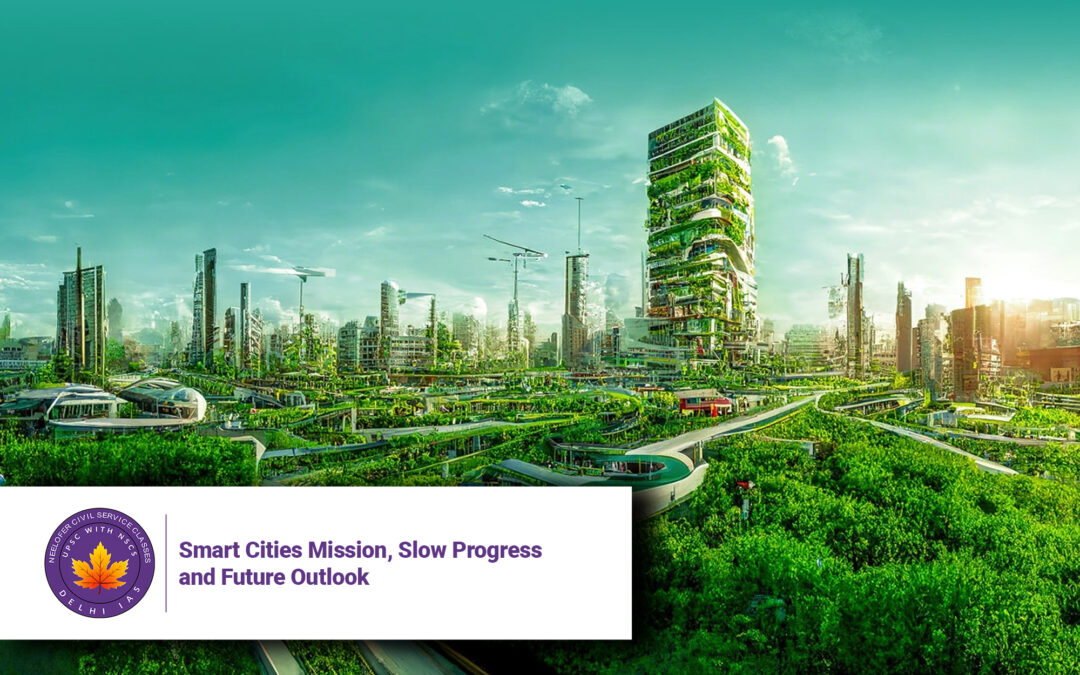
Smart Cities Mission, Slow Progress and Future Outlook
Why in News?
The Smart Cities Mission, launched in 2015 to transform 100 cities in India into citizen-friendly and sustainable urban centres, has seen significant delay in implementation, with only 57% of proposed projects completed by May 2024, despite the original completion deadline being June 2023. This delay and underutilisation of funds have drawn attention to the challenges in urban governance and the need for renewed focus on execution.
Introduction
India is undergoing a rapid urban transition, with more than 34% of its population living in urban areas. To address the challenges of growing urbanisation—such as poor infrastructure, pollution, inadequate transportation, and lack of digital services—the Government of India launched the Smart Cities Mission (SCM) in June 2015. The mission aimed to transform 100 selected cities into models of urban development by leveraging technology, citizen participation, and sustainable planning.
Now, ten years since its launch, the results have been mixed. While there are visible improvements in some cities, the overall progress remains slow and uneven.
Key Objectives of the Smart Cities Mission
-
Core Infrastructure Development: Reliable water and electricity supply, sanitation, waste management, urban mobility, and housing.
-
Sustainable Environment: Promotion of clean and green energy, energy-efficient buildings, and eco-friendly transportation.
-
Use of Technology: Implementing ICT-based solutions for governance, traffic management, water supply, and public services.
-
Citizen-centric Services: E-governance, smart classrooms, smart health centres, and safety measures like smart surveillance.
-
Area-Based Development (ABD): Focus on retrofitting and redevelopment of specific areas in the city to act as models for the rest of the region.
Key Issues Identified in the Progress Report
As of May 2024:
-
Out of 7,989 total proposed projects, only 4,546 (57%) were completed.
-
Total project cost: ₹1.7 lakh crore.
-
Projects under Area-Based Development (ABD) have been prioritised over Pan-City development.
-
States like Uttar Pradesh, Tamil Nadu, Maharashtra, Madhya Pradesh, and Gujarat have the highest number of projects.
-
Cities like Agra and Chennai received the highest funds, but also saw significant delays.
Specific Challenges Highlighted:
-
Delays in Tendering: Many projects took 2–3 years to even reach the tendering stage.
-
Capacity Issues: Urban local bodies (ULBs) lacked technical expertise for smart city planning.
-
Coordination Problems: Poor coordination between Centre, State, and Special Purpose Vehicles (SPVs).
-
Underutilisation of Funds: Several cities failed to utilise the central assistance and tied-up funds effectively.
-
Focus Shift: Some cities focused more on beautification (e.g., smart roads, LED streetlights) than long-term infrastructure solutions.
Positive Outcomes Despite Delay
Despite the slow pace, the Smart Cities Mission has led to certain notable outcomes:
-
Improved Public Transport: In cities like Surat, Bhopal, and Pune, intelligent transport systems have improved mobility.
-
Digital Initiatives: Several cities have implemented Integrated Command and Control Centres (ICCCs) for real-time monitoring.
-
Energy Efficiency: LED lighting and solar installations have reduced power usage.
-
Water and Waste Management: Cities like Indore and Visakhapatnam have improved solid waste management through smart technologies.
Alternative Approaches and Learnings
-
Decentralised Planning: Cities like Bhubaneswar and Pune involved citizens in project design, which led to better outcomes.
-
Private Sector Participation: Public-private partnerships (PPP) were effective in some cities, especially for ICT and surveillance infrastructure.
-
Phased Execution: Some cities broke down projects into smaller, manageable components, leading to faster implementation.
These approaches should be documented and scaled across other urban projects in India.
Challenges and the Way Forward
Challenges Ahead:
-
Capacity Building: Urban local bodies still lack the skilled workforce required to manage and operate smart systems.
-
Integration with Other Missions: The SCM must integrate with AMRUT, Swachh Bharat, and Housing for All to ensure synergy.
-
Sustainability Concerns: Many projects lack long-term financial and environmental sustainability.
-
Maintenance Issues: Infrastructure created under the mission requires regular upkeep, which is often neglected.
-
Urban Inequality: Focus on selected pockets has led to exclusion of other parts of the city.
Way Forward:
-
Extend Deadlines with Accountability: A realistic extension of the timeline with strict monitoring mechanisms.
-
Strengthen SPVs and ULBs: Provide technical and financial training to municipal staff and SPVs.
-
Promote Community Participation: Involving citizens ensures ownership and better utilisation of services.
-
Adopt Low-Cost Technologies: Focus on scalable, frugal innovations rather than flashy projects.
-
Outcome-Based Monitoring: Shift from input-based metrics (like money spent) to outcomes like air quality, water access, etc.
Conclusion
The Smart Cities Mission was a visionary step to revolutionise India’s urban landscape. However, its uneven implementation, delays, and fund mismanagement reveal deep-rooted governance issues. The Mission should not just be about technology, but about creating inclusive, livable, and sustainable cities. For future success, there is a need to strengthen institutional capacities, learn from model cities, and focus on outcomes that genuinely improve citizens’ lives.
Five Questions and Answers
1. What is the Smart Cities Mission?
The Smart Cities Mission is an urban renewal programme launched in 2015 to develop 100 cities across India into citizen-friendly and sustainable urban centres using smart solutions and technology.
2. How many projects have been completed under the Smart Cities Mission as of May 2024?
Out of 7,989 proposed projects, 4,546 (57%) have been completed by May 2024.
3. What are some key challenges faced in the implementation of the Mission?
Delays in tendering, underutilisation of funds, weak capacity in urban local bodies, poor coordination between stakeholders, and lack of sustainability are key challenges.
4. Which states have received the highest number of projects?
Uttar Pradesh, Tamil Nadu, Maharashtra, Madhya Pradesh, and Gujarat received the highest number of smart city projects.
5. What is the way forward for effective urban development under this Mission?
Capacity building, deadline extensions with accountability, promoting citizen participation, and shifting to outcome-based monitoring are essential for future progress.

