
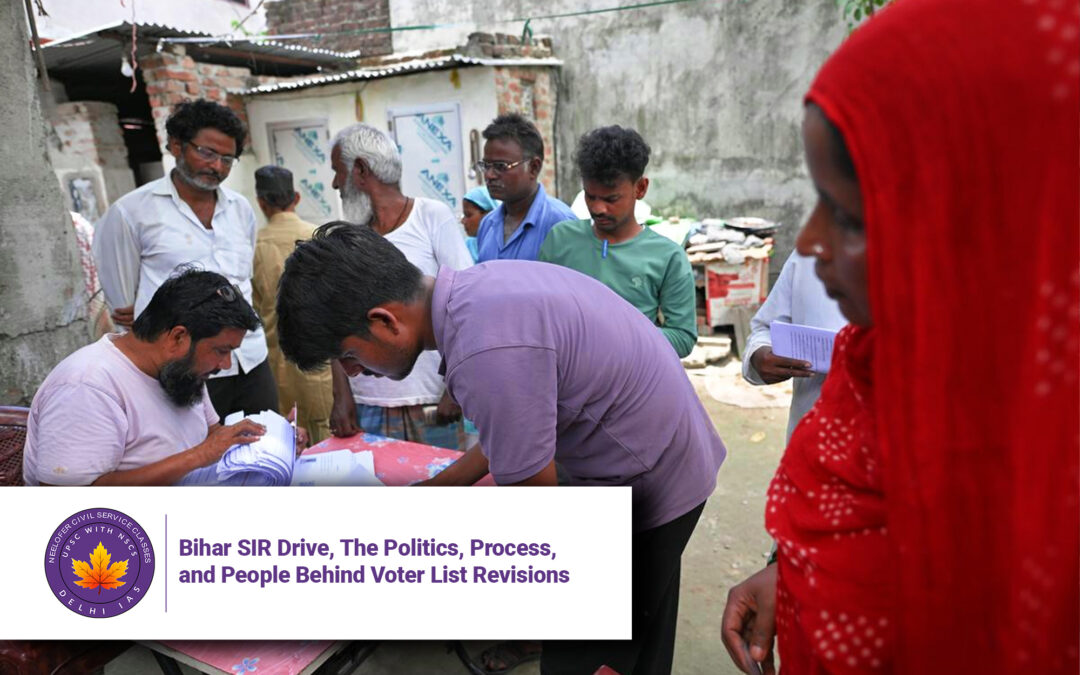
Bihar SIR Drive, The Politics, Process, and People Behind Voter List Revisions
Why in News?
The Election Commission’s Special Intensive Revision (SIR) of voter rolls in Bihar has become a flashpoint of political and social debate. Allegations of exclusion, chaos, and bias have emerged, but what the process reveals is deeper than just inefficiency. The exercise has brought into focus the nature of citizen-state engagement in India, showing that ordinary people are not passive entities but active participants in shaping how governance is negotiated.
Introduction
In democratic societies, the voter list is more than just an administrative document—it is a gateway to citizenship, rights, and power. In Bihar, the ongoing SIR drive initiated by the Election Commission of India (ECI) aimed to clean and update the electoral rolls by removing ineligible names. However, this technical procedure has created a complex political landscape, with criticisms emerging from various quarters, including civil society and political parties. At the heart of this issue is not just governance or enumeration but the fundamental relationship between the Indian state and its citizens.
The SIR has, in effect, become a de facto NRC (National Register of Citizens) exercise for Bihar, raising questions about due process, transparency, and the inclusion of marginalized groups. While the EC maintains that the exercise is lawful and necessary, social and political implications suggest that the process has been more controversial than expected.
Key Issues and Institutional Concerns
1. Scale and Confusion of the Exercise
The EC justified the SIR in the Supreme Court, citing its need to clean the voter list. However, the actual process on the ground has caused confusion and hardship. People were shocked to find their names missing due to reasons like being deceased, duplication, or lack of documentation. Many were excluded on the suspicion of being “permanently” outside Bihar, non-citizens, or lacking Aadhaar or mobile verification. As a result, ordinary citizens—especially the poor and illiterate—faced difficulties in proving their eligibility to vote.
2. Vulnerability of Marginalized Groups
The process disproportionately affected marginalized communities. Dalits, Muslims, and rural populations were reportedly the worst hit, with many being left out or struggling to re-enroll. Many activists see this as reminiscent of Assam’s NRC exercise, which too was marked by widespread exclusions and socio-political tension. Even though the stated goal was to clean up the rolls, the manner in which names were deleted seemed to be arbitrary and lacking sensitivity.
3. Technology-Driven Exclusion
The enumeration process relied heavily on mobile apps and Aadhaar-based digital verification. Enumerators—mostly Booth Level Officers (BLOs)—were required to submit updates through the Election Seva App. However, the dependence on digital methods created new barriers. Many poor or elderly voters did not have mobile numbers linked to their Aadhaar, nor did they possess proper identification documents. Consequently, the reliance on tech, while efficient in theory, excluded those who lacked digital literacy or access.
4. Politicisation of the Exercise
Political parties, particularly the opposition RJD, have accused the EC of targeting specific communities. The argument is that the selective deletion of voters is not just bureaucratic error but intentional disenfranchisement of a section of voters who are likely to support the opposition. Even though the EC claims neutrality, the timing and manner of the exercise close to the elections have invited suspicion and criticism.
5. Statistical Exercises and Human Reality
Census-like revisions, when driven purely by data, often fail to consider the human side of the process. Identity, belonging, and citizenship are not just digital entries but are rooted in personal histories and struggles. The EC’s SIR drive, although aimed at ensuring clean elections, missed this human element. As statistics become tools for political control, they also reflect power dynamics—who is counted, and who is left out.
Challenges and the Way Forward
1. Trust Deficit and Public Anger
The biggest challenge now is the erosion of trust between the people and the institutions meant to serve them. Many now fear that voter list revisions could be used as tools of political control rather than democratic empowerment. The EC must address these concerns transparently and publicly, reassuring citizens that the exercise is not politically motivated.
2. Strengthening BLO Training and Processes
Field-level enumerators (BLOs) were expected to manage a digital-heavy enumeration process with little training. In the absence of clear guidelines or local-level awareness, many made arbitrary deletions. BLOs should receive formal training in data handling, citizen rights, and inclusive methods. Their role is too crucial to be left to chance or minimal supervision.
3. Inclusion-Centric Reforms
The EC must adopt a people-first approach rather than a process-first one. Inclusion must be prioritized, and re-verification mechanisms should be designed for easy re-enrollment. Assistance centers should be established for citizens to understand the process and get help with documentation.
4. Accountability and Independent Oversight
Given the political nature of the controversy, independent monitoring bodies—possibly from civil society—should oversee such enumeration drives. A transparent complaint redressal mechanism should also be put in place to handle wrongful deletions.
5. Learning from Assam NRC’s Mistakes
Assam’s NRC exercise, which excluded over 19 lakh people, taught us how large-scale enumeration can backfire without proper planning and safeguards. Bihar’s SIR should not repeat those mistakes. The EC must ensure that future exercises are not driven by data obsession but guided by democratic values.
Conclusion
At its core, the SIR process in Bihar reflects the challenges of governance in a large and diverse democracy. While the goal of maintaining clean and updated voter rolls is legitimate, the execution has exposed systemic flaws—especially in how institutions interact with marginalized populations. Citizens are not just passive recipients of governance; they actively negotiate, protest, and push back.
Rather than dismissing the chaos as routine, we must see it as a lesson: Democracy is not just about numbers, but about people. Transparency, inclusion, and fairness must be the cornerstones of any democratic exercise—especially those that determine who gets to vote.
Q&A Section
1. Why did the Election Commission initiate the Special Intensive Revision (SIR) in Bihar?
The EC launched the SIR to clean up the electoral rolls by removing duplicate, deceased, or ineligible voters. The goal was to ensure a fair and updated voter list ahead of the upcoming elections. However, the process turned controversial due to its execution and socio-political impact.
2. What were the main criticisms of the SIR process?
Critics argued that the SIR exercise led to wrongful deletions, especially of marginalized groups like Muslims, Dalits, and the rural poor. The process was heavily digital, which excluded those without mobile access or documentation. It was also criticized for being politically motivated and poorly managed.
3. How did the SIR process affect ordinary citizens?
Many citizens discovered their names missing from the voter list due to errors, lack of documents, or arbitrary deletions. Some were told to re-verify their identity without clear guidance. The exercise created panic and confusion, especially among the poor and less educated.
4. What role did technology play in the SIR process?
The EC used digital tools like the Election Seva App for BLOs to upload data. Aadhaar and mobile verification were key steps. However, reliance on tech created hurdles for people who lacked digital access, leading to exclusion rather than inclusion.
5. What can be done to improve such voter revision exercises in the future?
Future exercises should prioritize inclusivity, provide better training to BLOs, establish transparent complaint systems, and avoid politicization. Most importantly, citizens must be viewed as active participants, not data points. Independent oversight and public communication can help rebuild trust in the process.

