
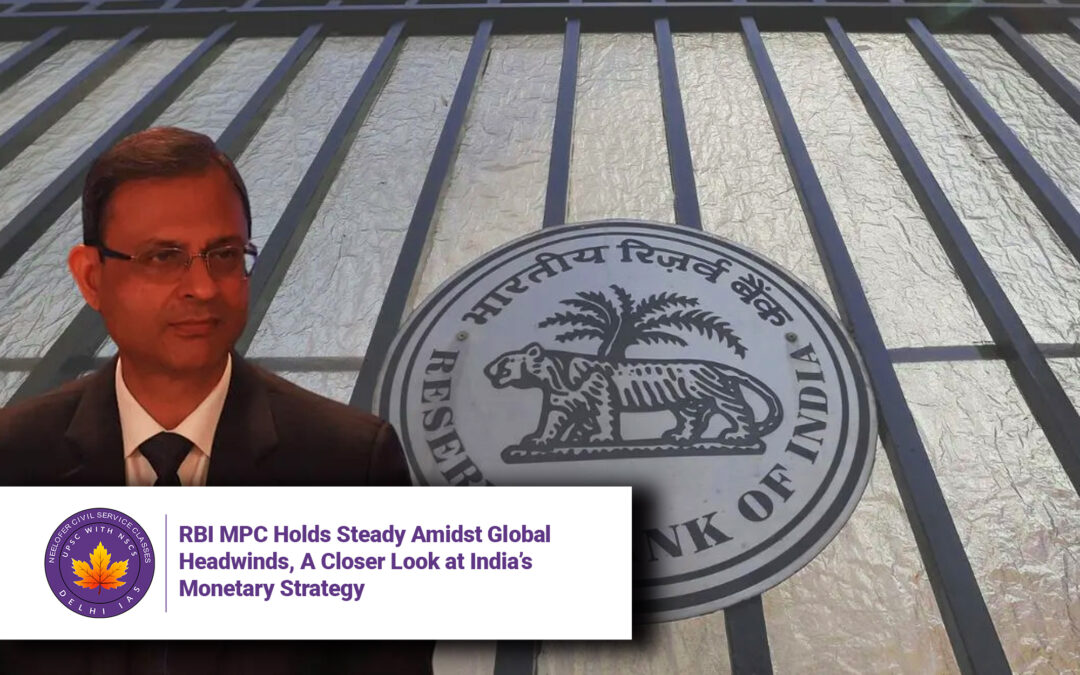
RBI MPC Holds Steady Amidst Global Headwinds, A Closer Look at India’s Monetary Strategy
Why in News
The 56th meeting of the RBI’s Monetary Policy Committee (MPC), held in August 2025, concluded with a decision to keep the policy rate unchanged. Amid global uncertainty—including fresh tariffs from the US and concerns over crude oil imports from Russia—the MPC’s decision has drawn attention. The committee also maintained the economic growth forecast for 2025–26 at 6.5%.
Introduction
In the face of rising global tensions and shifting trade dynamics, the Reserve Bank of India’s Monetary Policy Committee has opted for continuity. The MPC’s decision not to alter the policy rate reflects its wait-and-watch approach, particularly in light of recent frontloaded rate cuts. At the same time, the RBI continues to monitor transmission effects and potential inflationary pressures that could emerge from geopolitical shocks.
The MPC’s cautious optimism is backed by the IMF’s recent upgrade of India’s growth forecast in the July 2025 World Economic Outlook, adding credibility to India’s economic resilience.
Key Issues and Background
The MPC meeting coincided with high-impact developments. Most notably, US President Donald Trump imposed a 25% tariff on Indian goods, calling India’s economy “dead.” Shortly after the MPC decision, Trump announced an additional 25% tariff on India’s crude oil imports from Russia, further escalating tensions.
These events have added volatility to India’s external trade outlook and introduced inflationary risks, particularly in the energy sector. Amid such unpredictability, the MPC’s unchanged stance on policy rates and growth forecasts reflects its preference for stability over reaction.
Specific Impacts or Effects
-
Export Sector Concerns: The US tariffs could negatively impact Indian exporters, particularly those dependent on the American market. There’s also the risk of order cancellations, reduced earnings, and disrupted supply chains. Banks might see a rise in stressed loans from export-oriented businesses.
-
Inflation Risk via Oil Imports: If India shifts crude oil imports away from Russia due to tariffs, prices may rise, contributing to domestic inflation. This could shrink the already limited monetary space to support growth while keeping inflation low.
-
Muted Inflation Forecast: The RBI’s inflation projection remains at 3.1% annually—a level considered benign. However, this is heavily dependent on stable food prices. Should food inflation flare up, the low inflation advantage may quickly erode.
-
Transmission Lag: The MPC’s focus on evaluating the effects of previous rate cuts implies a recognition that monetary policy takes time to filter through the economy.
Challenges and the Way Forward
-
Policy Signalling vs. Political Strategy: An underlying question is whether the MPC’s decisions are purely independent or aligned with broader economic strategies of the government. In today’s geopolitical climate, such alignment could be deliberate to protect India’s larger interests.
-
Cautious Communication: Though the MPC’s actions were sound, the tone of its resolution and the governor’s statement could have been more reserved, especially in light of ongoing economic diplomacy and trade tensions.
-
Energy Security and Inflation Control: India needs to balance its crude oil sourcing strategy to avoid triggering energy-based inflation while ensuring it remains geopolitically neutral.
-
Global Trade Shocks: The evolving US stance on trade demands an agile response mechanism from both fiscal and monetary policy wings.
Conclusion
The RBI’s Monetary Policy Committee has rightly chosen a steady hand over hasty changes amidst a turbulent global environment. By maintaining the policy rate and growth forecast, the RBI is reinforcing a data-driven approach and resisting knee-jerk reactions to international political rhetoric.
Going forward, a consistent and well-communicated policy stance, combined with agile responses to global disruptions, will be key to sustaining India’s growth and financial stability. As long as Indian economic policy remains transparent and objective, the economy is likely to navigate these uncertain times without derailing its long-term trajectory.
Five Practice Questions with Answers
1. What was the decision taken in the 56th MPC meeting of RBI?
The MPC kept the policy rate unchanged and retained the 2025–26 growth forecast at 6.5%.
2. What global development immediately followed the MPC decision?
US President Donald Trump announced an additional 25% tariff on Indian crude oil imports from Russia.
3. Why did the MPC choose not to change the policy rate?
It is waiting for the transmission effects of earlier rate cuts and assessing future data before making further changes.
4. What risks are associated with changing India’s oil import strategy?
Switching crude sources could raise oil prices, potentially causing inflation and limiting monetary flexibility.
5. What is RBI’s inflation forecast for the current year?
The RBI forecasts annual inflation at 3.1%, mainly due to stable food prices.
