
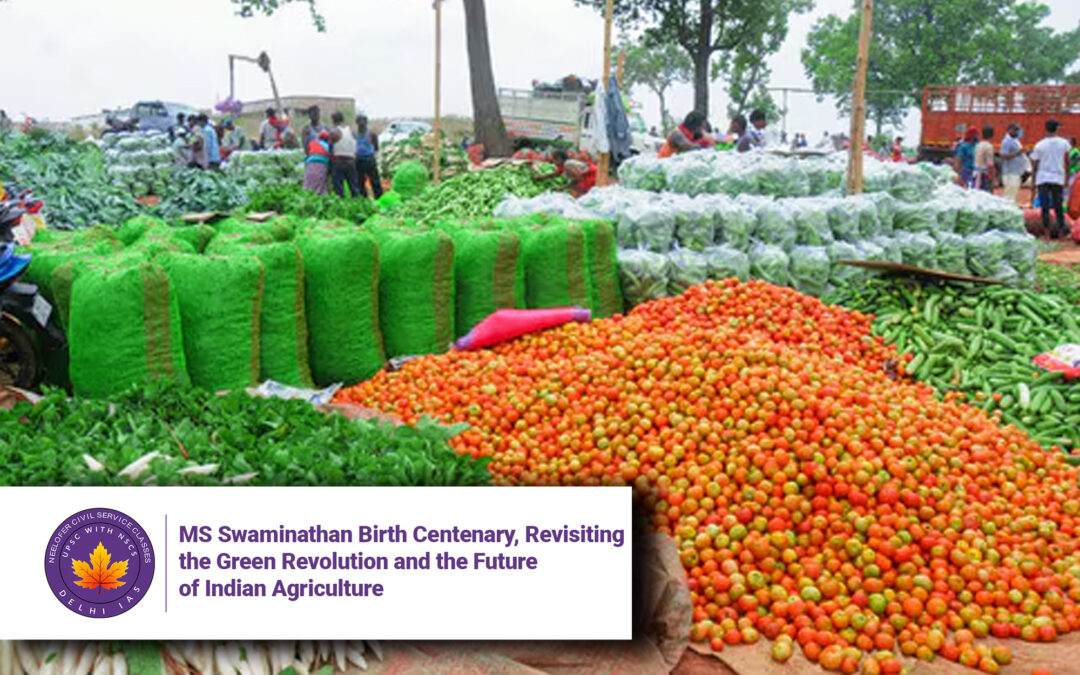
MS Swaminathan Birth Centenary, Revisiting the Green Revolution and the Future of Indian Agriculture
Why in News
On August 7, 2025, India celebrates the birth centenary of M. S. Swaminathan, the renowned agricultural scientist and administrator who played a key role in India’s Green Revolution. The Government of India has announced a ₹100 commemorative coin to mark the occasion. This event not only honours his contribution but also serves as a reflection point on the country’s journey toward food security and future agricultural resilience.
Introduction
The Green Revolution, initiated in the mid-1960s, stands as a landmark in India’s post-independence history. At a time when India was grappling with food shortages and a dependency on foreign food aid (notably the US PL-480 programme), the Green Revolution introduced crucial scientific and technological changes. With Swaminathan’s leadership, high-yielding, rust-resistant wheat varieties, improved irrigation, pest management, and policy focus transformed India’s food production.
As a result, wheat production grew from 12 million tonnes to 21 million tonnes between the mid-60s and 1970-71, and later to 76 million tonnes by the late 1990s. Similarly, rice yields increased from two tonnes per hectare in the 1960s to over six tonnes per hectare by the 1990s.
Key Issues and Background
India is now the world’s second-largest food producer, with agriculture contributing around $52 billion in exports. However, over 80 percent of Indian farmers still operate small, mixed-crop, low-input farms that remain highly vulnerable to market and environmental shocks.
While the Green Revolution helped India become a self-sufficient and food-exporting country, today’s challenges require a new model focused on inclusivity, sustainability, and profitability. With trade and geopolitical dynamics shifting rapidly, India must rethink its food and farm strategies for long-term resilience.
Specific Impacts or Effects
The heavy dependence on food imports in the 1960s was replaced by surplus production, symbolising a shift from food insecurity to self-sufficiency. The Green Revolution also played a pivotal role in building agricultural confidence and farmer-scientist partnerships.
On August 7, 2025, a new challenge arises. The US is set to impose a 25 percent reciprocal tariff on Indian goods, including major agricultural exports like non-basmati rice and spices. This move threatens to jeopardise the income of small-scale producers who are already at risk due to high production costs and logistical barriers.
At a macroeconomic level, the projected annual loss due to these tariffs is $7–8 billion, a small percentage of GDP but potentially devastating for rural economies and exporters.
Challenges and the Way Forward
India’s agriculture is deeply rooted in smallholder farming, which is both a strength and a vulnerability. While it has enabled wide participation in food production, it also suffers from low productivity and high exposure to risks.
The current challenge is twofold:
-
Improve the quality of agricultural growth by ensuring it is inclusive, diversified, and sustainable.
-
Navigate international trade waters smartly. With 25 percent of its grain supply coming from foreign markets, India must combine production gains with effective food diplomacy and negotiation.
Agriculture must move beyond mere volume growth. It must also grow better, leveraging smart technologies, stronger domestic systems, and fair international trade agreements.
Conclusion
The centenary of M. S. Swaminathan is a moment of pride and pause. While we celebrate the gains of the Green Revolution, we must also prepare for the next one—built on equity, sustainability, and global competitiveness.
As India commemorates Swaminathan’s legacy, it must protect its farmers from trade shocks, empower smallholders, and secure its place as a major food exporter through smarter negotiations and inclusive reforms. The future of India’s food security lies not only in growing more but also in growing better and negotiating wisely.
Five Practice Questions with Answers
1. Who was M. S. Swaminathan and what is his contribution to Indian agriculture?
He was an agricultural scientist credited with leading India’s Green Revolution, which transformed India from a food-deficient to a self-sufficient nation.
2. What triggered the Green Revolution in India?
It was initiated due to severe food shortages and dependency on the US PL-480 food aid programme during the 1960s.
3. What is the significance of August 7, 2025, in the context of Indian agriculture?
It marks the birth centenary of M. S. Swaminathan and coincides with the imposition of a 25 percent tariff by the US on Indian agricultural exports.
4. What are the modern challenges faced by Indian agriculture?
Challenges include dependence on smallholder farms, trade vulnerabilities, climate risks, and the need for inclusive, sustainable growth.
5. Why is there a need to “negotiate smarter” in the agricultural sector?
Because India is now a major exporter of food products and must protect its farmers from sudden foreign policy changes and maintain its trade competitiveness.

