
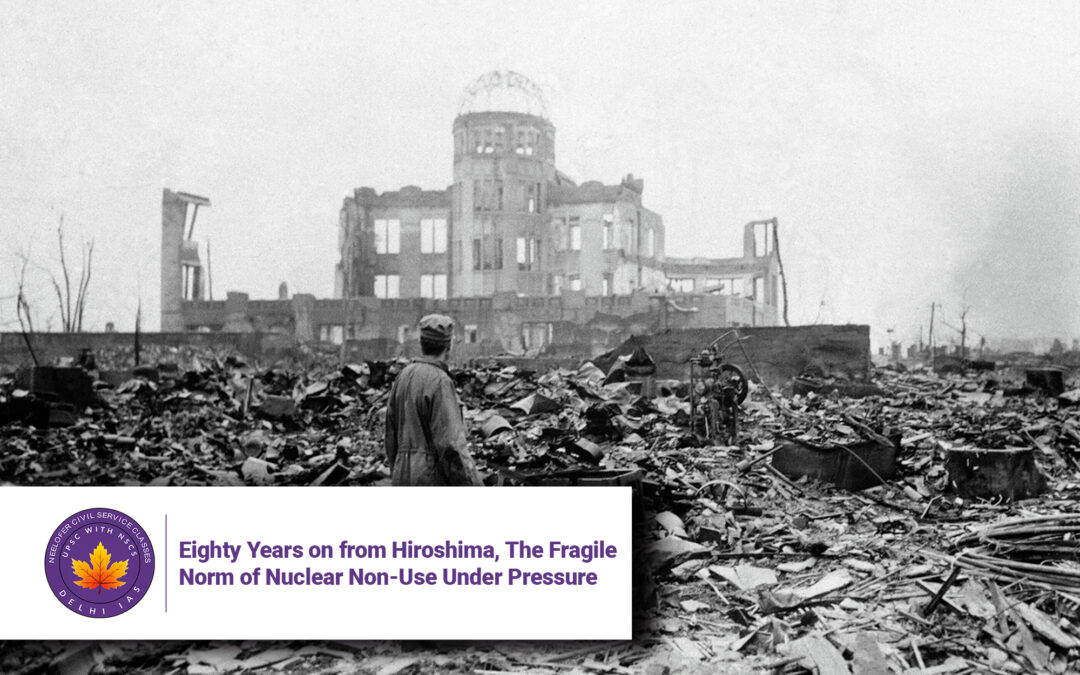
Eighty Years on from Hiroshima, The Fragile Norm of Nuclear Non-Use Under Pressure
Why in News?
August 6, 2025, marked the 80th anniversary of the atomic bombing of Hiroshima, Japan. This historic day reignites the global discourse on nuclear weapons, the ethics of their use, the norm of nuclear non-use, and the looming threats posed by modern nuclear hostilities. As recent developments test long-standing doctrines and diplomatic agreements, this anniversary is not just a remembrance but also a reflection on the fragility of peace in a nuclear-armed world.
Introduction
At precisely 8:15 a.m. on August 6, 1945, the first atomic bomb detonated above the city of Hiroshima, instantly killing over 70,000 people. This horrifying act marked the beginning of the nuclear age. Just three days later, a second bomb was dropped on Nagasaki, killing another 40,000 people on impact. By the end of 1945, radiation sickness and related injuries had claimed the lives of tens of thousands more.
In the 80 years since, despite rapid advances in the development and sophistication of nuclear weapons, no nuclear bomb has been used in active warfare again. This enduring restraint is termed the “norm of non-use” — a principle that has governed international behavior for decades. However, recent geopolitical developments and nuclear modernization programs threaten to undermine this fragile norm.
The Norm of Non-Use: An Ethical Legacy
The survivors of Hiroshima and Nagasaki — known as the Hibakusha — have been at the forefront of the anti-nuclear movement. Their stories, filled with pain, trauma, and loss, transformed them into global symbols of peace. Under American occupation after World War II, much of the immediate aftermath of the atomic bombings was censored. Only years later did the world fully comprehend the horrors of radiation poisoning, which spread sickness and death for years after the explosions.
One of the most influential stories involves the U.S.’s 1954 thermonuclear test known as Castle Bravo. The explosion was far more powerful than expected and exposed the Japanese fishing vessel Fukuryu Maru (Lucky Dragon No. 5) to deadly radiation, even though it was 86 miles away from the designated test zone. The death and sickness that followed created an early international wave of resistance to nuclear weapons — reinforcing the ethical arguments that the Hibakusha had long promoted.
The experience of radiation sickness from Castle Bravo was pivotal. Japan, as a nation, started to comprehend that the real horror of nuclear weapons wasn’t just the explosion — but the prolonged, invisible suffering caused by radiation. Activists like those from the Nihon Hidankyo (the Japanese Confederation of A- and H-Bomb Sufferers Organizations) continued their campaign for nuclear disarmament, eventually influencing global treaties and earning nominations for the Nobel Peace Prize.
Legal Frameworks and Treaties
Several international treaties have attempted to regulate or ban nuclear weapons:
-
The Nuclear Non-Proliferation Treaty (NPT): Signed in 1968, it seeks to limit the spread of nuclear weapons while promoting peaceful uses of nuclear energy and pushing for disarmament.
-
The Comprehensive Nuclear-Test-Ban Treaty (CTBT): While it bans all nuclear explosions, it has not yet entered into force due to non-ratification by key countries.
-
The Treaty on the Prohibition of Nuclear Weapons (TPNW): Adopted in 2017, it bans the development, testing, stockpiling, and use of nuclear weapons. However, none of the nuclear-armed states have signed it.
While these treaties form a framework for nuclear disarmament, enforcement remains weak, and compliance is often politically motivated. The 1996 advisory opinion by the International Court of Justice stated that the threat or use of nuclear weapons would “generally be contrary” to international humanitarian law, but it stopped short of a definitive legal prohibition, citing the ambiguity of self-defense scenarios.
The Rising Tensions: Russia, India, and the Future of Deterrence
Recent geopolitical developments have placed the nuclear norm under unprecedented stress. Russia’s nuclear posturing during its invasion of Ukraine — including threats of nuclear retaliation — has blurred the boundaries between deterrence and intimidation. These actions have raised fears about the normalization of nuclear threats as tools of statecraft.
Closer to home, Indian Prime Minister Narendra Modi’s firm stance that India “will not tolerate any nuclear blackmail” during Operation Sindoor has sparked concern over potential shifts in India’s nuclear doctrine, traditionally rooted in “No First Use.” Limited military responses and escalated rhetoric show how nations are inching closer to normalizing the language and posture of nuclear readiness.
This global erosion of norms has been further accelerated by advancements in nuclear technology. The Cold War-era vision of massive, city-destroying bombs has evolved into discussions around “usable nukes” — smaller tactical nuclear weapons designed for limited battlefield use. Though smaller in yield, the threshold for their use is dangerously lower, making them tempting tools in conventional warfare.
Revisiting the Ethical Dilemmas
The fundamental ethical dilemma remains: can a weapon so devastating be morally or legally justified in any scenario?
There is little basis in law or logic for treating nuclear weapons as normal war tools. Unlike conventional arms, the humanitarian cost of nuclear use is incalculable. They do not just kill soldiers or damage infrastructure; they affect generations through radiation, genetic damage, and environmental catastrophe.
Despite the logic of deterrence, the use of nuclear weapons — even once — would represent a colossal failure of diplomacy and humanity. The survivors of Hiroshima and Nagasaki are living reminders of this reality, yet they had to wait over 70 years for global recognition. The Nobel Peace Prize nomination for the Nihon Hidankyo in 2024 is a late but significant step in acknowledging their peace efforts.
A Global Wake-Up Call
As we reflect on 80 years since Hiroshima, the world is again at a crossroads. The rhetoric, modernization, and posturing around nuclear weapons suggest a worrying complacency.
A single miscalculation — such as a misunderstood test or a retaliatory misfire — could escalate into global catastrophe. The idea that nuclear threats can be “contained” or used for political gain is not just irresponsible — it’s deadly.
The Fukuryu Maru incident, where civilians became accidental victims of nuclear testing, stands as a warning: nuclear danger extends beyond the battlefield. With the expansion of nuclear states and weakening arms control frameworks, the margin for error has never been thinner.
Conclusion
Eighty years ago, Hiroshima changed the world forever. It forced humanity to confront its capacity for destruction and inspired global norms of restraint. Yet today, those very norms are unraveling under pressure.
We must not let the silence of non-use become a complacent lull. The global community must reinvigorate the push for disarmament, strengthen treaties, educate the next generation, and amplify the voices of survivors.
As citizens of the world, we are all stakeholders in peace. The legacy of Hiroshima demands that we not only remember but also act — before history repeats itself, this time with no survivors left to tell the tale.
Q&A Section
Q1: What is meant by the “norm of non-use” of nuclear weapons?
A: The norm of non-use refers to the informal global agreement not to use nuclear weapons in warfare since 1945. Although many nations possess them, no country has used a nuclear bomb in combat since the bombings of Hiroshima and Nagasaki.
Q2: Why are recent developments putting this norm under pressure?
A: Recent events, such as Russia’s nuclear threats during its Ukraine conflict and India’s hardened nuclear rhetoric, suggest a growing willingness to consider nuclear weapons as viable military tools. Additionally, the development of tactical or “usable” nukes lowers the threshold for potential use.
Q3: How did the Hibakusha contribute to the anti-nuclear movement?
A: The Hibakusha — survivors of Hiroshima and Nagasaki — became global peace advocates. Their testimony highlighted the long-term human suffering caused by radiation, influencing global nuclear treaties and shaping ethical discourses on the use of such weapons.
Q4: What are the key international treaties concerning nuclear weapons?
A: The three major treaties are:
-
The Nuclear Non-Proliferation Treaty (NPT)
-
The Comprehensive Nuclear-Test-Ban Treaty (CTBT)
-
The Treaty on the Prohibition of Nuclear Weapons (TPNW)
These treaties seek to prevent the spread of nuclear weapons and promote disarmament, although enforcement remains inconsistent.
Q5: What lessons can be drawn from the 80th anniversary of Hiroshima?
A: The anniversary serves as a reminder of the devastating consequences of nuclear warfare and the importance of preserving the norm of non-use. It also urges the global community to renew efforts toward disarmament, prevent escalation, and ensure nuclear weapons are never used again.

