
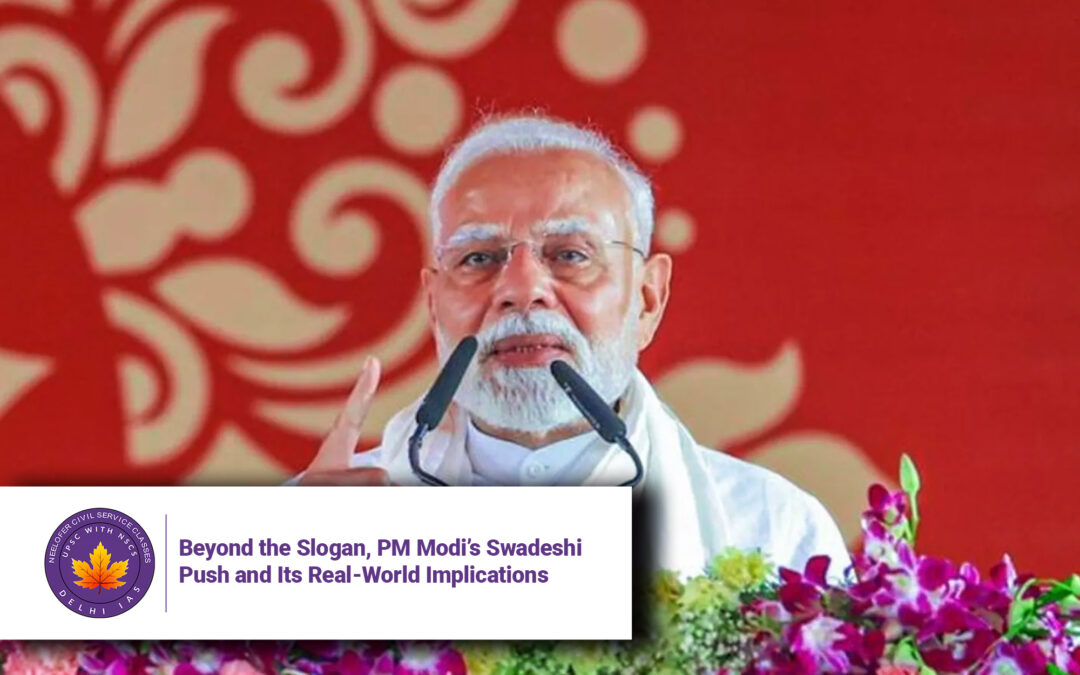
Beyond the Slogan, PM Modi’s Swadeshi Push and Its Real-World Implications
Why in News?
Prime Minister Narendra Modi has made a fresh and passionate call for “Swadeshi”—a movement to support and rely on locally produced goods and services. This renewed push is rooted in the broader vision of Atmanirbhar Bharat (Self-Reliant India) and is meant to reduce India’s dependency on imports. The call comes at a time of global economic disruption, trade protectionism, and rising tariffs, particularly from the United States. While the initiative aims to strengthen India’s domestic manufacturing base and encourage local consumption, there are growing concerns about whether such efforts, if not handled with pragmatic strategies, might backfire.
Introduction
Against the backdrop of faltering globalization, rising trade barriers, and increasing protectionist policies around the world, Prime Minister Narendra Modi has once again called upon Indians to embrace Swadeshi—buying and selling only domestically produced goods. This announcement aligns with his 2020 vision of Atmanirbhar Bharat, where India becomes more self-reliant across sectors.
The call is not just rhetorical—it reflects a deeper concern over India’s trade dynamics and its heavy dependence on imports, particularly of intermediate goods. The push comes when US President Donald Trump imposed a 25% tariff on Indian goods and labelled the Indian economy as “dead.” While the global economic environment seems turbulent, India’s massive domestic demand still offers immense opportunities. However, the path to becoming self-reliant is filled with structural challenges, cost pressures, and the need for a comprehensive industrial strategy.
Key Institutional and Economic Concerns
1. The Challenges of Local Manufacturing
The Prime Minister’s vision is noble, but there are deep-rooted issues with promoting domestic manufacturing in India. As highlighted by Moody’s, restricted access to foreign markets, especially the US, can negatively affect India’s manufacturing sector. Currently, manufacturing contributes just 17-18% of India’s GDP, and this figure has remained stagnant for years. A long-term strategy is urgently required to push this number upward.
Moreover, producing locally isn’t always economically viable. Not every product can be manufactured in India at competitive prices. The cost of production for many goods—particularly intermediate ones like components, chemicals, and semiconductors—remains lower abroad, leading to continued imports.
2. Structural Barriers
India has a relatively cheap labor force, but this advantage is often nullified due to:
-
Poor infrastructure
-
Complex red tape
-
Rigid labour laws
-
High-interest rates
These factors make domestic manufacturing less competitive and often prompt companies to seek government subsidies and protectionist policies, rather than striving for global competitiveness.
3. Import Duties and Trade Policy
The average import duty in India is around 17%, one of the highest among major economies. While this may protect domestic industries in the short term, it can also hurt consumers by making goods more expensive and reduce the competitiveness of Indian exporters. Rather than shutting out global competition, India needs to focus on making its products globally competitive.
The government is encouraged to explore alternative trade strategies such as the China Plus One approach, where India positions itself as a viable manufacturing destination for companies looking to reduce dependence on China.
Way Forward: The Pragmatic Approach to Swadeshi
Instead of simply pushing for Swadeshi out of sentiment, the government must support competitive manufacturing that can serve both domestic and export markets. Here’s how:
1. Improve Infrastructure and Labour Reforms
The focus must shift to reducing infrastructure bottlenecks, streamlining labour regulations, and easing the cost of doing business. A competitive domestic manufacturing ecosystem cannot be built on subsidies alone.
2. Review Import Duty Regime
Rather than relying on high import tariffs, the government must review and possibly reduce duties where necessary to ensure that domestic consumers are not overburdened with high prices, while also making Indian products viable in international markets.
3. Encourage Export-Oriented Production
India must not isolate itself from global supply chains. Instead, it should focus on making locally-produced goods that are competitive enough to be exported, rather than solely replacing imports.
The Role of the PLI Scheme
The Production-Linked Incentive (PLI) scheme has been a cornerstone of the government’s efforts to boost local manufacturing. With an investment commitment of ₹1.76 lakh crore, the PLI scheme aims to reduce import dependency and increase domestic production, especially in sectors like electronics.
-
Since the launch of the ₹1.97 lakh crore scheme, actual payouts have been ₹21,534 crore so far.
-
This has encouraged many consumer electronics companies to set up local manufacturing units.
-
The bulk of consumer products in India—like food, clothing, and electronics—are already made locally. The PLI scheme aims to extend this self-reliance to more advanced sectors.
However, to truly attract more foreign direct investment (FDI), India must ensure that these incentives are backed by transparent policies and a stable business environment.
The Reality of Local Production in India
While there is visible enthusiasm for Swadeshi, the ground reality is more nuanced:
-
Most consumer goods in India are already domestically produced.
-
Imports are usually limited to specialized or high-end components and intermediate goods.
-
Rising inflation and low household income growth have dampened consumer spending in recent times, although this is expected to improve with tax cuts and festive season demand.
India should also not forget the importance of small and medium enterprises (SMEs) in the Swadeshi movement. These units often lack the financial strength to compete without some level of government support. As PM Modi rightly emphasized, “their interests need to be taken care of.”
Conclusion
The Prime Minister’s Swadeshi push has reignited a national conversation about India’s place in the global economy. It is a reminder of the need to nurture local industry, reduce reliance on imports, and build a self-sustaining economy. But this must be done with clear-headed pragmatism—not emotion.
Swadeshi should not mean isolation. It should mean strengthening India’s position in the global value chain. By focusing on competitiveness, infrastructure, and smart policy reforms, India can walk the path of self-reliance without falling into the trap of protectionism. The call for Swadeshi is inspiring, but it must be matched by realistic strategies, otherwise, it may become a slogan with unintended consequences.
Q&A Section
Q1: What is the main objective behind PM Modi’s renewed push for Swadeshi?
Answer:
The main objective is to promote local manufacturing, reduce import dependency, and support domestic businesses as part of the broader vision of Atmanirbhar Bharat (Self-Reliant India). It also aims to harness India’s large domestic market to support local producers.
Q2: What are the key challenges India faces in becoming self-reliant?
Answer:
Key challenges include:
-
Poor infrastructure
-
Complex regulatory environment
-
Rigid labour laws
-
High interest rates
-
Inability to produce goods at competitive prices
These factors limit India’s manufacturing competitiveness and make imports more attractive for many industries.
Q3: How is the PLI scheme supporting India’s Swadeshi movement?
Answer:
The Production-Linked Incentive (PLI) scheme offers financial incentives to companies for producing goods locally. With investment commitments worth ₹1.76 lakh crore and disbursals of ₹21,534 crore so far, it is expected to reduce imports and boost domestic production, especially in electronics and other high-tech sectors.
Q4: Why is it important to review import duties in India?
Answer:
India has one of the highest average import duties (17%). While this protects local industries, it can lead to higher consumer prices and reduce global competitiveness. A review is necessary to strike a balance between protecting domestic industries and encouraging export-oriented growth.
Q5: What is the risk of blindly promoting Swadeshi without an economic strategy?
Answer:
Blindly promoting Swadeshi without a competitive manufacturing base can lead to:
-
High-cost goods that find no demand
-
Dependence on subsidies
-
Inefficiencies and waste of resources
-
Missed opportunities in global markets
Instead, a strategic, economic approach is needed to ensure Swadeshi complements globalization rather than replaces it.

