
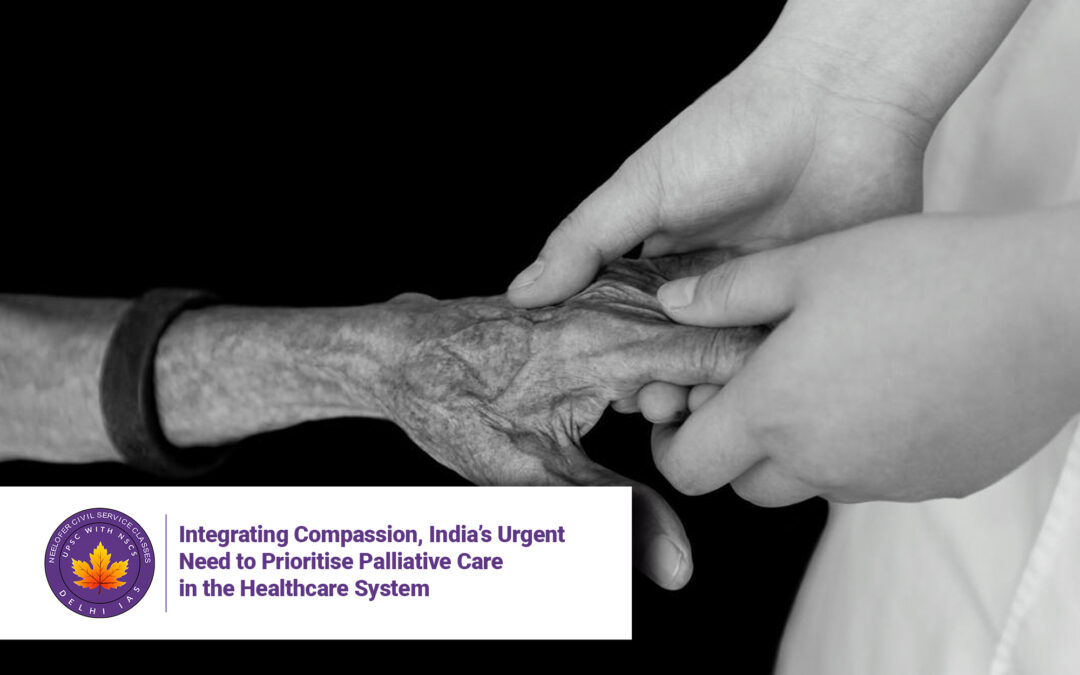
Integrating Compassion, India’s Urgent Need to Prioritise Palliative Care in the Healthcare System
Why in News?
A new wave of healthcare discussions has brought to light India’s glaring gaps in palliative care services. Millions suffer needlessly due to inadequate support for chronic and terminal conditions. A recent spotlight on integrating compassion into India’s health infrastructure stresses the urgency for systemic reform, education, awareness, and funding in the area of palliative care.
Introduction
India, home to over 1.4 billion people, is facing a major challenge in meeting the healthcare needs of those with terminal or chronic illnesses. Palliative care, which is a form of specialised medical care focused on relief from pain and stress of serious illness, remains grossly underfunded and underused. Despite its crucial role in ensuring the dignity and quality of life for millions, palliative care is absent in many parts of the country’s health ecosystem.
Globally, an estimated 40 million people require palliative care, 78% of whom live in low- and middle-income countries. Yet, only 14% of those in need receive it. In India, although 7–10 million people are estimated to need palliative care annually, just 1.7–2% can access these services. This article delves into the structural, educational, financial, and societal challenges in India’s palliative care landscape and provides a roadmap for reform.
Understanding Palliative Care and Its Importance
Palliative care is not about curing a disease. Rather, it is about improving the quality of life for patients with serious illnesses such as cancer, chronic respiratory diseases, cardiovascular disease, and neurodegenerative disorders. It addresses physical pain, emotional distress, spiritual concerns, and social needs.
This care is essential not only for patients but also for their families, reducing the burden of caregiving, hospitalisation costs, and emotional trauma. Especially as India’s burden of non-communicable diseases continues to grow, palliative care becomes an essential part of the long-term healthcare plan.
The World Health Organization (WHO) defines palliative care as a human right. But in India, where health systems are strained and inequity is rampant, access remains a privilege for the few.
Key Issues and Institutional Concerns
1. Lack of Trained Professionals
One of the most pressing concerns is the acute shortage of trained palliative care doctors. India has a poor doctor-to-population ratio (1:1,834), and among these doctors, very few are trained in palliative medicine. The ideal WHO-recommended ratio is 1 doctor per 1,000 people, and even this does not ensure expertise in end-of-life care. The result is a limited understanding among healthcare providers about how to handle chronic pain, manage terminal conditions, or address the psychosocial aspects of dying.
2. Policy Implementation Gaps
The inclusion of palliative care in the National Health Policy (NHP) 2017 was a step forward, but policy alone is not enough. Implementation has been slow, uneven, and often absent at the grassroots level. While some states have made progress—particularly Kerala, which has community-based models of palliative care—others lag behind due to lack of resources, political will, and awareness.
3. Poor Public Awareness
A significant barrier to the expansion of palliative care is the general lack of public understanding. Most Indians are unaware that palliative care exists beyond cancer care and includes comprehensive support for a wide range of chronic illnesses. Misconceptions also persist, such as the belief that palliative care is only needed at the very end of life, rather than something that can begin early during the illness trajectory.
4. Financial and Infrastructure Constraints
Many public hospitals lack the infrastructure, space, and funds to provide dedicated palliative care units. Although schemes like Ayushman Bharat can cover palliative care, the lack of trained providers and facilities makes this benefit theoretical rather than practical. Private hospitals, on the other hand, often charge high fees, excluding low-income families from accessing quality palliative support.
5. Urban-Rural Disparity
Rural India, home to nearly 70% of the population, is the most neglected when it comes to palliative care services. According to data, over 34.3 lakh registered doctors and 13 lakh allied health-care professionals exist in India, but their availability in rural and tribal areas is sparse. This means that people in remote locations often die in pain, without dignity or professional care.
Challenges and the Way Forward
Linking Palliative Care with Medical Education
India’s medical education system must take a lead in this transformation. The All India Institute of Medical Sciences (AIIMS) has proposed including palliative care in the MBBS curriculum to train students in handling pain, communication with patients and families, and ethical issues around end-of-life care.
Incorporating this into medical training ensures that future doctors are equipped not just with clinical knowledge but with compassion—a vital component often missing from the current system. Training allied health professionals like nurses and social workers in palliative care also adds a support framework that can extend care to a larger base.
Government and Private Partnerships
The government must create dedicated budgets for palliative care infrastructure. Public-private partnerships, especially involving non-governmental organisations (NGOs), can help bridge service gaps, deliver community-level outreach, and raise awareness through local campaigns.
Kerala’s model is a case in point, where a mix of government initiatives and NGO-led services ensures that even in the remotest districts, patients can receive home-based palliative care. This approach should be replicated across the country with appropriate contextual adaptations.
Insurance and Affordability
The Ayushman Bharat scheme and other public insurance systems must explicitly include palliative services. Currently, even when policies exist, many families are unaware or unable to utilise them due to bureaucratic complexity and lack of institutional coordination.
Making these services affordable also requires cost control in private hospitals and establishing free or subsidised services in public healthcare systems.
Raising Public Awareness
A major part of the problem lies in the invisibility of palliative care. Targeted campaigns using mass media, social media, and community influencers can help break the taboo around death and dying. These campaigns must explain what palliative care includes—pain management, emotional support, family counselling, and dignity in death—and make clear that these services are a right, not a privilege.
International Comparisons
The United States, with its well-developed hospice system, offers a valuable model. In the U.S., hospice and palliative care services are covered under Medicare and Medicaid, and most hospitals have dedicated units. More importantly, there is an emphasis on advance care planning, informed consent, and supporting caregivers.
India can adapt this model to fit its own cultural and socioeconomic landscape, where joint family systems and religious beliefs influence how people approach illness and death.
Conclusion
The Indian health system is at a crossroads. With a rising burden of non-communicable diseases, an ageing population, and inequities in care delivery, the integration of palliative care is no longer optional—it is a necessity.
To bring compassion back into medicine, the country must take a multi-pronged approach: revamping medical education, ensuring insurance coverage, building healthcare infrastructure, empowering community workers, and launching mass awareness campaigns. Only then can India ensure that its citizens live—and die—with dignity.
Q&A Section
1. What is palliative care and why is it important in India?
Palliative care is specialised medical care focused on providing relief from symptoms, pain, and stress caused by serious illness. It aims to improve the quality of life for both patients and their families. In India, it is especially important due to the high burden of chronic illnesses and limited access to end-of-life support systems.
2. Why is access to palliative care so limited in India?
Access is limited due to a shortage of trained professionals, poor public awareness, inadequate infrastructure, lack of funding, and poor integration into mainstream healthcare services—especially in rural and underserved regions.
3. What steps has India taken so far to improve palliative care?
India included palliative care in the National Health Policy 2017, and institutions like AIIMS have proposed including it in the MBBS curriculum. States like Kerala have developed successful community-based models. However, national implementation remains slow and inconsistent.
4. What role can public-private partnerships play in expanding palliative care?
Public-private partnerships can help by pooling resources, sharing training programs, delivering services in rural areas, and spreading awareness. NGOs can fill gaps in government services and ensure last-mile delivery of care.
5. How can awareness about palliative care be improved among the public?
Awareness can be improved through education campaigns, inclusion of palliative care information in public health outreach, and community-driven efforts that explain the benefits and availability of such services. Media, NGOs, and local health workers can play vital roles in this regard.

