
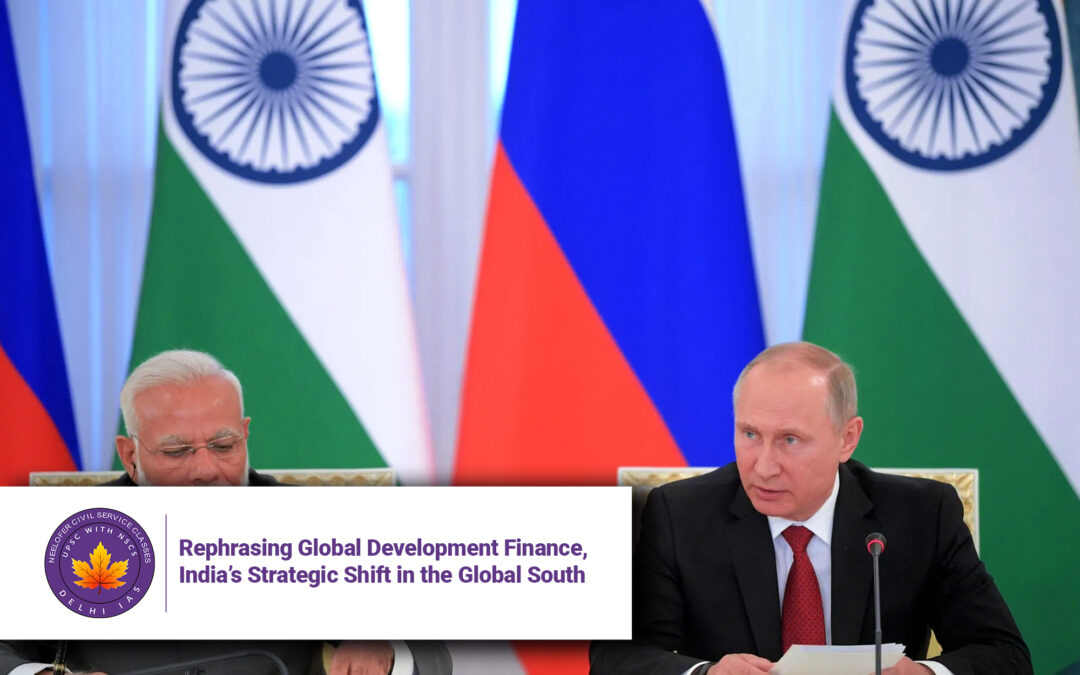
Rephrasing Global Development Finance, India’s Strategic Shift in the Global South
Why in News?
India’s development cooperation with the Global South has witnessed a significant rise over the past several years, not just in volume but also in depth and structure. India has more than doubled the quantum of its development finance—from around $3 billion in 2010-11 to approximately $7 billion in 2023-24. Alongside this financial increase, India has introduced a more balanced, strategic framework for its engagement with developing countries through initiatives such as the Global Development Compact (GDC) and the Indian Development and Economic Assistance Scheme (IDEAS).
This development comes at a time when global development finance is in flux. Traditional sources of funding such as Official Development Assistance (ODA) from Western countries are shrinking, and the geopolitical landscape is becoming increasingly complex. Against this backdrop, India is emerging as a reliable, responsive, and reform-oriented partner for the Global South.
Introduction
India’s role in global development finance has transformed significantly in recent years. It is no longer seen merely as a recipient of aid or a marginal donor, but as a proactive development partner. India’s developmental approach combines financial support, capacity building, technology transfer, and market access, offering an alternative to traditional aid paradigms.
During the third Voice of Global South Summit (VOGS) in 2024, Prime Minister Narendra Modi articulated the concept of a Global Development Compact (GDC), aiming for harmony across various modes of development cooperation. This came soon after the G-20 summit, where India’s presidency placed the concerns of the Global South at the center of international discourse.
By focusing on key areas like Lines of Credit (LoCs), Triangular Cooperation (TrC), and concessional finance, India is reshaping the global development finance architecture. However, this transformation is occurring amid global uncertainties, including a steep decline in traditional foreign aid and the worsening debt crisis in many developing nations.
Key Issues and Institutional Concerns
1. India’s Expanding Development Portfolio
The Indian government has made consistent efforts to deepen and diversify its development partnerships. The financial allocations have seen a major boost:
-
Development assistance nearly doubled from $3 billion (2010-11) to $7 billion (2023-24).
-
Budgetary provisions for LoCs and credit lines have increased steadily under the IDEAS scheme.
-
India is utilizing LoCs as a core instrument of engagement, enabling partner countries to develop infrastructure, energy projects, and other vital services at concessional terms.
This expansion is also reflected in India’s increasing participation in international platforms such as the G-20 and the VOGS, where India has taken the lead in pushing for reforms in global financial governance.
2. Shrinking ODA and Debt Crises
Traditional aid from ODA providers has been shrinking. In 2023, global foreign aid dropped by about 45 percent from 2021 levels, amounting to approximately $214 billion. This dramatic reduction in resources is partly due to the redirection of funds to domestic recovery efforts in developed countries post-COVID-19 and amid ongoing geopolitical tensions.
At the same time, many countries in the Global South are facing a debt servicing crisis due to excessive borrowing from international capital markets. These commercial loans, often extended at high-interest rates, are becoming unsustainable for several low-income and developing countries.
India’s model of concessional financing through LoCs is gaining importance as it provides much-needed flexibility, lower interest rates, and capacity-building support, which traditional loans do not offer.
3. India’s Strategic Development Compact
To bring coherence and sustainability to its development assistance, India introduced the concept of the Global Development Compact (GDC) at the VOGS. This initiative aims to align five modalities of engagement:
-
Capacity Building
-
Technology Transfer
-
Market Access
-
Grants
-
Concessional Finance
By integrating these elements into a single strategic framework, India is working to build holistic partnerships rather than transactional relationships. This approach also seeks to involve a wider set of partner countries and encourages cross-national collaboration on multi-country development initiatives.
4. Triangular Cooperation (TrC)
India’s growing involvement in Triangular Cooperation (TrC) is another notable shift. In this model, a project is co-financed and implemented by:
-
One donor country from the Global North,
-
One donor or partner from the Global South (India), and
-
A beneficiary country, usually another developing country.
For example, India has collaborated with Germany and Japan to implement infrastructure and social development projects in countries such as Mozambique, Ghana, and Cameroon.
These projects are not only cost-effective but also emphasize shared learning, mutual respect, and localization of solutions. India’s approach through TrC has focused on areas such as:
-
Expanding digital infrastructure
-
Improving healthcare and education
-
Regional energy integration
-
Climate-resilient agriculture
The India-Germany TrC Declaration of Intent (2022) has already begun implementation across various nations in Africa, Asia, and Latin America.
5. Financing the Sustainable Development Goals (SDGs)
Meeting the global SDG targets by 2030 requires trillions in development finance. According to estimates, the annual shortfall to achieve the SDGs is now over $2.5 trillion. This gap has only widened due to the pandemic and multiple geopolitical crises.
India has taken this challenge seriously and is attempting to reframe development finance by:
-
Pooling resources with other nations
-
Engaging in joint ventures with institutions like the African Development Bank (AfDB)
-
Promoting south-south and south-north-south partnerships
Through innovative finance models, India is helping unlock capital, technology, and human resources to drive inclusive growth in the Global South.
Challenges and the Way Forward
Despite the promising developments, several hurdles remain.
A. Sustainability of Concessional Finance
India’s concessional loan model, while attractive, puts pressure on domestic financial resources. Ensuring the sustainability of these efforts will require:
-
Strong institutional oversight
-
Monitoring and evaluation frameworks
-
Return on investment mechanisms
B. Institutional Coordination
India’s development finance efforts are currently spread across multiple ministries and agencies. Streamlining these structures and creating a centralized development finance agency could improve efficiency and impact.
C. Geopolitical Risks
As India increases its footprint, it may face pushback from traditional donors or be drawn into geopolitical rivalries. Diplomatic agility and non-alignment will be essential to safeguard its strategic interests.
D. Technological and Human Resource Limitations
Scaling up projects across diverse regions requires skilled manpower, linguistic competence, and cultural sensitivity. Investing in specialized training and institutional capacity building is necessary.
E. Measurement of Impact
Unlike Western ODA frameworks that often emphasize quantitative impact, India’s model must incorporate robust indicators for outcome-based evaluation, local ownership, and long-term viability.
Conclusion
India’s evolving role in global development finance is both timely and transformative. As the traditional aid landscape contracts, India is stepping up with an approach that is inclusive, flexible, and responsive to the needs of the Global South.
Through initiatives like the Global Development Compact, expanded LoCs, and Triangular Cooperation, India is providing more than financial aid—it is offering a vision of sustainable and equitable development.
In a world marked by fragmentation, economic distress, and uncertainty, India’s leadership in development cooperation offers a model that emphasizes shared growth, dignity, and self-reliance. The coming years will determine whether this vision can be institutionalized and scaled to make a lasting impact on the global development landscape.
Q&A Section (5 Questions and Answers)
Q1. What is the Global Development Compact (GDC) proposed by India?
Answer:
The GDC is a strategic framework announced by Prime Minister Narendra Modi during the Voice of Global South Summit in 2024. It aims to harmonize five key modalities of development engagement—capacity building, technology transfer, market access, grants, and concessional finance. The objective is to create a comprehensive and balanced approach to India’s cooperation with Global South countries.
Q2. Why is India focusing more on Lines of Credit (LoCs) under its development assistance programs?
Answer:
India is emphasizing LoCs because they provide concessional financing to partner countries at lower interest rates compared to commercial loans. Given the global liquidity crisis and debt burden in many developing nations, LoCs offer a sustainable alternative for funding infrastructure and development projects without placing an undue financial burden on the recipient countries.
Q3. What is Triangular Cooperation (TrC), and how is India involved in it?
Answer:
Triangular Cooperation involves collaboration between a donor from the Global North, a partner like India from the Global South, and a beneficiary country. India is actively engaging in TrC with countries such as Germany and Japan to fund and implement development projects in Africa, Asia, and Latin America. This model promotes cost-effectiveness, shared learning, and respect for local priorities.
Q4. What are the major challenges in India’s development finance model?
Answer:
Key challenges include the sustainability of concessional financing, lack of centralized institutional coordination, geopolitical risks, limited technical manpower, and the need for a robust monitoring and evaluation system. Addressing these will be critical to ensuring the long-term success and impact of India’s development initiatives.
Q5. How is India’s development assistance different from traditional ODA provided by Western countries?
Answer:
India’s assistance model is based on mutual respect, shared benefits, and non-interference in domestic affairs. Unlike traditional ODA, which often comes with policy conditions, India’s development cooperation is more flexible and inclusive. It emphasizes demand-driven projects, local capacity building, and south-south solidarity.

