
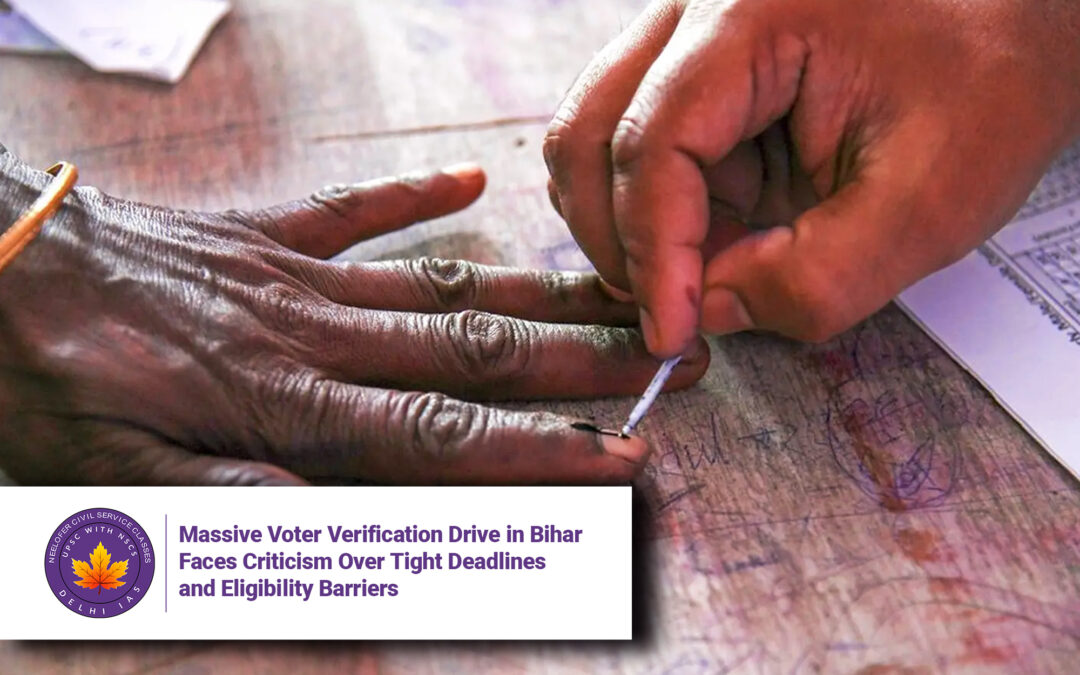
Massive Voter Verification Drive in Bihar Faces Criticism Over Tight Deadlines and Eligibility Barriers
Why in News
The Election Commission of India (ECI) has launched an Intensive Revision of Electoral Rolls in Bihar, requiring 4.76 crore people to prove their citizenship within just one month. The move has drawn strong criticism due to its rushed timeline and the potential for mass disenfranchisement, especially among marginalized groups.
Introduction
In a move that marks a sharp break from India’s historical approach to universal suffrage, the ECI’s new order mandates the entire electorate of Bihar to submit documentary proof of citizenship. With 7.9 crore voters in the state, this decision — if not significantly altered — could severely affect the democratic rights of millions.
Key Issues and Background
-
Scale of the Task:
As per the ECI’s press note from June 28, 49.6% of the 7.9 crore voters in Bihar have already undergone verification through previous revisions. However, 2.94 crore voters still need to submit eligibility proof. -
Neglecting the 2003 Base:
The 2003 voters’ list, which served as the basis for the Sample Registration System, has been largely overlooked. About 1 crore of the deceased from that list have already been removed, and yet the verification process now ignores its foundational validity. -
Tight Timeline:
The deadline to complete verification is July 31, giving voters just about a month to secure and submit their documents.
Specific Impacts or Effects
-
Exclusion of Marginalized Groups:
A paper by Prof. Pinak Sarkar shows that only 48% of permanent adult residents in Bihar have valid documentation from before 2003. Verifying the remaining population, especially SC/ST/OBC communities, will be an uphill task. -
Barriers in Documentation:
The ECI accepts seven types of documents:-
Identity cards (like PAN, DL) issued before July 1, 1987
-
Birth certificates
-
School certificates
-
Maternity health cards (NFHS)
-
Census/NPR data
-
Forest rights certificates
-
Tribe or caste certificates
However, a significant share of the population — especially rural women, landless people, and tribals — lack these formal documents.
-
-
Youth Voters at Risk:
Nearly 1.76 crore youth aged 18–40 who weren’t in the 2003 list now need to prove their eligibility. According to the 2022 state estimates, 20.4% of Biharis have age proof, leaving over 3.16 crore struggling to meet the requirement. -
Children Born Between 2001–2006:
About 2.8% of Bihar’s population was born during this time frame, yet there’s minimal birth record coverage for this group, increasing their risk of exclusion.
Challenges and the Way Forward
-
Why Not Use Aadhaar?
Aadhaar is excluded as a proof of citizenship, even though it has a 98% penetration rate in Bihar. This has raised concerns since Aadhaar, used in nearly all other citizen services, could help ease the burden of documentation. -
Migration and Informality:
With high interstate migration and widespread informal work arrangements, many citizens have no stable records. SC/ST and OBC groups, which form 60–70% of Bihar’s population, are most likely to suffer from exclusion. -
Need for Extension & Inclusion:
With such a massive task at hand, many suggest extending the verification window beyond July 31. Public awareness, legal aid camps, and relaxed documentation norms are necessary to ensure no genuine voter is left out. -
Legal and Electoral Risks:
If implemented without reform, this could lead to mass disenfranchisement in Bihar — and set a precedent for similar practices in other states. It would amount to an unprecedented rollback of voting rights in democratic India.
Conclusion
The ECI’s voter verification drive in Bihar, while aimed at electoral integrity, threatens to undermine the very foundation of Indian democracy — universal adult franchise. With inadequate timelines, complex eligibility conditions, and heavy documentation demands, the process risks excluding millions, especially the poor and marginalized. Unless the policy is significantly revised, this could become one of the most regressive exercises in the history of Indian elections.
5 Questions and Answers
1. What is the voter verification drive in Bihar about?
It is a special exercise by the ECI requiring 4.76 crore voters to submit proof of citizenship before July 31, 2025.
2. Why is the drive controversial?
Due to tight deadlines, high documentation requirements, and the risk of disenfranchising lakhs of people — especially from SC/ST/OBC communities and informal sectors.
3. What kind of documents are accepted as proof?
Only seven types, including identity cards issued before 1987, birth and school certificates, forest rights papers, and caste certificates.
4. Why is Aadhaar not accepted?
Aadhaar is not proof of citizenship, so the ECI has excluded it despite its wide availability.
5. What are experts suggesting?
Relaxing the document list, extending deadlines, and using Aadhaar or alternative methods to avoid excluding genuine voters.

