
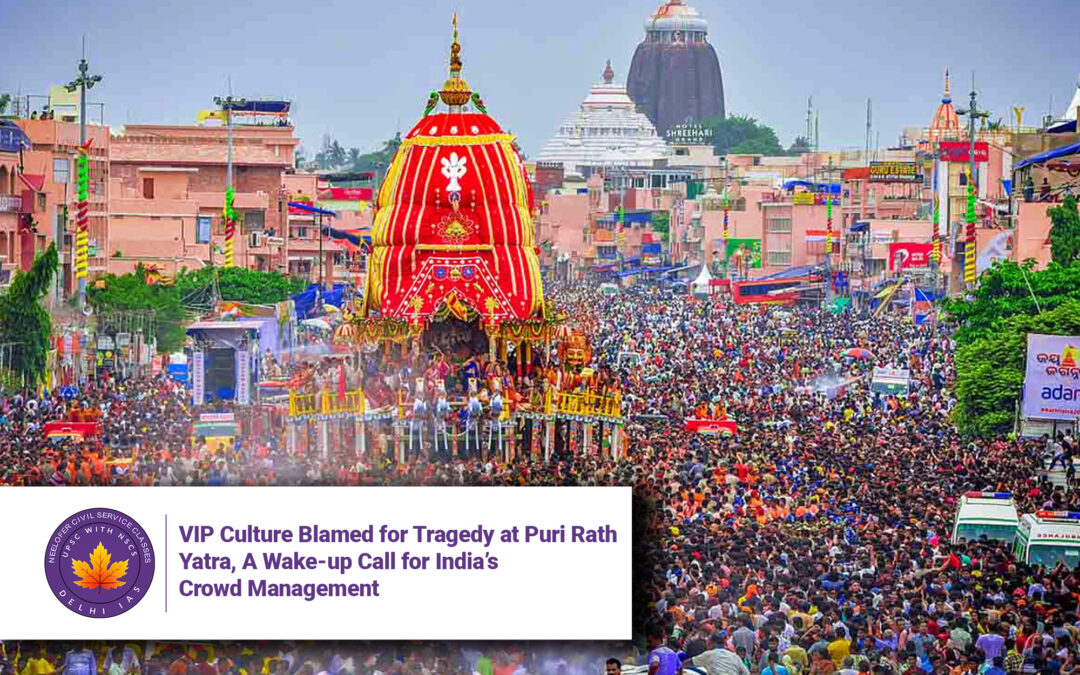
VIP Culture Blamed for Tragedy at Puri Rath Yatra, A Wake-up Call for India’s Crowd Management
Why in News
A tragic stampede during the world-famous Rath Yatra at the Jagannath temple in Puri, Odisha, on June 29, 2024, has reignited public outrage over India’s deeply entrenched VIP culture and poor crowd management. The incident left three people dead and more than 50 injured, prompting swift investigation orders by the state government.
Introduction
India has witnessed nine stampedes in the last 12 months — six of them occurring at religious events. The latest occurred during the Jagannath temple’s annual chariot procession, a grand festival attracting around half a million devotees. The mishandling of crowds and the creation of exclusive “VIP routes” are being widely criticized as key contributors to the disaster.
Key Issues and Background
-
The Rath Yatra and Its Scale:
Held annually between June and July, the Rath Yatra involves Lord Jagannath and his siblings Balabhadra and Subhadra being paraded from the main temple to Gundicha temple in massive chariots. The event draws lakhs of pilgrims, making it a logistical challenge every year. -
What Went Wrong This Year?
On June 29, the first day of the yatra, officials halted Lord Jagannath’s chariot around 7:45 p.m. due to an “unprecedented rush”, while the other two chariots continued. The Jagannath chariot was symbolically moved and fully resumed only the next morning. -
Overcrowding and VIP Entry:
In the meantime, around 750 devotees were hospitalized due to heatstroke, dehydration, and crowd stress. One of the key triggers of the stampede, as per eyewitness accounts, was the closure of a common exit gate to create a VIP corridor. This diverted thousands of ordinary pilgrims into an already congested path, amplifying pressure in the crowd. -
Logistical Failures:
Only a single corridor was used for two-way crowd movement, worsening congestion. Additionally, ritual trucks entered the congested zone at 4:20 a.m., toppling stalls and causing chaos. The delayed arrival of the main chariot further led to a massive bottleneck just outside the Gundicha temple near dawn.
Specific Impacts or Effects
-
Loss of Life and Injury:
Three people died, and over 50 were injured. A staggering 750 people were hospitalized, with many collapsing due to heat and poor crowd conditions. -
National Spotlight on VIP Privilege:
The incident has put India’s VIP culture under public and media scrutiny. Using public resources to prioritize elite access while risking ordinary lives is being termed unethical and dangerous. -
Repeat of Known Patterns:
India’s failure in crowd control has repeated across religious festivals, political rallies, celebrity events, and sports celebrations. Despite past tragedies, no systemic changes have been adopted.
Challenges and the Way Forward
-
End VIP Entry Culture:
Restrict privileged entry at peak times. If unavoidable, allow such access only at the beginning or end of public events to avoid interfering with general crowd flow. -
Crowd and Heat Management Planning:
With climate change worsening heat conditions, thermal comfort, water stations, and medical tents must become standard at all large gatherings — especially in summer months. -
Design Smarter Infrastructure:
Avoid using one corridor for both entry and exit. Use barricading, multiple lanes, and digital tracking of crowd density to prevent congestion. -
Accountability and Enforcement:
Officials responsible for closing common exits for VIP routes must be held accountable. Real-time audits and pre-event simulations should be made mandatory. -
Public-Centric Event Design:
Focus on the needs of elderly, women, and children in crowd-sensitive designs. Crowd behavior studies and international best practices should be adopted.
Conclusion
The Puri Rath Yatra stampede is not just a tragic event, but a symptom of a larger, chronic failure in India’s handling of public events — especially when it comes to VIP privilege overriding public safety. Religious and cultural festivals must be celebrated with devotion and dignity, but also with proper planning and equality. As the nation moves forward, curbing the culture of exclusivity in public spaces is not just a policy requirement, but a moral necessity.
5 Questions and Answers
1. What triggered the stampede at Puri’s Rath Yatra this year?
The stampede was caused by overcrowding, poor heat management, and a separate VIP entry that diverted pilgrims into a congested path.
2. How many people were affected by the incident?
Three died, over 50 were injured, and around 750 were hospitalized due to heat, dehydration, and crowd pressure.
3. What logistical errors were made?
A single corridor was used for both entry and exit, and trucks entered the congested zone early in the morning, causing further chaos.
4. Why is VIP culture being criticized?
A common exit was closed to create a VIP path, which worsened crowd congestion and contributed to the stampede.
5. What steps are recommended to avoid such incidents?
End VIP privileges at public events, design better crowd movement plans, ensure hydration and cooling zones, and hold officials accountable for mismanagement.

