
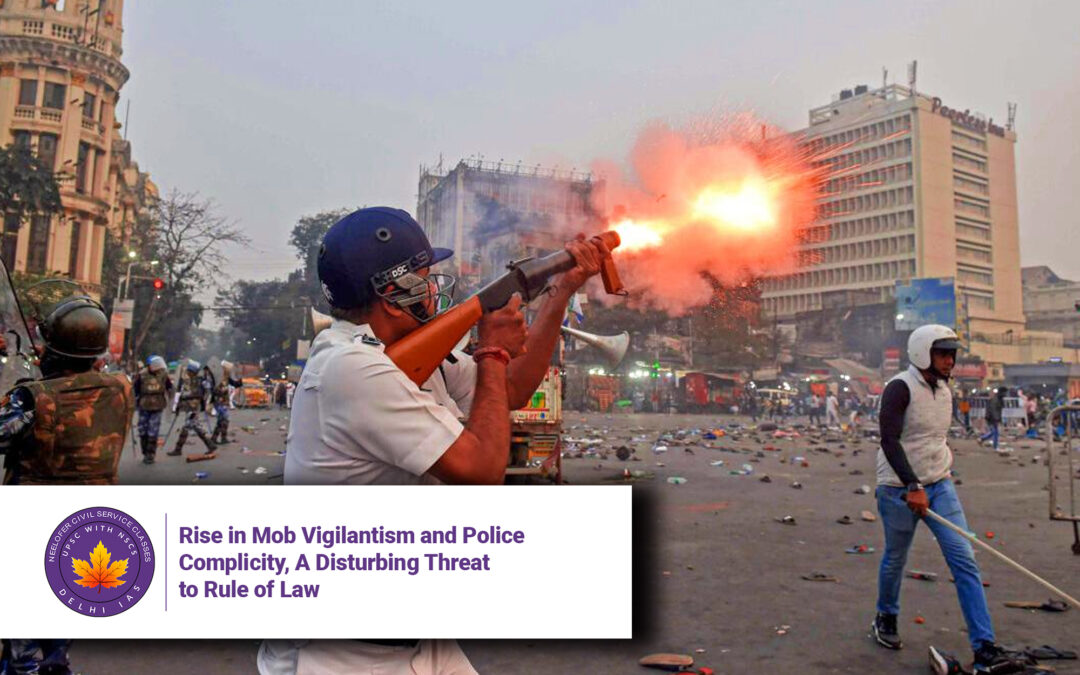
Rise in Mob Vigilantism and Police Complicity, A Disturbing Threat to Rule of Law
Why in News?
Recently, two shocking incidents—one in Chhattisgarh and the other in Maharashtra—have sparked nationwide concern. These events reveal a deeply disturbing pattern where the police appear to act not independently, but under pressure from vigilante mobs. On July 25, in Chhattisgarh, police arrested three individuals—including two nuns—on charges related to forced religious conversion and human trafficking. A day later, in Pune (Maharashtra), a mob stormed the house of a Kargil war veteran’s relative, accusing them of being illegal Bangladeshi immigrants. In both instances, police actions seemed to be driven more by mob sentiment than by evidence or due process.
These incidents reflect a dangerous breakdown in law enforcement autonomy and hint at a growing tendency for police to take cues from right-wing groups and self-proclaimed community leaders.
Introduction
The strength of any modern democratic society rests on the rule of law. This principle mandates that law enforcement agencies act fairly, independently, and with integrity—guided only by the Constitution and evidence, not by pressure from mobs or political organizations. However, the recent episodes in Chhattisgarh and Maharashtra reveal a disturbing reality. Law enforcement officials, rather than upholding justice and due process, appear to be functioning under the influence—or even the direct control—of vigilante groups.
This trend poses a serious threat to the foundational values of the Indian Republic. It compromises the protection of minorities, undermines institutional trust, and erodes citizens’ faith in democratic governance. If left unchecked, this culture of mob-driven justice could have long-lasting consequences.
Key Issues
1. Chhattisgarh Incident: Arrest of Two Nuns and Another Individual
On July 25, 2025, police in Chhattisgarh arrested three individuals, including two Catholic nuns, on charges related to human trafficking and forced religious conversion. What made the situation alarming was not just the arrest, but the manner in which it was conducted. According to multiple reports, the police acted solely based on allegations from members of the Bajrang Dal—a right-wing organization—without independent verification.
The accused were allegedly detained under pressure from a mob. One of the women later admitted she was coerced by a right-wing activist to give a false statement against the nuns. This raises questions about police neutrality, investigative integrity, and adherence to due process.
Furthermore, the local police reportedly filed the First Information Report (FIR) entirely based on Bajrang Dal’s version of events. There was no initial effort to cross-verify claims or conduct a preliminary investigation before the arrests. This action not only undermines the credibility of law enforcement but also gives vigilante groups a license to misuse state machinery for ideological purposes.
2. Maharashtra Incident: Violence Against Veteran’s Family
The following day, in Pune, Maharashtra, another troubling incident occurred. A mob of 60–70 people—again allegedly affiliated with Bajrang Dal—stormed the house of a Kargil war veteran’s relative. The attackers accused the family members of being illegal Bangladeshi immigrants, based solely on their appearance and language.
Despite the family’s presentation of valid identity documents, including Indian citizenship proofs, the police sided with the mob. Instead of dispersing the unlawful gathering or protecting the innocent family, the police detained the members of the household and took them to the police station late at night.
This case becomes even more appalling when one considers the family’s connection to a Kargil war veteran—someone who has served and sacrificed for the nation. The fact that even such families are not immune from suspicion and mob violence shows how normalized xenophobic vigilantism has become.
3. Erosion of Police Autonomy
In both incidents, police forces failed in their primary duty—to act as impartial guardians of the law. They instead functioned as extensions of mob anger and vigilante narratives. This undermines democratic norms and opens the door to selective law enforcement and institutional bias.
The Supreme Court has previously warned against mob vigilantism, especially in sensitive matters like religious conversion, illegal migration, and cow protection. Yet, these warnings are increasingly being ignored. The line between official law enforcement and vigilante justice is blurring at an alarming pace.
4. Misuse of Anti-Conversion and Anti-Migration Narratives
There is a growing trend where political and social groups weaponize narratives of religious conversion and illegal migration to instigate mob violence. In Chhattisgarh, the nuns were accused of converting people to Christianity without consent. In Maharashtra, the accused were labeled as illegal Bangladeshis. In both instances, the mobs had no credible proof, yet they took the law into their own hands—and the police followed their lead.
This misuse of sensitive topics not only targets minorities unfairly but also creates an atmosphere of fear and insecurity among genuine Indian citizens, especially those from marginalized backgrounds.
Alternative Approaches
To restore public faith in policing and constitutional governance, the following measures can be considered:
1. Enforce Supreme Court Guidelines on Mob Violence
The Supreme Court has laid down detailed guidelines to prevent lynching and mob vigilantism. These include the appointment of nodal officers, swift FIR registration, and disciplinary action against negligent officers. These must be implemented strictly across all states.
2. Conduct Independent Investigations
Whenever such incidents occur, independent fact-finding committees or human rights commissions must be allowed to investigate and present their findings. This ensures transparency and accountability.
3. Re-train Law Enforcement Personnel
There is a need for periodic training of police officers on constitutional rights, minority protection, and bias-free policing. Officers must learn to withstand political and social pressure and adhere strictly to evidence-based investigations.
4. Monitor Right-Wing Vigilantism
The central and state governments must monitor activities of self-proclaimed community vigilantes who frequently indulge in unlawful actions under the guise of moral policing or nationalism. Stringent action must be taken against those instigating mob violence.
Challenges and the Way Forward
Challenges:
-
Political Complicity: Often, such groups operate under the patronage of political actors, making it difficult for police to act impartially.
-
Weak Institutional Accountability: There are very few repercussions for officers who comply with mob demands or conduct biased investigations.
-
Media Polarization: Sections of the media amplify unverified claims made by vigilantes, further legitimizing unlawful actions.
-
Public Fear and Silence: Citizens often hesitate to speak out against such groups for fear of being labeled “anti-national” or “sympathizers.”
Way Forward:
-
Reaffirming the commitment to secular and democratic values is non-negotiable.
-
The judiciary, civil society, and media must play a proactive role in calling out and resisting mob violence.
-
Community outreach and public awareness campaigns can help prevent the spread of hate and misinformation.
-
Encouraging whistleblower mechanisms within the police to report undue political or mob pressure.
Conclusion
The incidents in Chhattisgarh and Maharashtra reflect a grim reality where mob sentiments increasingly dictate police actions. This is a betrayal of the democratic promise of equality before the law. When law enforcement starts responding to the loudest voices instead of the Constitution, society begins to crumble.
The Supreme Court has time and again warned against such tendencies. Yet, without strict implementation and political will, these warnings remain mere words on paper. India’s strength lies in its rule of law, not in mob rule. Upholding that principle is not just the responsibility of the police—it is the duty of every citizen, institution, and leader in this nation.
Five Questions and Answers
Q1. What were the recent incidents that highlighted police acting under mob pressure?
A: In Chhattisgarh, two nuns were arrested for alleged forced conversion based on claims from Bajrang Dal. In Pune, a mob attacked a veteran’s family calling them Bangladeshis, and police took the family to the station without proper verification.
Q2. Why are these incidents considered dangerous to democratic governance?
A: These incidents show police compromising their independence and acting under pressure from right-wing vigilantes, violating constitutional procedures and fundamental rights.
Q3. What has the Supreme Court said about mob vigilantism?
A: The Supreme Court has warned against mob rule, especially in cases related to religious conversion and migration, and issued guidelines for preventing such acts.
Q4. How can the government and police respond to such trends?
A: By strictly enforcing Supreme Court guidelines, retraining police officers, taking action against vigilantes, and ensuring independent investigations into such cases.
Q5. What is the broader impact of such incidents on society?
A: They erode public trust in law enforcement, instill fear among minorities, and undermine the rule of law, threatening the very fabric of democratic society.

