
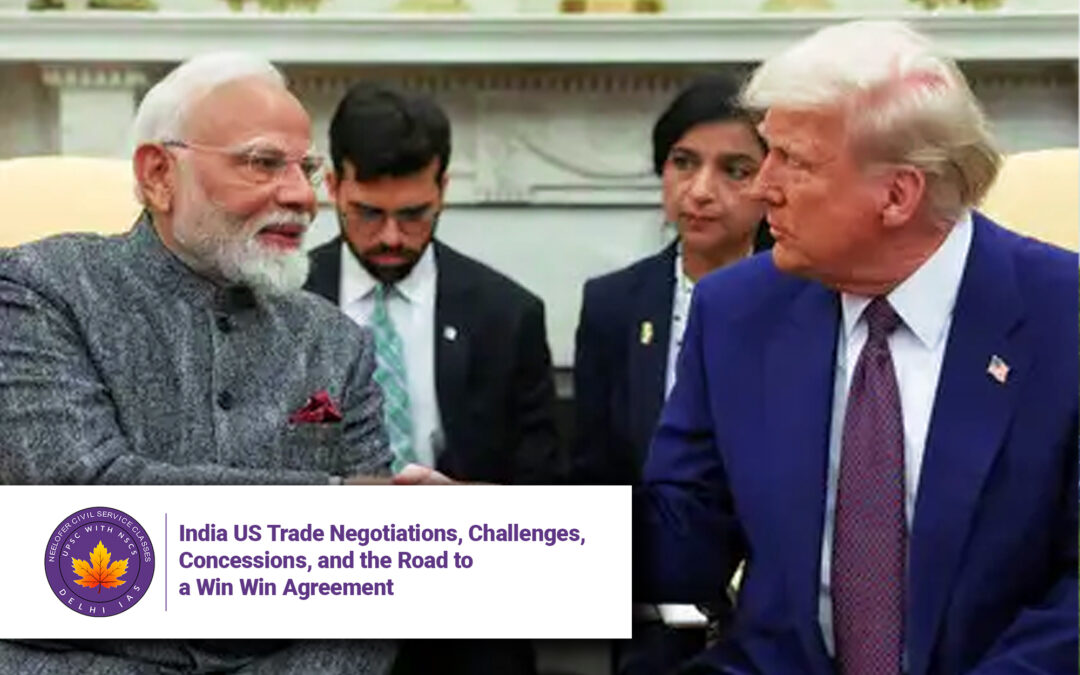
India US Trade Negotiations, Challenges, Concessions, and the Road to a Win-Win Agreement
Why in News?
India’s ongoing trade negotiations with the United States, under the Trump administration, have taken center stage in the global trade landscape. As Washington pushes for steep concessions, New Delhi struggles to strike a balance between domestic interests and international obligations. With trade talks across the globe accelerating, India finds itself at a pivotal moment to either resist or adapt. The evolving India-US trade discussions could potentially redefine economic engagement, especially in a world shaped by protectionist policies and changing geopolitical alliances.
Introduction
In the era of rising protectionism, the Trump administration has pursued aggressive trade strategies to secure better deals for the United States. Tariff reductions, quota limitations, and pressure tactics have marked the current U.S. trade negotiations with its key partners including Vietnam, the UK, Japan, Indonesia, and the EU. Amid this, India’s slow and careful approach has stood out, raising questions about its ability to secure favorable terms.
The headline issue lies in the U.S.’s insistence on “one-sided deals,” where countries must either eliminate their tariffs on American goods or face punitive duties on their exports. This article examines the implications of these ongoing negotiations, India’s response, and the broader impact on global trade.
Key Issues and Institutional Concerns
1. The Trump Trade Doctrine
The Trump administration’s trade policies are founded on the principle of reciprocity and leverage. The U.S. has enforced steep tariffs on countries that don’t conform to its terms, with a clear message: accept our demands or face penalties. Trump’s “Liberation Day” tariffs, imposed in April, mark this aggressive stance, compelling trade partners to rethink their strategies.
Countries like Vietnam have already made significant concessions. While U.S. tariffs on Vietnamese exports have reduced from 46% to 20%, America still enjoys duty-free access to Vietnam’s market. In contrast, Vietnamese transhipped goods entering the U.S. continue to face a 40% import duty. This imbalance is symptomatic of the broader pattern in these negotiations.
2. Disproportionate Base Tariffs
One of the main reasons these deals are termed “one-sided” is the stark disparity in base tariff rates. U.S. base rates for imports remain much higher compared to the average global rates that prevailed before April:
-
UK: 10% base rate
-
Vietnam: 20%
-
Indonesia: 19%
-
Japan: 15%
-
EU: 5%
Despite these figures, the U.S. continues to push for near-zero or zero-duty access for its own exports, making it difficult for partners to justify concessions domestically.
3. India’s Position and Cautious Strategy
India has chosen a measured and cautious approach. Unlike other nations that have hurriedly complied, New Delhi has been resisting demands, arguing that a similar lopsided agreement is politically untenable at home.
Finance Minister Nirmala Sitharaman’s decisions to reduce tariffs on select items like whisky and pharmaceuticals underscore India’s willingness to cooperate. However, India has resisted making large-scale unilateral concessions. It is betting on Trump’s unpredictability to buy more time, especially beyond the current deadline of 1 August.
4. The Services Sector & Visa Access
India could turn the tide by negotiating better terms in services, such as IT, which forms a significant part of its export economy. Access to high-value H-1B visas — especially for companies like Amazon and TCS — could offset tariff disadvantages. India’s demands are not limited to goods alone; the country wants fair treatment in people-to-people exchange and professional mobility too.
5. Digital Trade and Modernization
Digital trade is emerging as a central component of modern trade agreements. Drawing inspiration from the U.S.-Indonesia digital trade pact, India could demand paperless and electronic documentation systems. According to estimates by UNESCAP-ADB, such modernization could substantially reduce export costs and negate the impact of tariffs. This is critical for India’s small and medium exporters who struggle with traditional documentation systems.
Challenges and the Way Forward
1. Unilateral Pressure from the U.S.
Trump’s moves, such as imposing a 50% duty on copper and 200% on some pharmaceutical imports, exemplify unilateralism in trade policy. These decisions have impacted even close allies and signal a disregard for reciprocal trade traditions. India must prepare itself for such aggressive tactics and negotiate from a position of strength.
2. Political Risk for India
Conceding to U.S. terms could lead to backlash within India. With sectors like steel, aluminum, textiles, and agriculture at risk, the government must avoid appearing weak. A hasty deal could hurt local industries and labor, especially ahead of political cycles or elections.
3. Strategic Timing and Extended Talks
By holding off until after August 1, India may gain valuable negotiation leverage. Trump’s tendency to change course rapidly could work in India’s favor. There is still room to push for a balanced deal if India remains firm and strategic. The longer the negotiation window, the more likely that India will extract meaningful concessions.
4. Sectoral Demands and Customization
India must press for sector-specific relief. These may include:
-
Conditional relief on steel and aluminum
-
Tariff-rate quotas for automobiles
-
Lowering U.S. tariffs on textiles and apparel
-
Better market access for Indian food products
-
Inclusion of services trade and higher visa quotas
By diversifying its demands across sectors, India can build a package that’s politically acceptable and economically beneficial.
Conclusion
The India-U.S. trade negotiations are at a defining moment. The Trump administration’s pressure tactics are designed to extract the maximum from its trade partners. But India is choosing strategic patience over hasty compliance. By leveraging extended talks, sectoral diversification, digital modernization, and visa diplomacy, India aims for a deal that protects domestic interests while enhancing global trade ties.
It is still possible to reach a win-win arrangement — one that aligns with India’s development goals and satisfies U.S. demands to an acceptable extent. Commerce Minister Piyush Goyal’s emphasis on achieving a “win-win” deal is not just diplomatic language; it is a reflection of India’s larger strategic thinking.
In a world driven by transactional diplomacy, India’s balanced approach may prove to be not only politically wise but economically smart. The coming weeks will determine whether this long arc of negotiation finally bends toward mutual benefit or becomes another chapter in failed global trade reform.
Q&A Section
Q1: What are the key demands made by the U.S. in its trade negotiations with India?
A1: The U.S. has demanded zero or near-zero tariffs on its exports to India, reduced base tariff rates, removal of import duties on key sectors, and acceptance of one-sided trade conditions. It has also pressed for greater access to India’s markets in goods, pharmaceuticals, and digital trade.
Q2: Why has India been cautious in responding to the U.S. demands?
A2: India faces political and economic challenges in accepting a one-sided trade deal. Conceding to U.S. terms could hurt local industries such as steel, textiles, and automobiles. Domestically, such concessions could also lead to political backlash and economic instability.
Q3: What sectors could benefit if India negotiates favorable terms in the ongoing trade talks?
A3: If India succeeds in negotiation, sectors like IT services (via better H-1B visa access), automobiles (via tariff quotas), textiles, and digital trade (paperless export systems) could benefit significantly. These sectors are crucial for India’s employment and export revenue.
Q4: How does the digital trade agreement with Indonesia serve as a model for India?
A4: The U.S.-Indonesia digital trade pact includes features like acceptance of e-documents and online filing, which significantly lower export costs. India could demand similar provisions to make its trade ecosystem more efficient and competitive.
Q5: What is the significance of the August 1 deadline in these negotiations?
A5: The August 1 deadline is the end of a 90-day reprieve on higher tariffs imposed by the U.S. on Indian exports. India is using this period to gain time, negotiate better terms, and avoid making rushed concessions under pressure.

