
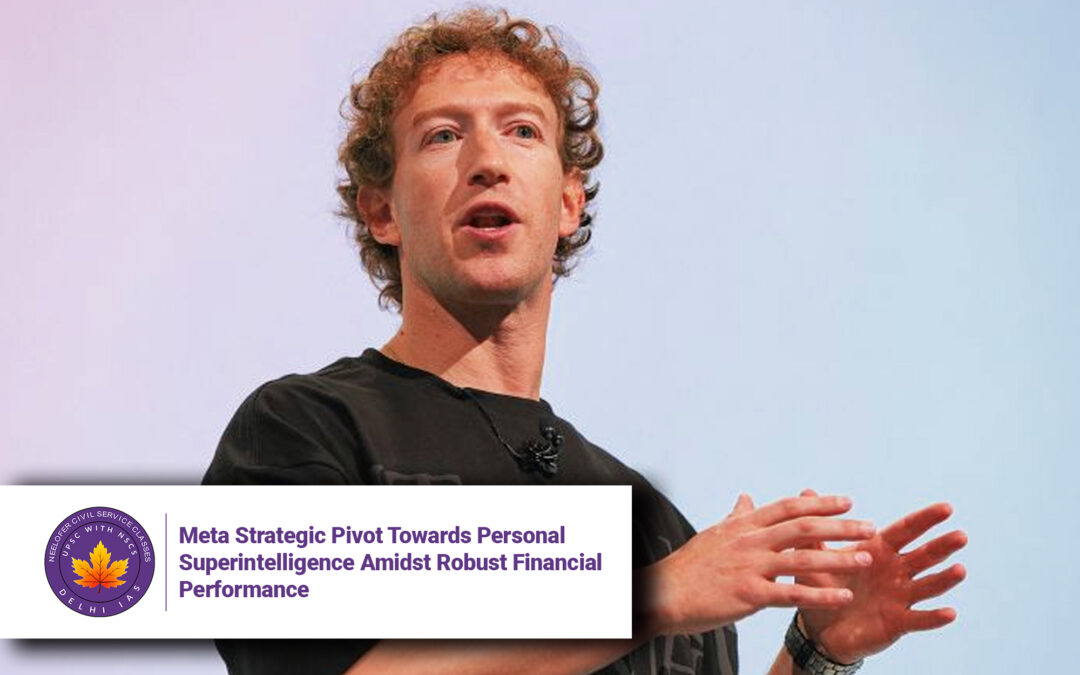
Meta Strategic Pivot Towards Personal Superintelligence Amidst Robust Financial Performance
Why in News?
Meta Platforms Inc., led by CEO Mark Zuckerberg, has made a significant strategic pivot in the artificial intelligence (AI) landscape. The announcement came alongside Meta’s strong second-quarter financial results, where Zuckerberg revealed plans to build a “personal superintelligence” while transitioning away from its previous open-source approach to AI. This major shift, delivered through a 616-word manifesto and multiple public communications, marks a new chapter in Meta’s AI journey and has far-reaching implications for technology, competition, consumer services, and investor confidence.
Introduction
Mark Zuckerberg’s messaging on Wednesday was loud and clear: Meta is now betting big on AI, but not just any AI—on a personal superintelligence that will be carefully guarded rather than open-sourced. This announcement came on the back of a very strong earnings report, with Meta’s revenue rising by 22% and profits by 36% year-on-year in the second quarter. The underlying communication blitz served two purposes: to declare Meta’s AI ambitions and to provide a distraction from growing expenses, particularly in its struggling Reality Labs division.
What made this communication particularly important was the timing. Meta had previously committed to an open-source AI future through its Llama model. Now, however, Zuckerberg is reorienting Meta’s focus towards building a closed, in-house “personal superintelligence,” diverging from past transparency and openness. This strategy shift comes amidst fierce global competition in AI, with U.S. firms like OpenAI, Microsoft, and Amazon, and Chinese companies like DeepSeek, making rapid advances in the enterprise AI space.
Key Issues and Strategic Considerations
1. From Open Source to Closed Doors
Earlier, Meta had committed to building Llama, its large language model (LLM), as an open-source tool. That approach was positioned as a counter to the more secretive AI efforts by OpenAI and Google. However, this week’s manifesto clarified a major shift—Meta will no longer make its advanced AI models fully open. Zuckerberg noted that Meta would be “careful about what we choose to open source,” reflecting not only a business consideration but also safety and competitive strategy.
This change aligns Meta more closely with its rivals, who have long avoided full transparency about their models. According to Zuckerberg, the rationale is that personal superintelligence should help people, not take their jobs. Still, critics argue that closing access contradicts Meta’s prior messaging and limits collaborative research opportunities.
2. Defining “Personal Superintelligence”
The term “personal superintelligence,” as used by Zuckerberg, is both novel and vague. While it implies a system designed to assist individuals in daily life, its exact technical definition remains unclear. What distinguishes it from existing generative AI tools like ChatGPT or Google Gemini? The manifesto described it as a tool “for personal empowerment” rather than replacing jobs, but it remains uncertain how this vision will manifest practically.
Zuckerberg’s vision leans heavily on consumer AI, focusing on services that can benefit Meta’s vast user base. With over 3.48 billion daily users of Meta-owned platforms, even a modest integration of AI tools into messaging apps like WhatsApp or Facebook Messenger could significantly change user experiences.
3. Financial Results as a Strategic Cover
The second quarter of 2025 was a financial success for Meta. Revenue soared to $50.5 billion—well above analysts’ estimates—and user growth continued, with a 6.4% increase in daily active users compared to the same quarter last year. These strong numbers gave Meta a cushion to announce controversial strategic decisions without much immediate investor backlash.
Investor sentiment remains strong, as evidenced by Meta’s share price jumping up to 12% in after-hours trading. This upward movement shows investor faith in Meta’s long-term vision, despite rising costs and losses in the metaverse business.
4. Ballooning Costs in AI Talent and Infrastructure
Zuckerberg admitted that AI-related costs are surging and are expected to grow significantly in 2026. Like its peers, Meta is investing billions in data centers and AI research infrastructure. But unlike its rivals, Meta has emphasized its willingness to “shovel obscene amounts of money” into AI, particularly in attracting top talent.
This focus is part of a broader pattern where major tech firms are fiercely competing for limited AI talent and hardware, driving up costs. Analysts point out that such a move may not be sustainable without concrete ROI from these expensive AI deployments.
5. Metaverse Division Continues to Bleed
Meta’s Reality Labs, the division responsible for developing the so-called “metaverse,” reported a loss of $4.53 billion in the quarter—its fifth consecutive quarter with losses over $4 billion. In total, Zuckerberg has now spent upwards of $20 billion on the metaverse concept with little to show for it.
The juxtaposition of this loss with AI expansion raises questions: Is Meta quietly shifting focus away from the metaverse toward AI due to public and investor skepticism? While no such admission was made, analysts believe the current PR push towards AI is designed to overshadow the metaverse’s poor returns.
Challenges and the Way Forward
1. Navigating the Closed vs. Open Source Debate
Zuckerberg’s pivot to a more closed AI ecosystem could stifle innovation and collaboration. Although Meta insists it will balance openness with safety and commercial interest, critics are wary. Meta may need to offer clearer policies on what aspects of AI it will share, especially if it hopes to avoid regulatory scrutiny.
2. Convincing Consumers and Policymakers
Meta must now convince a broad audience—consumers, lawmakers, and investors—that its vision of “personal superintelligence” is ethical, inclusive, and effective. Given growing fears around data privacy, job loss, and misinformation powered by AI, this will not be easy.
3. Justifying Rising Costs
AI talent, infrastructure, and R&D are not cheap. Meta must demonstrate that its new direction leads to profitable consumer products. Otherwise, it risks falling into the same trap as its metaverse investments—big spending with little payoff.
Conclusion
Meta’s latest communication strategy has smartly leveraged a strong quarterly performance to introduce a bold, controversial pivot in its AI approach. By focusing on “personal superintelligence,” Zuckerberg is making a bet that consumer-centric AI will be the next big wave. Whether Meta’s closed-door strategy will pay off remains to be seen, but it is clear that AI is now the centerpiece of its long-term growth strategy.
The road ahead is filled with uncertainty: regulatory challenges, rising infrastructure costs, fierce competition, and skeptical users. Yet, if Zuckerberg’s vision is realized, Meta could reshape not just the future of consumer technology—but how billions of people interact with AI in their everyday lives.
Q&A Section
Q1: What is Meta’s “personal superintelligence” and how is it different from other AI?
A: “Personal superintelligence” is Meta’s vision for AI tools that empower individuals rather than replace them. Unlike general-purpose AI models like ChatGPT or Bard, Meta’s version is envisioned as being deeply integrated into users’ personal lives. However, it remains largely undefined technically, and Meta has shifted away from an open-source strategy, intending to keep much of this AI internal.
Q2: Why is Meta abandoning its open-source Llama AI model approach?
A: Meta initially promoted openness in AI through Llama but has now pulled back, stating that the company must be careful about what it chooses to open source. The shift is driven by business strategy, safety concerns, and competitive positioning. Meta now believes that controlling its AI gives it better strategic advantage and helps avoid misuse.
Q3: How did Meta perform financially in the second quarter?
A: Meta saw a 22% increase in revenue and a 36% increase in profit compared to the same period last year. Its revenue for the quarter reached $50.5 billion, and its daily user base grew by 6.4%. Shares rose as much as 12% in after-hours trading, showing strong investor confidence.
Q4: What’s happening with Meta’s Reality Labs (metaverse division)?
A: Reality Labs continues to report massive losses—$4.53 billion in the latest quarter. This marks the fifth consecutive quarter with losses exceeding $4 billion. Despite Zuckerberg’s long-standing commitment to the metaverse, there are growing doubts about its viability, and the company seems to be shifting its focus more towards AI.
Q5: What are the potential challenges Meta could face with this new AI strategy?
A: Meta may face regulatory scrutiny for moving towards closed AI systems. There are also concerns about rising costs, competition from more advanced players like OpenAI and Microsoft, and public trust issues. Additionally, if “personal superintelligence” doesn’t lead to tangible, consumer-facing innovations, the huge investment may not yield expected returns.

