
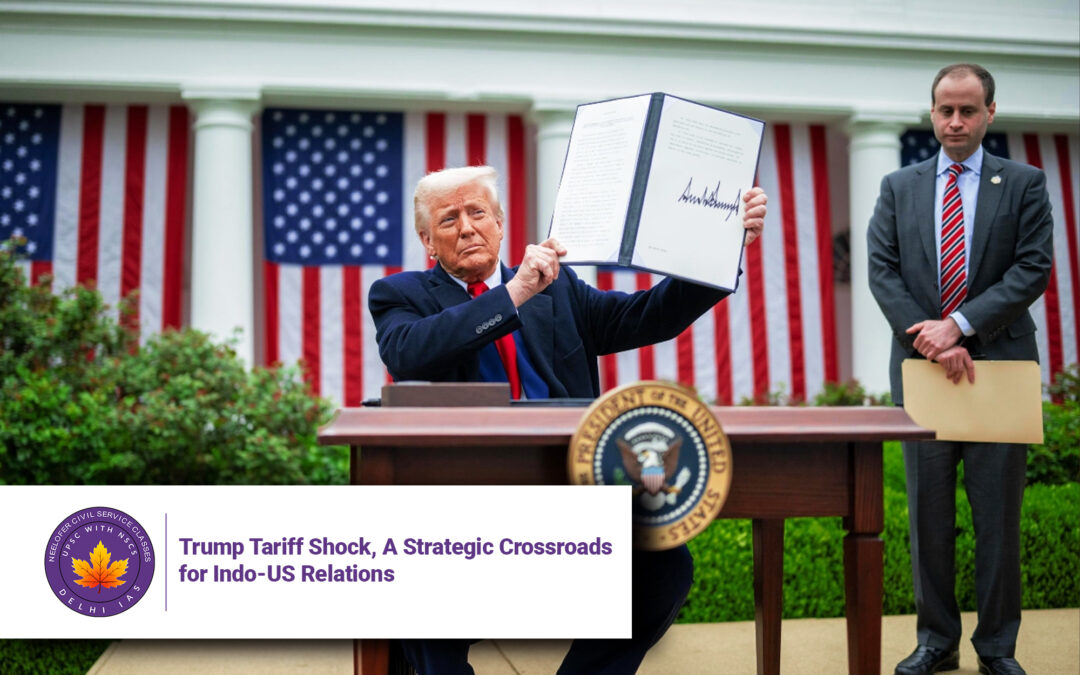
Trump Tariff Shock, A Strategic Crossroads for Indo-US Relations
Introduction: A Trade Deal Unravels
In a stunning move that has raised eyebrows in geopolitical and economic circles alike, former US President Donald Trump has unilaterally pulled the plug on the ongoing Indo-US trade deal negotiations. In a post on his platform Truth Social, Trump announced that India will now face 25% tariffs on its exports to the United States along with a yet-unspecified “penalty” for continuing to import energy from Russia.
With an August 1 deadline looming, the sudden imposition of tariffs and strategic penalties suggests a fundamental rupture in Indo-US relations. Trump’s announcement, marked by its characteristic abruptness, signals not just the end of a trade dialogue but also the potential unraveling of a fragile but growing bilateral alliance.
Backdrop: A Troubled Trade Timeline
The Indo-US trade negotiations had already been suffering from a variety of unresolved issues, ranging from agricultural access to defense alignments. But this latest move appears to bring the entire engagement to a grinding halt.
While Trump’s administration insists that India’s purchases of Russian energy violate shared democratic interests and strategic alignments, the move is widely interpreted as political brinkmanship.
What makes this action especially significant is not the tariffs alone, but the potential domino effect it could trigger:
-
Disruption of trade relations
-
Strained defense partnerships
-
Rising energy costs for India
-
Strategic realignment involving China and Russia
Economic Impact: A Blow to India’s Exports
The US remains India’s largest export market, absorbing nearly $87 billion worth of Indian goods in the fiscal year 2024–25. This accounts for almost 20% of India’s total exports ($437 billion). Until now, Indian exporters benefited from relatively low tariffs under special trade arrangements.
The 25% tariff hike drastically undermines India’s competitive edge in the American market. While some analysts believe the hike may be negotiable or part of Trump’s traditional negotiation theatrics, the immediate pain will be felt by exporters and investors.
Even if the penalty for buying Russian oil is minor (e.g., 1% additional cost), the combined effect could push up logistics costs, depress export margins, and deter foreign investment. Indian businesses—especially in textiles, pharmaceuticals, IT hardware, and industrial equipment—will bear the brunt.
Strategic Risks: Oil and Defense Dilemmas
India’s continued purchases of Russian oil and defense equipment have long been a sore point in Indo-US diplomacy. The US has pushed India to pivot away from Russia and align with Western energy and defense suppliers.
Now, Trump’s penalties seek to enforce that pivot. But switching suppliers will be costly and complex:
-
Oil Diversion: Redirecting oil imports from Russia to the US or Middle Eastern nations may raise energy prices and impact inflation.
-
Defense Procurement: Long-standing defense partnerships with Russia (fighter jets, missile systems, submarines) cannot be swiftly or cheaply replaced.
Any coercive attempt to force India’s hand on these issues might backfire, alienating New Delhi and pushing it closer to alternative alliances with Russia or China.
Negotiation Breakdown: What Went Wrong?
Multiple theories surround the collapse of the trade talks:
-
Agriculture & Dairy Market Protection: India stood firm on shielding its agricultural and dairy sectors from cheaper US imports.
-
Lack of Diversification: The US pushed India to diversify away from Russian energy and defense supplies, which India resisted.
-
Investment Incentives: Unlike Japan and the EU, India reportedly did not offer major investment deals or incentives to attract US businesses.
These divergent expectations possibly led to a breakdown in trust and momentum. India’s resistance to opening sensitive sectors, coupled with its cautious foreign policy, may have been interpreted as unwillingness to play ball in Trump’s transactional style of diplomacy.
Domestic Fallout: Bloodbath in the Markets?
The political announcement has already spooked Indian markets. Analysts expect a sharp correction in capital markets, possibly on Thursday, given the uncertainty. Investor confidence could take a serious hit, especially in export-driven industries.
Currency volatility may also rise, further complicating India’s macroeconomic management. The Reserve Bank of India may be forced to intervene to stabilize the rupee and control inflationary pressure from costlier imports.
Geopolitical Implications: Is the Quad at Risk?
The long-term question goes beyond trade:
What happens to Indo-US strategic relations now?
India is a key member of the Quad alliance (alongside the US, Japan, and Australia), designed to counter China’s growing influence in the Indo-Pacific. A souring of relations with the US could undermine this bloc’s unity.
Worse, China might exploit the rift. Trump’s admission that China too imports oil from Russia while being offered a “better deal” than India only fuels skepticism in New Delhi about American consistency.
India, surrounded by unpredictable neighbors and facing pressure from both East and West, cannot afford to alienate either side. It may be forced into recalibrating its foreign policy, possibly becoming more non-aligned or strategically autonomous in the process.
The Trump Doctrine: Deal as Art, Not Policy
Trump’s approach to diplomacy—transactional, media-driven, and often unpredictable—raises serious questions about the reliability of US foreign policy. As the article rightly notes, “In Trump’s trade lexicon… the deal is the art.”
But for India, the stakes go far beyond theatrical deal-making. With energy security, strategic autonomy, and economic stability on the line, India will need to find a balanced, assertive response.
Summary Takeaways:
-
India will face 25% tariffs on exports to the US starting August 1.
-
Additional penalties may apply due to Indian energy deals with Russia.
-
India’s $87 billion exports to the US are at risk.
-
Strategic concerns include defense purchases, oil imports, and the Quad alliance.
-
Markets are bracing for short-term volatility.
-
India may move toward greater strategic independence.
5 Key Questions & Answers
Q1: Why did Trump impose tariffs and penalties on India now?
A1: Trump cited India’s continued purchase of oil from Russia and failure to offer trade concessions (like agricultural market access or investment incentives) as reasons. It appears to be a mix of geopolitical pressure and Trump’s style of deal-making.
Q2: How much of India’s exports are impacted?
A2: Nearly 20% of India’s total goods exports go to the US, worth approximately $87 billion annually. The new 25% tariff will significantly impact these exports, particularly in manufacturing and industrial sectors.
Q3: What sectors in India are likely to suffer the most?
A3: Export-heavy industries like textiles, auto parts, pharmaceuticals, industrial equipment, and electronics will suffer from increased costs and reduced competitiveness in the US market.
Q4: Can India substitute Russian oil and defense imports easily?
A4: No. Replacing Russian oil and defense systems will not only be costly but may also disrupt India’s current defense capabilities and energy infrastructure. Alternative suppliers may not offer the same pricing or reliability.
Q5: What does this mean for India’s geopolitical alignment?
A5: If tensions persist, India may move toward a more non-aligned or neutral foreign policy stance, distancing itself from US-led alliances like the Quad. Alternatively, it could double down on partnerships with the EU and ASEAN to counterbalance US pressure.
Final Thought
While short-term volatility is certain, the larger narrative is about strategic autonomy. India will have to navigate this new landscape carefully—balancing its energy needs, defense dependencies, and geopolitical alliances without giving in to coercion or compromising its national interests.
In a global order shaped more by personalities than policies, India’s long game will depend on diplomatic agility, economic resilience, and strategic foresight.

