
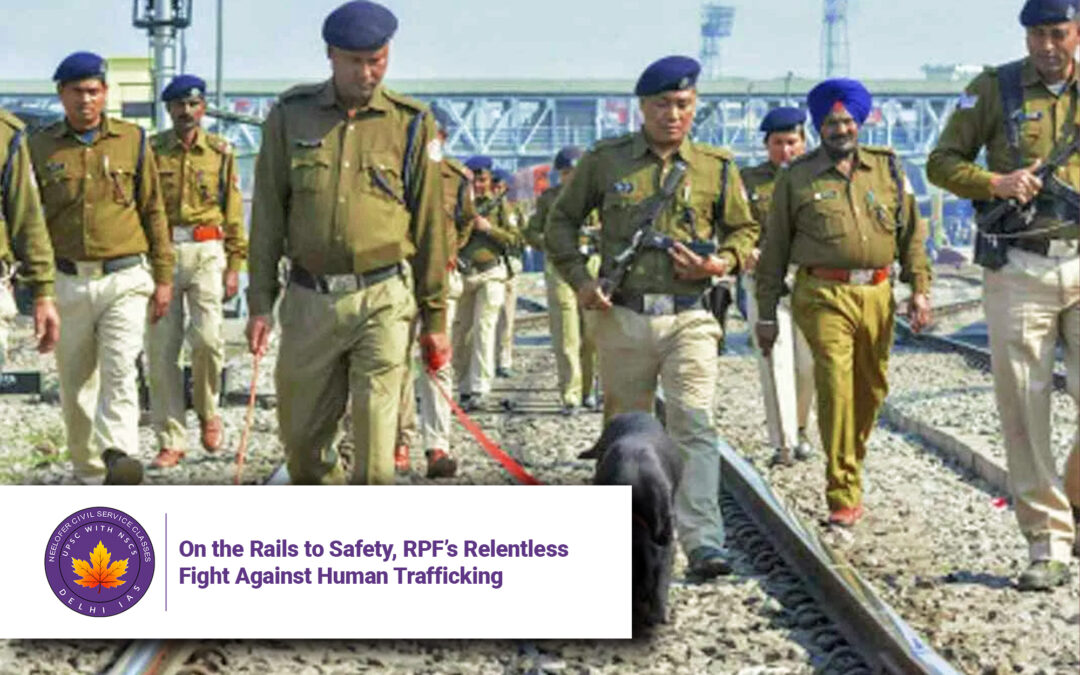
On the Rails to Safety, RPF’s Relentless Fight Against Human Trafficking
Why in News?
The Railway Protection Force (RPF) has emerged as a crucial stakeholder in India’s battle against human trafficking. With its recent proactive campaigns, especially Operation Nanhe Farishtey and Operation AAHT, RPF has saved thousands of lives, arrested traffickers, and collaborated across agencies to rescue vulnerable victims, making Indian Railways a safer environment for all.
Introduction
On a regular afternoon at Jalpaiguri Railway Station in July 2021, what appeared to be just another group of passengers boarding coaches turned out to be a human trafficking attempt in progress. It was through the quick observation and intervention by Sub Inspector Sarika Kumari and her colleagues from the Railway Protection Force (RPF) that two young girls were rescued, and the traffickers arrested. This case, like many others, is a testament to RPF’s evolving role beyond protecting railway property—it is now a frontline force against human trafficking.
In just 54 months between 2021 and mid-2025, the RPF rescued over 2,900 victims and arrested 701 traffickers. With strategic partnerships, tech-backed operations, and targeted missions like Operation Nanhe Farishtey and Operation AAHT, the RPF is now a cornerstone in India’s war on human trafficking.
Key Issues / Background
-
Human Trafficking through Railways:
Railways have long been used by traffickers due to their vast network, accessibility, and affordability. Victims, especially women and children, are often moved under the guise of employment or familial travel. Many traffickers exploit these conditions to transport minors into forced labour, child marriages, begging rackets, or sex trafficking. -
Lack of Awareness and Detection Challenges:
Victims are frequently unaware of their fate or misled by false promises. Upon inquiry, many cannot provide basic information about their destinations or employers. Traffickers are known to coach victims to stay silent or provide rehearsed explanations. -
Need for Proactive Policing:
Earlier, police efforts were more reactive—responding to complaints or discovered crimes. But the evolving patterns of trafficking necessitate proactive, intelligence-led policing, surveillance, and community engagement to prevent crimes before they occur. -
Children as Prime Targets:
Children, especially girls, remain the most vulnerable group. RPF records show that over 64,000 children were rescued in 2023 alone, with nearly 43,900 being girls. Most were lured with false promises or abducted into exploitative environments. -
Lack of Integrated Networks:
Human trafficking often goes beyond one jurisdiction or agency. RPF recognized the importance of collaboration across Child Welfare Committees (CWCs), District Child Protection Units (DCPUs), Civil Society, NGOs, and state police forces to build a trafficking-free environment.
The Core of the Transformation
Operation Nanhe Farishtey, launched in 2020, marked a significant shift in approach. The operation aims to rescue children who are lost, abandoned, or trafficked. By using this mission as a window into the trafficking machinery, RPF not only rescued children but exposed and dismantled deeper criminal networks. Operation Nanhe Farishtey alone led to the rescue of over 64,000 children.
Operation AAHT (Action Against Human Trafficking) was launched in 2022, establishing 750 specialized units at major railway stations. These units are staffed with trained personnel and equipped with surveillance tools, AI-driven data analytics, and strong coordination systems to detect trafficking activity and coordinate rescues.
Five Key Observations
-
Rescues and Arrests with Lasting Impact:
Between 2021 and mid-2025, the RPF rescued 2,912 human trafficking victims and arrested 701 traffickers. These rescues are more than just numbers—they represent lives saved from cycles of exploitation and abuse. -
Building a Network of Resistance:
The RPF’s collaboration with CWCs, CHDs, DCPUs, NGOs like AARAMBH India, and shelter homes has created a safety net for rescued victims. These partnerships ensure the rescued are not left in limbo and are properly rehabilitated. -
Intelligence-Led Policing:
Through AI, big data, pattern detection, and CCTV surveillance, RPF officers have gained access to smarter tools that help identify suspicious movements and people. Ticket examiners, porters, and even stall vendors are trained to detect red flags. -
Public Engagement as a Force Multiplier:
Campaigns such as “A Station Where Child Deserves to Be Free” are focused on building community awareness. Public notices, announcements, school outreach, and social media campaigns serve to make passengers alert and responsive. -
Constant Vigilance Across the Network:
With over 13,000 trains and 7,500 stations, the Indian Railways is both a challenge and an opportunity. RPF is now working on training personnel at all 135 major stations for full-scale anti-trafficking intervention.
Challenges and the Way Forward
Despite the success, several challenges remain:
-
Scale of the Network: India’s railway system is among the largest in the world, making it a vast terrain for traffickers to exploit.
-
Inter-State Jurisdiction Conflicts: Trafficking cases often involve crossing state lines, which can complicate enforcement and rescue operations.
-
Inadequate Training and Resources: Not all staff are fully equipped to identify and respond to trafficking indicators.
-
Post-Rescue Rehabilitation: Rescued victims require care, shelter, counselling, legal aid, and education or employment to prevent re-victimization.
-
Technology Integration Gaps: While AI and surveillance have helped, their penetration across smaller or rural stations is still limited.
To overcome these, the RPF is scaling up real-time data integration, working with more NGOs, expanding capacity-building sessions, and enhancing community engagement programs.
Conclusion
On this year’s World Day Against Trafficking in Persons (July 30), the Railway Protection Force’s consistent efforts present a powerful case for proactive, multi-agency-led crime prevention. The Indian Railways is no longer just a transport system—it is a battleground for safety and justice. By acting swiftly, building networks of trust and surveillance, and engaging society, the RPF is proving that safety on the rails is not just about protecting property—it’s about protecting people.
As society evolves and crime becomes more sophisticated, so must the institutions designed to protect us. The RPF has shown the blueprint: proactive detection, compassionate rescue, and collaborative rehabilitation. Human trafficking can only be truly defeated when every individual—official or citizen—sees themselves as a defender of dignity and freedom.
Q&A Section
1. What is the primary role of the Railway Protection Force (RPF) in the context of human trafficking?
The RPF’s traditional role was to safeguard railway property and ensure the safety of passengers. However, over recent years, it has evolved to take on the critical task of identifying and combating human trafficking through the railways by rescuing victims, arresting traffickers, and working with civil society for rehabilitation.
2. What is Operation Nanhe Farishtey and what has been its impact?
Operation Nanhe Farishtey was launched in 2020 as a mission to rescue children who are lost, trafficked, or in unsafe conditions. It has been instrumental in rescuing over 64,000 children—many of whom were girls—and has become a model for integrating child rescue with long-term support systems.
3. What tools and techniques does the RPF use to detect trafficking activity?
The RPF uses a combination of intelligence-based policing, AI-powered surveillance systems, CCTV monitoring, collaboration with other agencies, and on-ground staff training. Ticket examiners, station staff, and vendors are also sensitized to detect suspicious activities.
4. What is Operation AAHT and how does it differ from previous approaches?
Launched in 2022, Operation AAHT (Action Against Human Trafficking) established 750 specialized units across India’s railway network. These units are dedicated exclusively to combating trafficking through organized rescues, coordination with NGOs, and use of tech-enabled monitoring. It marked a shift from reactive to proactive policing.
5. How is the RPF ensuring that rescued victims are properly rehabilitated?
The RPF coordinates with Child Welfare Committees, District Child Protection Units, and NGOs to ensure rescued individuals receive safe shelter, medical support, and long-term care. It has also engaged organizations like AARAMBH India for capacity-building and information exchange to strengthen rehabilitation efforts.

