
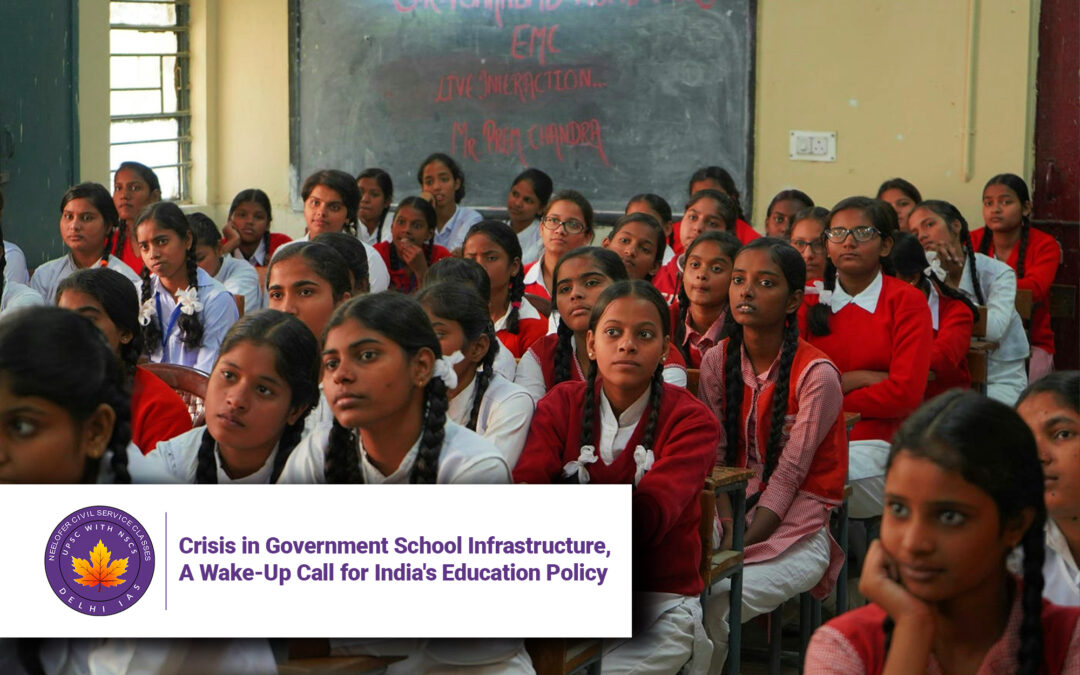
Crisis in Government School Infrastructure, A Wake-Up Call for India’s Education Policy
Why in News?
On July 25, 2025, a devastating incident unfolded at the Piplodi Government School in Rajasthan’s Jhalawar district when a part of the school building collapsed as students from Classes 6 and 7 gathered for their morning prayers. The tragedy claimed the lives of seven children and left several others injured. This horrific event has sparked widespread public outrage and brought to the forefront the neglected and deteriorating infrastructure of government schools in India, particularly in rural and tribal areas.
While the incident was tragic on its own, what amplified the public concern was the fact that most of the affected students came from tribal communities — historically among the most marginalised and underserved groups in the country. The school, located in southeastern Rajasthan near the Madhya Pradesh border, was not even listed among the 8,000 schools officially identified by the state’s Education Department as being in a poor condition. This detail alone underscores the grave extent of the infrastructural decay that plagues India’s public education system.
A Disturbing Trend
The very next day, another school in Nagaur district reportedly experienced a similar structural failure, though fortunately, the school was closed for a holiday and no students were harmed. These back-to-back incidents in Rajasthan have thrown the spotlight on the urgent need for a comprehensive evaluation and overhaul of the state of government-run educational institutions.
According to data from the Unified District Information System for Education (UDISE) 2023-24, Rajasthan alone has over 70,000 government schools serving approximately 84 lakh students. These schools cater primarily to children from poor and marginalised communities, for whom access to private schooling is financially unviable. Despite their crucial role in achieving educational equity, many of these schools remain in a state of severe neglect.
The Rajasthan Education Department itself estimates that around 8,000 of these government schools are in poor physical condition. Disturbingly, the Piplodi school — where the recent collapse occurred — was not among those flagged as unsafe, suggesting that the real number of structurally compromised schools may be much higher than currently documented.
Budget Allocations and Systemic Inefficiencies
Despite the acknowledged need for urgent infrastructure repair, state budget allocations have fallen short in making meaningful improvements. Over the past two fiscal years, approximately ₹650 crore had been earmarked by the Rajasthan state government for improving school infrastructure. However, systemic inefficiencies, lack of proper monitoring, and administrative delays have ensured that these funds had little actual impact.
The failure to convert financial allocations into tangible improvements highlights a deeper governance issue. Merely increasing budgetary outlays, without addressing institutional inefficiencies, does little to resolve the underlying problems. Worse, it perpetuates a cycle of neglect and exposes millions of students to unsafe and unfit learning environments.
This situation places a moral and constitutional responsibility on the ruling government in Rajasthan, led by the Bharatiya Janata Party (BJP), to prioritise the infrastructure of public schools. In a state where educational outcomes already lag behind national averages, ensuring safe and conducive learning spaces should be treated as a top priority.
A National Wake-Up Call
While these incidents occurred in Rajasthan, they are emblematic of a larger, nationwide crisis in the public education sector. The tragedy at Piplodi is not an isolated case but a symptom of a systemic rot that affects government schools across many Indian states. Years of policy defocus on public education, coupled with increasing encouragement of private sector participation, have left government schools in a state of decay.
The National Education Policy (NEP) 2020 had proposed a bold and urgent vision for transforming India’s education sector. Among its key recommendations was the need to raise public expenditure on education from the existing 4.6% of GDP to 6%, with a significant portion of this increased spending earmarked for infrastructure development.
The NEP rightly identified infrastructure as a one-time, high-priority investment. It recognised that without addressing the basic physical conditions of schools — including buildings, classrooms, toilets, drinking water, electricity, and digital connectivity — other reforms would be rendered ineffective. Unfortunately, five years into the implementation of NEP 2020, there is little concrete evidence to suggest that either the Union or State governments have followed through on this commitment.
Policy Drift and the Rise of Private Sector Reliance
In practice, government policy over the past several years has moved in a different direction. Emphasis has been laid increasingly on:
-
Reducing government support,
-
Promoting self-financing models, and
-
Encouraging private sector participation, even in basic education.
While such approaches may be suitable for higher education or vocational training, they are poorly suited for elementary and secondary education, which must remain under the strong purview of the state. In developed countries across Europe, North America, and East Asia, basic education is considered a non-negotiable public good. India, as a developing country with vast socio-economic inequalities, cannot afford to abdicate this responsibility.
Privatising school education risks deepening existing inequalities. Marginalised communities, already struggling with poverty, lack of transport, and low literacy levels, will be further excluded if government schools are allowed to fail. Education is not a luxury but a fundamental right enshrined in Article 21A of the Indian Constitution.
The Problem with ‘Model Schools’
In recent years, some governments have turned to setting up ‘model schools’ — elite, well-funded institutions designed to serve as exemplars of educational quality. While these may showcase what is possible, they serve only a small fraction of the total student population. The vast majority of children — particularly in rural and remote areas — continue to attend crumbling, underfunded schools.
Model schools cannot come at the cost of mass school education. The real challenge lies not in building a few shining examples but in lifting the overall standard of government schools across the board. Every child, regardless of geography or socio-economic status, deserves access to a safe and enabling learning environment.
Foundational Learning at Risk
The NEP 2020 had rightly prioritised Foundational Literacy and Numeracy (FLN) as a cornerstone for India’s educational and economic future. Basic reading, writing, and arithmetic skills acquired in early schooling years are crucial for boosting workforce productivity, reducing dropouts, and reaping the much-anticipated demographic dividend.
However, FLN outcomes are directly tied to school infrastructure. Children cannot learn effectively in classrooms that are dark, overcrowded, unsafe, or without adequate teaching materials. Teachers, too, are demotivated and overburdened when asked to perform their duties in such environments.
India’s demographic advantage will not last forever. With the population aging rapidly, the window for reaping long-term benefits from youth-centric investments is narrowing. Ensuring high-quality education for all is not just a social imperative but an economic strategy for national development.
What Needs to be Done?
To prevent further tragedies and to truly reform India’s public education system, urgent and coordinated action is required at multiple levels:
1. Immediate Safety Audits:
All government schools, particularly in rural and tribal areas, must undergo rigorous infrastructure safety audits. States should prioritise schools in disaster-prone, underdeveloped, or high-enrolment zones.
2. Infrastructure Upgradation:
Focus should be placed on repairing classrooms, building toilets, ensuring clean drinking water, and providing digital infrastructure such as internet and smart boards.
3. Effective Fund Utilisation:
Budget allocations must be accompanied by transparent fund flow mechanisms, proper monitoring, and strict timelines to avoid delays and corruption.
4. Teacher Support and Training:
Recruitment of qualified teachers must go hand in hand with infrastructure improvement. Training programs should be expanded to equip teachers with both pedagogical and classroom management skills.
5. Community Engagement:
School management committees involving parents, local leaders, and educators should be empowered to monitor schools and flag issues promptly.
6. Public Education Campaign:
There needs to be a renewed public discourse that affirms education as a core public responsibility. Citizens must demand accountability and performance from their elected representatives.
Conclusion
The school building collapse in Rajasthan is not merely a localised tragedy. It is a reflection of the systemic apathy toward public school infrastructure across India. While policies like the NEP 2020 offer a roadmap for transformation, their implementation has been weak, misdirected, or slow.
Basic education must remain a non-negotiable duty of the state. Infrastructure is not a cosmetic concern — it is the very foundation upon which learning is built. As long as children are forced to study in unsafe, crumbling buildings, no educational reform can be considered meaningful or successful.
The time to act is now. Anything less would be a betrayal of India’s children and a forfeiture of the nation’s future.
Five Questions and Answers
Q1. What recent incident highlighted the poor infrastructure of government schools in Rajasthan?
A1. On July 25, a portion of the Piplodi Government School building in Jhalawar collapsed, killing seven students and injuring several others. Most of the victims were from tribal communities.
Q2. What does UDISE 2023-24 data reveal about school conditions in Rajasthan?
A2. Rajasthan has over 70,000 government schools serving 84 lakh students, with at least 8,000 schools identified as being in poor condition.
Q3. What financial measures has the Rajasthan government taken to address school infrastructure?
A3. Approximately ₹650 crore was allocated over the last two state budgets, but inefficiencies have limited the effectiveness of these measures.
Q4. How has the NEP 2020 addressed infrastructure in schools?
A4. NEP 2020 called for increasing education spending to 6% of GDP and prioritised one-time infrastructure spending as critical for foundational learning and overall reform.
Q5. What actions are needed to fix India’s public school system?
A5. Immediate safety audits, improved infrastructure, better fund utilisation, teacher recruitment and training, community involvement, and a renewed focus on public education responsibility.

