
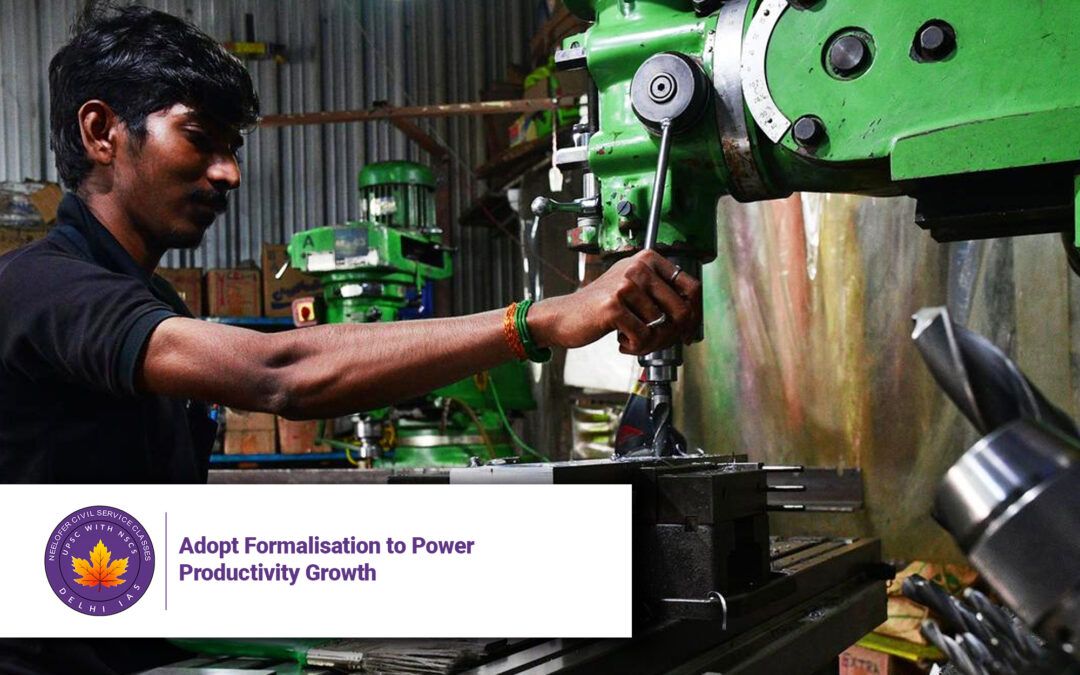
Adopt Formalisation to Power Productivity Growth
Why in News?
India’s formal manufacturing sector has witnessed a significant structural shift in recent decades, with a rising trend of contractualisation within the workforce. A recent longitudinal study based on the Annual Survey of Industries (ASI) from 1999-2000 to 2018-19—along with ASI data up to 2022-23—has thrown light on the growing share of contract labour in manufacturing. This trend, although often positioned as a means for operational flexibility, has raised deep concerns about its long-term impact on productivity. As India seeks to strengthen its industrial base and become a global manufacturing hub, policymakers and industry leaders are urged to adopt strategies for formalisation to enhance labour productivity and protect workers’ rights.
Introduction
India’s manufacturing sector, once considered the backbone of industrial development, has been undergoing profound structural changes in employment patterns. The formal sector, especially, has seen a gradual erosion of stable employment, with a rise in the share of contract labour. According to ASI data, the proportion of contract labour in the manufacturing workforce rose sharply from 20% in 1999-2000 to 40.7% in 2022-23.
While informalisation is often justified in the name of operational flexibility, cost-efficiency, and skill optimisation, the reality reflects a deep-rooted strategy of cost avoidance. This shift not only compromises the rights of workers but also has significant implications for India’s overall productivity performance. The study led by Irfan Ahmad Sofi, In-charge Head of the Department of Economics, Islamic University of Science and Technology, Kashmir, highlights how contractualisation—especially through third-party contracts—undermines productivity growth, calling for urgent formalisation policies.
Key Issues
1. Plight of Contract Workers
One of the most concerning outcomes of the growing trend of informalisation is the vulnerability of contract workers. These workers are usually hired through third-party contractors and are excluded from the protective ambit of key labour laws such as the Industrial Disputes Act, 1947, which ensures safeguards against layoffs, retrenchments, and arbitrary dismissals.
This exclusion translates into poor bargaining power and makes contract workers highly susceptible to exploitation. Wage data from 2018-19 further underlines the scale of this inequality:
-
Contract workers earned 14.47% less than regular workers on average.
-
The wage gap was especially stark in large enterprises (31%), followed by medium (23%) and small enterprises (12%).
When factoring in total labour costs (which include not just wages but also benefits and other employer expenses), the disparity becomes even more glaring. On average, employers spent 24% less on contract workers than on regular employees. In certain industries, this cost differential reached 78% to 85%, highlighting a clear strategy of labour cost minimisation through contractual employment.
2. Contractualisation Not Driven by Skills or Flexibility
Contrary to popular belief that contractualisation is used to source skilled, flexible labour for short-term needs, the study suggests that cost reduction is the primary driver. The supposed “flexibility” associated with contractual employment is often a myth used to justify a system that undermines labour rights.
The study makes it evident that:
“Contractualisation in India’s formal manufacturing is linked more to cost avoidance than it being a focus on genuine labour flexibility or skills.”
Thus, instead of being a productive tool for coping with market fluctuations or acquiring specialised talent, contract employment becomes a mechanism to evade obligations towards workers.
3. Impact on Labour Productivity
The analysis of productivity through real net value added per worker—a key metric for labour productivity—paints a concerning picture. Contract labour-intensive (CLI) enterprises showed, on average, a 31% lower labour productivity than regular labour-intensive (RLI) enterprises.
The productivity gap was most severe in:
-
Small enterprises (<100 workers): 36% gap
-
Medium-sized enterprises (100–300 workers): 23% gap
-
Labour-intensive CLI enterprises overall: 42% lower productivity
Even after adjusting for firm-specific and state-specific factors, the productivity differentials persisted. In essence, contractualisation appears to offer a short-term cost advantage at the expense of long-term productivity.
This gap is largely attributed to:
-
High labour turnover, discouraging training and innovation.
-
Short-term focus, which reduces employer investment in workforce development.
-
Principal-agent issues, where contractors and employers have misaligned interests, leading to poor performance accountability and increased risks such as absenteeism or shirking.
Interestingly, the study also finds that capital-intensive CLI enterprises show a relatively better productivity performance, with a 17% productivity gain. However, these enterprises form just 20% of the formal manufacturing sector, meaning the negative impact of contractualisation remains widespread.
Alternative Approaches
Given the clearly detrimental effects of contractualisation on productivity and worker welfare, policy reforms are imperative. Here are some approaches and policy interventions proposed:
1. Labour Code Reforms
In 2020, the Government of India introduced a new labour code on industrial relations, aimed at balancing employer flexibility with worker protections. It allows companies to hire non-regular workers on fixed-term contracts without third-party contractors, thereby reducing the exploitation linked to contractor-driven informalisation.
However, the effectiveness of this code remains in question, as its implementation is still pending. Labour unions express concern that increased flexibility in hiring could further worsen job security unless accompanied by adequate safeguards.
2. Promoting Longer-Term Contracts
Policymakers can encourage firms to:
-
Shift towards longer-term contracts,
-
Offer concessions in social security contributions, and
-
Support skill-building programmes for contract workers.
This could not only enhance job security but also boost morale, reduce turnover, and eventually raise productivity.
3. Leveraging Government Schemes
The government has already taken steps through initiatives such as the Pradhan Mantri Rojgar Protsahan Yojana (PMRPY) launched in 2016. This scheme incentivises job creation by subsidising the employer’s contributions to Employees’ Provident Fund (EPF) and Employees’ Pension Scheme (EPS).
The scheme covered over one crore employees and aimed to make formal hiring more attractive. Although PMRPY ended in March 2022, its extension or revival could further promote formal employment. Continued support to employers who formalise jobs can reduce their resistance to hiring permanent workers.
Challenges and the Way Forward
Despite policy intent, several obstacles remain:
-
Delayed Implementation: Key labour codes are yet to be effectively implemented, reducing their on-ground impact.
-
Lack of Employer Incentives: Without financial or regulatory incentives, many firms may continue preferring informal labour to cut costs.
-
Weak Labour Inspections: Enforcement of labour laws, especially in small and medium enterprises, remains patchy.
-
Trade Union Resistance: While unions oppose contractualisation, they are often not integrated into policy dialogues effectively.
To move forward:
-
States must accelerate the implementation of the new labour codes.
-
Financial support for formalisation, such as tax breaks or social security subsidies, should be increased.
-
Awareness campaigns must educate employers on the long-term productivity benefits of formalisation.
-
Labour inspections and audits need to be strengthened to monitor violations.
-
Industrial skill development schemes must be aligned with formal hiring targets.
Conclusion
India stands at a critical juncture in its journey to become a global manufacturing powerhouse. The data clearly shows that the path of contractualisation—driven by short-term cost-cutting motives—has failed to deliver long-term productivity benefits and has left a large portion of the workforce vulnerable to exploitation.
The time has come to shift focus from merely reducing wage bills to creating a high-skill, high-productivity manufacturing ecosystem anchored in formal and secure employment. Formalisation, if done right, will not only safeguard workers’ rights but will also enhance productivity, innovation, and industrial resilience—powering India’s economic growth in the years ahead.
Five Questions and Answers
Q1. What is the current share of contract labour in India’s formal manufacturing sector?
A1. As per the Annual Survey of Industries, the share of contract labour increased from 20% in 1999-2000 to 40.7% in 2022-23.
Q2. What is the primary reason behind the increasing contractualisation of workers?
A2. The study suggests that contractualisation is mainly driven by cost avoidance rather than genuine labour flexibility or the need for specialised skills.
Q3. How does contractualisation impact labour productivity?
A3. Contract labour-intensive enterprises exhibit, on average, 31% lower labour productivity than regular labour-intensive firms, especially in small and medium enterprises.
Q4. What are the government’s policy initiatives to promote formalisation?
A4. Initiatives include the 2020 labour code on industrial relations and the Pradhan Mantri Rojgar Protsahan Yojana (PMRPY), which aimed to incentivise formal hiring by subsidising employer contributions to EPF and EPS.
Q5. What can be done to reverse the trend of informalisation in the formal sector?
A5. Key actions include implementing labour codes, providing financial incentives for formal hiring, promoting longer-term contracts, strengthening labour inspections, and aligning skill programmes with formal job creation goals.

