
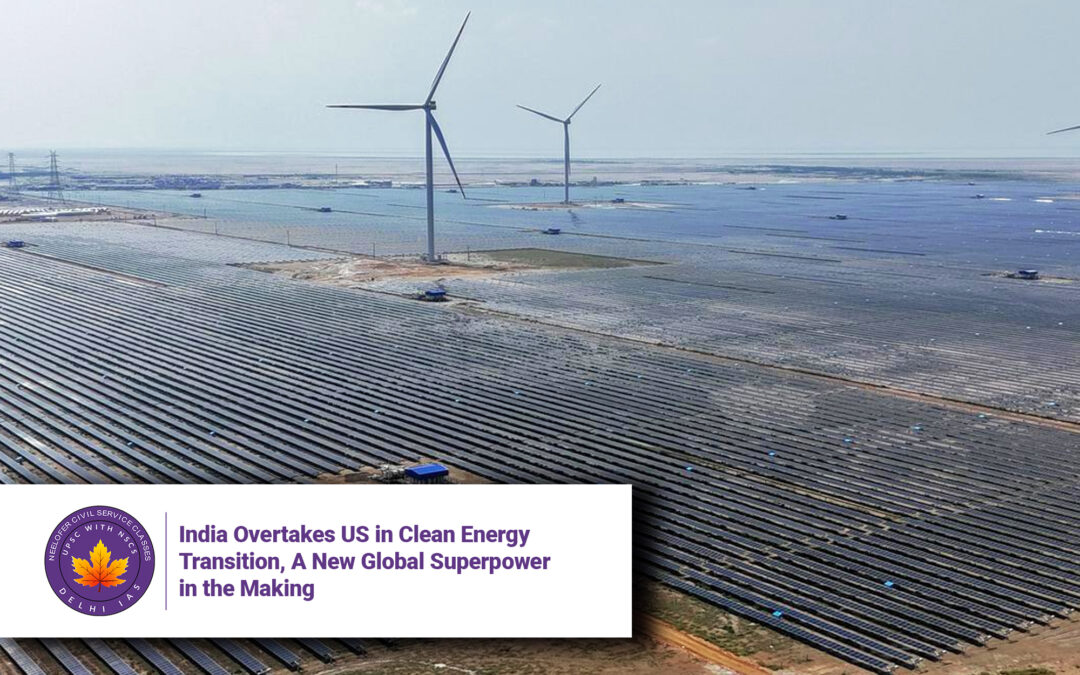
India Overtakes US in Clean Energy Transition, A New Global Superpower in the Making
Why in News?
India is rapidly advancing in its clean energy transition, surpassing the United States in the pace of renewable energy adoption. A Bloomberg opinion piece by columnist David Fickling highlights how India, following China, is leaving the US behind in the race for renewable energy leadership.
Introduction
Once considered a laggard in clean energy, India is now emerging as a global front-runner. The nation connected 22 gigawatts (GW) of wind and solar energy in the first half of 2025 alone—enough to power nearly 10% of the grid at full capacity. This surge positions India to overtake the US, which expects to connect 40GW for the entire year.
Key Highlights
-
Ambitious Targets & Achievements
India is now on course to meet Prime Minister Narendra Modi’s target of 500GW of non-fossil energy capacity by 2030. Already, 414GW of clean power (including nuclear and hydro) is either operational or under construction—just shy of the national goal. -
Financial & Regulatory Support
A drop in inflation allowed the Reserve Bank of India to lower policy rates, reducing financing costs for clean energy developers. A waiver on transmission charges for solar and wind projects—recently expired—spurred a rush to complete builds, boosting capacity. -
Manufacturing Boom & Exports
India’s solar panel manufacturing has scaled significantly, now producing 91GW—more than domestic demand. With lower tariffs on exports to the US, Indian manufacturers are gaining an edge over Chinese and Southeast Asian competitors. -
Socioeconomic Shift
Rising incomes and a growing middle class are shifting government focus from basic subsistence to clean jobs and livable cities. Urban energy demand is being met increasingly by renewables, reducing dependency on coal despite continued construction of coal-fired plants. -
Global Implications
Emissions from India’s power sector are not expected to peak until the 2030s. However, combined efforts from India and China suggest the global outlook on climate is improving faster than perceived—especially when compared to stalled progress in the US.
Challenges and the Way Forward
-
Ending Waivers and Policy Transitions:
The recent end of cost-saving waivers could slow down development in the short term, requiring careful regulatory transitions to maintain momentum. -
Balancing Coal and Renewables:
While India continues to build coal plants to ensure energy security, the real-time use of coal is declining due to better weather and increasing renewable generation. -
Need for Global South Leadership:
Renewable energy suits the aspirations of the Global South—providing affordable, clean, and sustainable power for billions. India’s progress could become a model for other developing nations.
Conclusion
India’s clean energy revolution is real and accelerating. Once trailing behind, the nation is now a global contender in renewable energy. With the US falling behind due to policy stagnation and political inaction, India’s leadership in energy transformation represents a defining trend of the 21st century.
Q&A Section
1. How much renewable capacity did India add in the first half of 2025?
India added 22GW of wind and solar capacity in just the first six months of the year.
2. What is India’s renewable energy target for 2030?
India aims to reach 500GW of non-fossil generation capacity by 2030.
3. How is India’s solar panel manufacturing industry performing?
India now manufactures over 91GW of solar panels annually—more than its current domestic demand.
4. Why is India reducing its reliance on coal?
Improved weather and rising renewable generation pushed fossil-fuel-fired power down 4% in early 2025, marking the first such decline since the COVID-19 pandemic.
5. How does India’s clean energy progress compare to the US?
While India is accelerating toward clean energy goals, the US is falling behind due to political stagnation and reduced investment momentum.

