
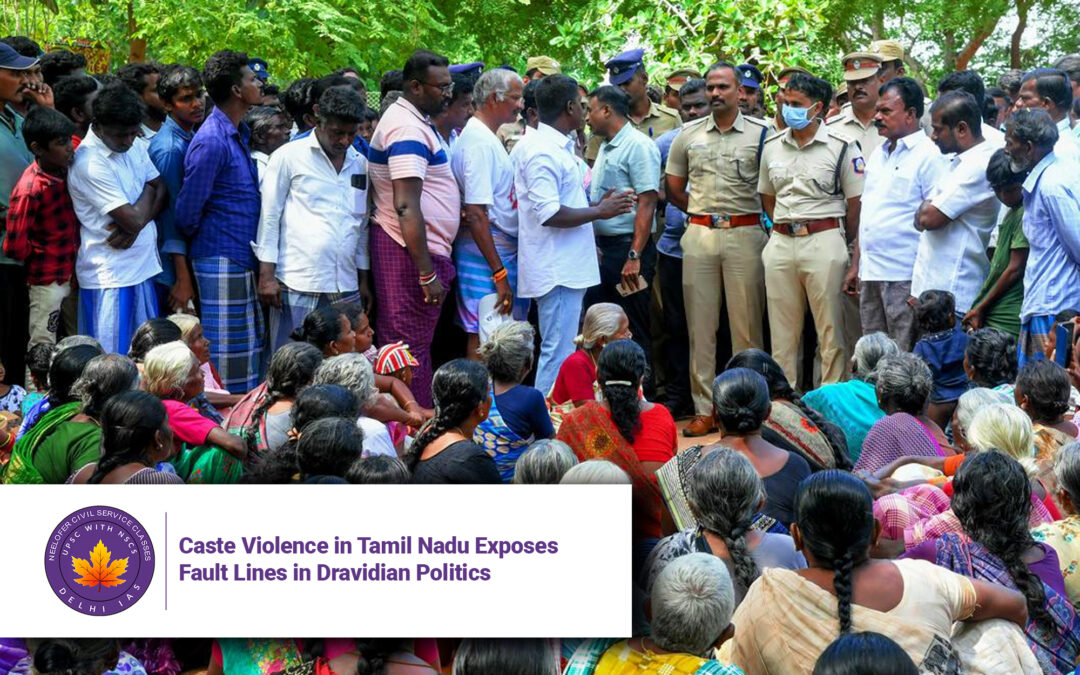
Caste Violence in Tamil Nadu Exposes Fault Lines in Dravidian Politics
Why in News?
Recent incidents of anti-Dalit violence in Tamil Nadu, especially in Tirunelveli district, have sparked debate about the effectiveness and sincerity of the Dravidian Movement’s promise of social justice. These incidents reflect administrative failures and raise questions about political hypocrisy in a state long governed by parties committed to anti-caste ideologies.
Introduction
Tamil Nadu has long been regarded as a bastion of social justice, driven by the anti-caste ideology of E.V. “Periyar” Ramasamy. Since 1967, Dravidian political parties like DMK and AIADMK have championed this philosophy. However, the state continues to witness caste-based violence, especially against Dalits, challenging the claim of progress and inclusivity.
Key Incident
In a recent case in Tirunelveli, a 27-year-old Dalit software engineer was murdered, allegedly for being in a relationship with a woman from the Most Backward Caste community. The accused is reportedly the woman’s brother, and their parents are police sub-inspectors. This gruesome crime has once again exposed deep-rooted caste biases even in highly literate and socially advanced regions.
Institutional and Social Failures
The recurring caste crimes in Tamil Nadu point not only to the social divide but also to institutional neglect. The Justice Chandru report on a previous case revealed severe caste prejudice in educational institutions and an alarming reluctance from authorities to act. Despite improvements in education and employment, Dalits still face barriers that turn violent when traditional power hierarchies are challenged, especially through inter-caste relationships.
Political Irony and Hypocrisy
Despite their anti-caste roots, Dravidian parties have failed to move beyond their core OBC vote banks and challenge caste hierarchies effectively. This failure highlights a growing gap between ideological commitments and political practice. The political discourse now focuses more on economic growth than on caste annihilation, weakening the original goals of social reform.
Challenges and the Way Forward
-
Strengthen law enforcement to act impartially against caste-based crimes.
-
Reform education systems to eliminate caste-based student segregation.
-
Encourage political parties to revisit their foundational ideologies.
-
Promote inter-caste harmony through awareness campaigns.
-
Focus on ideological as well as economic development for inclusive growth.
Conclusion
Tamil Nadu’s caste violence problem is not just a social issue but a political one. It exposes the cracks in the Dravidian model of justice and equality. The way forward lies in a genuine political reinvention that returns to the core of social justice while addressing the complexities of modern development.
Question & Answer Section
1. What recent incident brought caste violence in Tamil Nadu back into focus?
A 27-year-old Dalit software engineer was killed in Tirunelveli for allegedly being in a relationship with a woman from a Most Backward Caste community.
2. What does the Justice Chandru report reveal about institutions in Tamil Nadu?
The report found deep-rooted caste prejudice in institutions and a reluctance by authorities to acknowledge and act against caste discrimination.
3. How have Dalits become more politically assertive in Tamil Nadu?
Through improved education and service-sector employment, which have disrupted traditional caste-based power structures.
4. Why are Dravidian parties criticized despite their anti-caste stance?
They have failed to move beyond their core OBC voter base and have not implemented strong policies for true caste annihilation.
5. What is the suggested long-term solution to Tamil Nadu’s caste issues?
A return to and reinvention of social justice-focused politics, alongside enforcing the rule of law and reducing caste-based polarization in society.
